
Bespoke fitted library shelving is defined as fully custom-built, wall-integrated storage designed to precise room dimensions, materials, and finish specifications. Unlike modular systems or flat-pack bookcases, this approach treats shelving as an architectural element rather than furniture placed against a wall. The result is a fitted library wall that looks as though the room was designed around it. Bravo London has completed over 1,000 projects of this kind, and the demand for tailored library cabinetry continues to grow as homeowners move away from generic storage towards spaces that genuinely reflect their taste and lifestyle.
What do you need before you design bespoke fitted library shelving?
Good preparation separates a successful project from an expensive mistake. Before a single shelf is cut, you need accurate measurements, a clear material brief, and a realistic budget.
Measuring your space accurately
Measure every wall dimension twice: width, height, and depth of any alcoves or recesses. Record ceiling height at multiple points, since older British homes frequently have floors and ceilings that are not perfectly level. Note the position of skirting boards, cornices, power sockets, and radiators. These details directly affect how your custom library shelves are designed and built.

Tools and materials to have ready
You will need a steel measuring tape, a spirit level, a stud finder, and either a sketch pad or design software such as SketchUp or RoomSketcher. For materials, the most common choices are:
- Solid hardwoods such as white oak, walnut, or ash for a premium, long-lasting finish
- MDF with veneered faces for a cost-effective option that paints cleanly and holds detail well
- Plywood carcasses for structural rigidity, particularly in larger floor-to-ceiling units
Understanding budget tiers
Cost varies significantly depending on your chosen approach. Three main tiers cover most projects:
| Tier | Approach | Typical Cost |
|---|---|---|
| Entry-level | DIY using modular systems such as IKEA BILLY | £600–£1,200 |
| Mid-range | Modular systems with integrated lighting and closed cabinets | £800–£2,400 |
| Bespoke millwork | Fully custom-built, architecturally integrated shelving | £15,000–£45,000+ |

A high-end 12-foot wide custom library wall with base cabinets and solid white oak finishes typically costs between £25,000 and £45,000. That figure reflects the precision craftsmanship, material quality, and architectural integration that bespoke millwork demands.
Pro Tip: Locate your wall studs before finalising any design. Loaded shelving carries 30–40 pounds per linear foot, and units must be anchored to wall studs rather than drywall alone to remain safe and stable long-term.
How do you design shelving that balances style and function?
The best fitted shelving design does two things at once: it stores what you need and it defines the character of the room. Achieving both requires deliberate decisions at the design stage.
-
Plan floor-to-ceiling height. Floor-to-ceiling built-ins act as spatial separators and add permanence to a room without requiring architectural walls. They draw the eye upward and make ceilings feel taller.
-
Mix open shelving with closed cabinetry. Open shelves display books and objects. Base cabinets with doors conceal clutter, media equipment, or files. The combination keeps the wall looking curated rather than chaotic.
-
Work around architectural features. Shelving flanking a fireplace reads as visually balanced when the unit width roughly matches or sits slightly narrower than the fireplace opening. Base cabinets aligned with the mantel height create a clear horizontal line that unifies the composition.
-
Vary shelf heights deliberately. Open shelving with a range of shelf heights accommodates different book sizes and decorative objects, creating a curated look rather than a purely functional one. Standard shelf depths run 25–30 cm for books and 35–40 cm for base cabinets.
-
Choose finishes and hardware that complement your interior. Painted MDF in Farrow and Ball shades such as Hague Blue or Down Pipe reads as considered and cohesive. Brushed brass or matte black hardware adds contrast without competing with the books themselves.
-
Use colour on back panels. Painting interior back panels in deep forest green, terracotta, or navy creates visual depth and a sense of considered design, even in simpler modular units.
Pro Tip: When designing around a window, keep the shelf depth shallower on the window side to avoid blocking natural light. A depth of 20 cm on that side preserves brightness while still offering useful storage.
For inspiration on how cohesive built-in shelving integrates with other architectural features in a home, the same principles that apply to fitted wardrobes translate directly to library walls.
What is the step-by-step process for installing bespoke library shelving?
Execution follows design. A clear sequence prevents costly errors and keeps the project on schedule.
-
Prepare the site. Clear the wall completely. Mark stud positions with a pencil and confirm their spacing. Check for any pipes or cables behind the wall using a detector before drilling.
-
Build or commission your units. If working with a bespoke joinery company, supply your measured drawings and material brief. If building yourself, cut carcasses from 18 mm plywood and face frames from your chosen hardwood or MDF.
-
Install a level base. Shim the bottom of each unit to account for uneven floors. A spirit level is non-negotiable here. An unlevel base means every shelf above it sits at a slight angle.
-
Anchor units to studs. Fix each carcass through the back panel and into wall studs using 75 mm screws. For walls without accessible studs, install a plywood backing board spanning multiple studs first, then fix the units to that.
-
Integrate lighting before closing up. LED strips or puck lights require wiring to be planned and routed before the shelving is fully fixed. Lighting transforms the usability and atmosphere of a library wall, particularly in the evening.
-
Add finishing details. Apply mouldings at the ceiling junction and along the base to conceal gaps and create a built-in appearance. Fill screw holes, sand, and paint or finish as specified.
Key finishing touches to consider:
- Soft-close hinges on all cabinet doors for a quality feel
- Adjustable shelf pins rather than fixed shelves for long-term flexibility
- Matching pelmet lighting at the top of the unit to illuminate the full wall
For rooms with ceilings above 10 feet, a rolling ladder on a continuous rail becomes both a practical necessity and a defining architectural feature. The rail must be specified at the drawing stage, with precise height alignment and stops built into the design for safe operation. At ceiling heights above 12 feet, a ladder is not optional: it is the only safe way to access upper shelves.
What mistakes should you avoid with bespoke library shelving?
Even well-intentioned projects go wrong. These are the most common errors and how to avoid them.
- Measuring once and cutting twice. A single measurement error can mean a unit that does not fit flush against a wall or ceiling. Always measure at multiple points and take the smallest dimension as your working figure.
- Ignoring load capacity. Shelving loaded with books is heavy. Built-in bookcases carry 30–40 lbs per linear foot of packed shelving. Fixing into drywall without stud support is a structural failure waiting to happen.
- Designing without considering the fireplace or window. Asymmetric shelving around a fireplace looks unfinished. Visual balance is achieved by aligning unit widths and base cabinet heights thoughtfully, not by filling every available centimetre.
- Overlooking uneven floors and ceilings. British period properties rarely have perfectly level surfaces. Scribing the top of a unit to follow a ceiling line, rather than cutting it flat, is the mark of quality joinery.
- Choosing fixed shelf heights. A library that cannot adapt to your collection becomes frustrating quickly. Specify adjustable shelf pin systems from the outset.
"Custom library shelving is designed as an integral architectural element that appears as though the room was designed around it rather than shelving added later." — Straw Woodwork
For maintenance, wipe painted MDF surfaces with a damp cloth rather than abrasive cleaners. Oil solid hardwood shelves annually to prevent drying and cracking. Check fixings every two to three years, particularly if the shelving carries heavy reference books or display objects.
Key takeaways
Bespoke fitted library shelving succeeds when accurate measurement, structural anchoring, and deliberate design decisions work together from the start.
| Point | Details |
|---|---|
| Measure before everything | Record width, height, and depth at multiple points to account for uneven walls and ceilings. |
| Anchor to studs | Loaded shelving carries 30–40 lbs per linear foot and must fix into wall framing, not drywall. |
| Mix open and closed storage | Combining open shelves with base cabinets keeps the wall functional and visually ordered. |
| Plan lighting early | LED strip or puck light wiring must be routed before units are fully fixed in place. |
| Use adjustable shelves | Adjustable pin systems future-proof your library as your collection and needs change. |
Why bespoke library shelving is worth getting right
After working on over 1,000 fitted furniture projects at Bravo London, one thing stands out clearly: the clients who are most satisfied are those who treated their library shelving as architecture, not furniture. The difference is not just visual. It is structural, functional, and deeply personal.
The trend moving through 2026 is away from minimalist white shelving and towards statement library walls with character. Deep colours, mixed materials, and integrated lighting are all appearing more frequently. But the underlying principle has not changed. A well-designed library wall should feel as though it has always been part of the room.
What I find most rewarding is the moment a client realises their awkward alcove or underused wall has become the defining feature of their home. That does not happen with a flat-pack bookcase. It happens when every dimension, finish, and detail has been considered for that specific space and that specific person.
My honest advice: do not compromise on the anchoring and the measuring. Everything else, from colour to hardware to ladder choice, can be adjusted. A unit that is not level or not properly fixed cannot be corrected without starting again.
— Bravo London
Transform your home with bravo london's bespoke shelving
If you are ready to move from planning to building, Bravo London's team of specialist craftspeople can take your library shelving from concept to completion. Every project begins with a detailed consultation to understand your space, your collection, and your style.
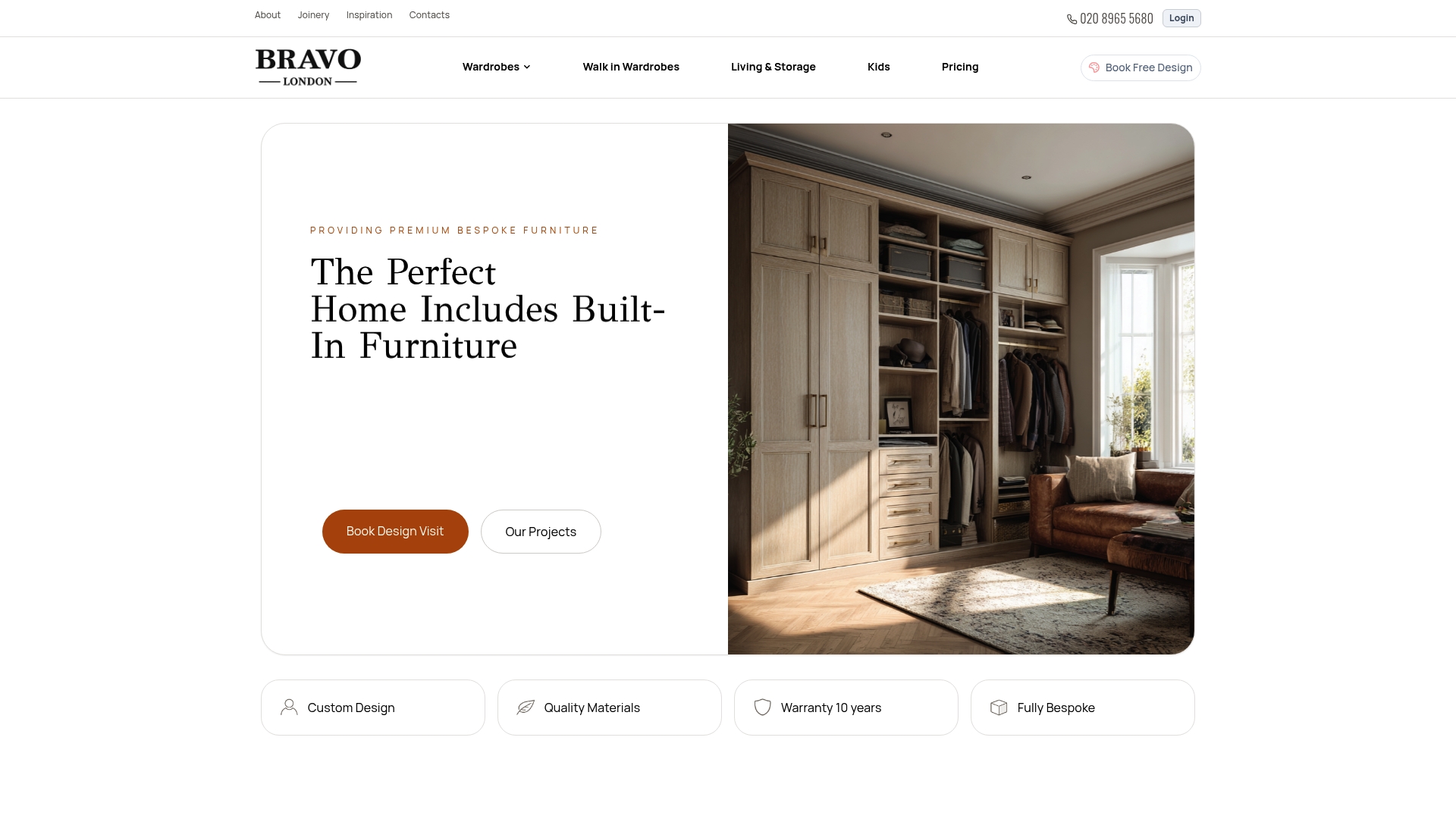
Bravo London designs and builds bespoke fitted storage across London and the surrounding areas, with a 10-year warranty on every installation. Whether you are working with a grand Victorian reception room or a compact modern flat, the team tailors each design to your exact requirements. Explore the full range of bespoke cabinet furniture options and request a free consultation to get started.
FAQ
What is a bespoke fitted library wall?
A bespoke fitted library wall is a fully custom-built shelving system designed to the precise dimensions of a specific room, integrating with the architecture rather than sitting in front of it. It typically combines open shelving, closed base cabinets, and finishing details such as mouldings and integrated lighting.
How much does bespoke library shelving cost in the UK?
Costs range from approximately £600 for entry-level DIY modular systems to £45,000 or more for premium bespoke millwork in solid white oak with special features. Mid-range modular options with integrated lighting typically fall between £800 and £2,400.
Do i need a rolling ladder for my library shelving?
A rolling ladder becomes a functional necessity when ceiling height reaches 10 feet or above. Below 9 feet, it is largely decorative. Above 12 feet, it is the only practical way to safely access upper shelves.
How do i make my library shelving look built-in?
Apply mouldings at the ceiling and floor junctions to conceal gaps, match the paint colour of the shelving to the room's trim, and use consistent hardware throughout. Scribing the top of the unit to follow the ceiling line, rather than leaving a visible gap, is the single most effective technique.
What is the best material for bespoke library shelves?
Solid hardwoods such as white oak or walnut offer the best longevity and visual quality. MDF with a veneered or painted finish is a cost-effective alternative that holds detail well and is easier to paint. Plywood carcasses provide structural rigidity for larger units.