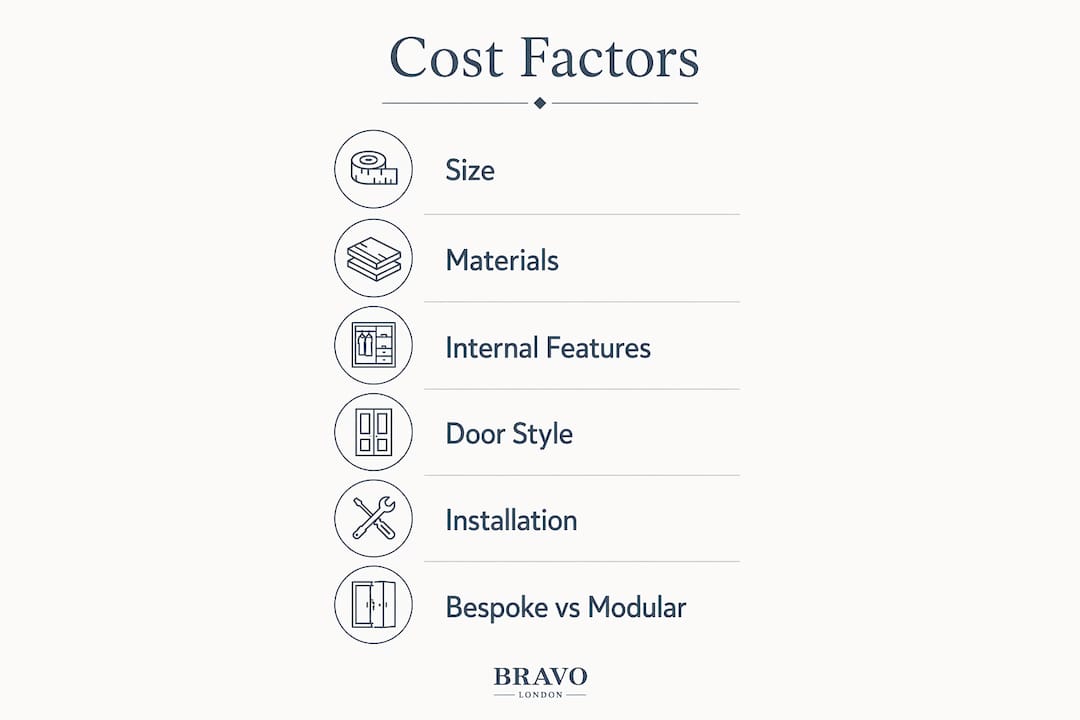
Fitted furniture cost is determined by six measurable factors: size and dimensions, materials and finishes, internal configuration, door style and hardware, installation complexity, and whether the unit is bespoke or modular. Understanding these factors before you request a quote means you can compare proposals accurately and avoid being surprised by the final figure. Bespoke fitted wardrobes can range from £2,900 to over £10,000 depending on specification, while modular alternatives start considerably lower. This guide breaks down each cost driver so you can build a realistic budget from the outset.
Fitted furniture cost factors explained: the full pricing breakdown
The fitted furniture pricing breakdown starts with one principle: every variable that makes a piece unique also makes it more expensive. Size, material grade, internal features, door mechanism, and room conditions each add to the base price in ways that are predictable once you understand the logic.
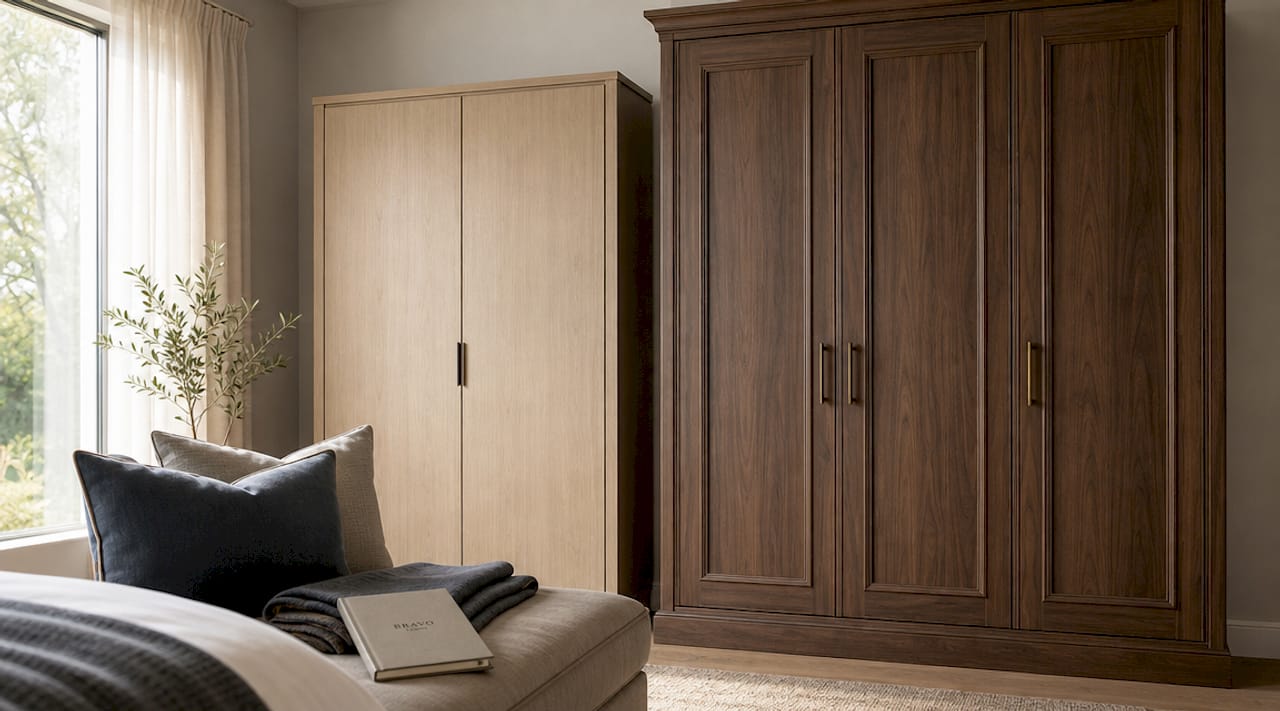
Typical fitted wardrobe totals run from around £1,000 to £2,000 for a basic build, £3,000 to £5,000 for a mid-range specification, and £5,000 to £10,000 or more for a high-end or fully bespoke design. These bands exist because each tier introduces a different combination of materials, features, and labour intensity. A basic unit uses standard carcass board, hinged doors, and minimal internal fittings. A bespoke unit uses premium veneers, soft-close mechanisms, integrated lighting, and a made-to-measure frame that accounts for every millimetre of your room.
The most useful thing you can do before approaching any supplier is to separate these factors in your own mind. When you receive a quote, you will then be able to identify exactly what is driving the price rather than comparing headline figures that may represent entirely different specifications.
How does size affect the cost of fitted furniture?
Size is the most direct cost driver in any fitted furniture project. More linear metres means more carcass material, more panels, more framework, and more installation time. Price per metre commonly ranges from £400 to £800 for mid-range builds and exceeds £1,000 per metre for bespoke designs with premium materials. That range alone explains why two wardrobes of similar appearance can differ by thousands of pounds.
Floor-to-ceiling units cost more than standard-height units because they require additional panels, more precise fitting to account for ceiling height variations, and greater structural consideration. A wardrobe that runs the full width of a wall in a large master bedroom will naturally cost more than a two-door unit in a box room, even if both use identical materials.
| Unit size | Typical price band |
|---|---|
| 2-door standard height | £1,000 to £2,500 |
| 3-door floor-to-ceiling | £2,900 to £4,500 |
| 4-door bespoke | £4,900 to £6,200+ |
| Full-wall alcove unit | £3,000 to £7,000+ |
Room shape also matters. A perfectly rectangular room with flat walls and a level floor is the simplest case. Any deviation from that, such as a chimney breast, an alcove, or a sloped ceiling in a loft conversion, adds cutting complexity and labour time. Corner fitted wardrobes are a good example: the angled junction requires custom-cut panels and precise joinery that a standard flat-wall unit does not.
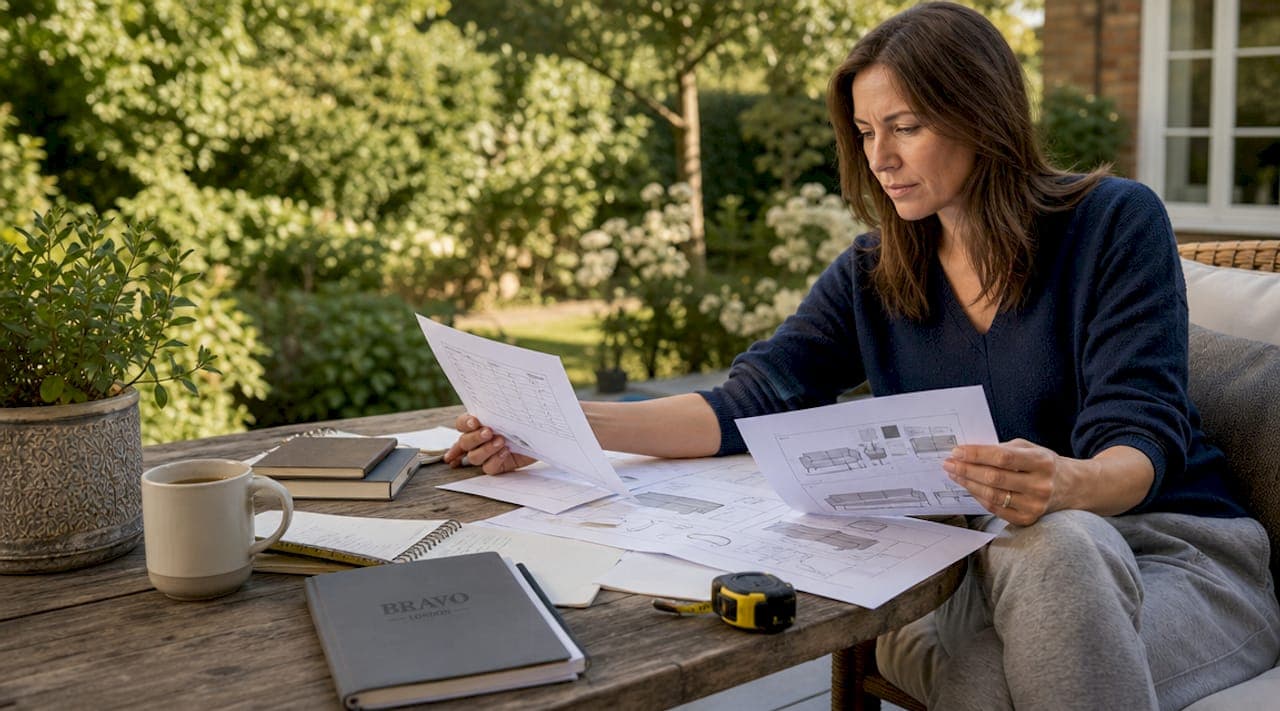
Pro Tip: Before requesting quotes, sketch your room dimensions including ceiling height, any alcoves, and the position of radiators or sockets. Suppliers who receive accurate measurements at the enquiry stage can give you a more reliable estimate from the start.
What role do materials and finishes play in the total cost?
Material choice is the second-largest variable in the custom furniture cost analysis. The carcass, the doors, and the surface finish each carry their own price tier, and upgrading any one of them moves the overall cost upward.
The most common carcass materials, from lowest to highest cost, are:
- Particleboard (chipboard): The standard for budget and mid-range units. Durable for most domestic applications but less resistant to moisture.
- MDF (medium-density fibreboard): Smoother surface than particleboard, takes paint well, and is the preferred substrate for painted finishes. Costs more than chipboard.
- Veneered MDF or plywood: A real wood veneer applied over an engineered core. Gives the appearance of solid wood at a lower price point, but still significantly more expensive than plain MDF.
- Solid wood: The premium option. Used in high-end bespoke joinery. Costs the most and requires skilled craftsmanship to work with accurately.
Surface finishes follow a similar hierarchy. A foil-wrapped door costs less than a painted lacquer door, which costs less than a real wood veneer door with an oiled finish. High-gloss lacquer finishes are particularly labour-intensive because they require multiple coats, sanding between coats, and careful handling to avoid surface marks.
Door style also affects price in ways that go beyond aesthetics. Sliding wardrobes are typically more expensive than hinged because they require track systems, precise alignment tolerances, and more complex installation. Hinged doors are simpler to fit and adjust, which keeps labour costs lower. For guidance on the full range of door options, the wardrobe door customisation guide from DIY Doors covers practical considerations across styles and finishes.
Pro Tip: If your budget is tight, consider using a premium finish only on the doors and visible panels, with a standard carcass board behind. The visual result is close to a fully premium build at a noticeably lower cost.
How do internal features and add-ons change the price?
Internal configuration is where fitted furniture budgets most often exceed initial expectations. Homeowners frequently focus on the external appearance of a unit and underestimate how much the internal fittings contribute to the final cost.
Feature add-ons such as LED lighting, soft-close mechanisms, and mirrors do not simply add a small fixed amount to the price. They represent integrated systems that alter planning and installation requirements. LED lighting requires wiring, a transformer, and potentially an electrician's involvement. Mirror doors add weight, which affects the hinge or track specification. Soft-close drawers require a different drawer box and runner system compared to standard push-open drawers.
Common internal features and their cost implications include:
- Drawers: Each drawer box, runner, and front panel adds to the material and labour cost. Soft-close runners cost more than standard ones.
- Shoe racks and pull-out trays: Require additional framework and precise spacing to function correctly.
- Jewellery trays and velvet-lined inserts: Premium accessories that add cost both in materials and in the time required to fit them accurately.
- Integrated LED lighting: Adds electrical complexity and typically requires a separate quote line for wiring.
- Mirror doors or panels: Increase door weight and require heavier-duty hardware throughout.
The practical advice here is to request an itemised quote that lists each internal feature separately. This allows you to make informed decisions about which elements to include and which to defer, rather than accepting or rejecting a package price without understanding what drives it. For ideas on making the most of internal space, the fitted walk-in wardrobe design page at Bravo London shows how configuration choices translate into real-world storage solutions.
How does installation complexity affect your budget?
Installation is a significant cost line that many homeowners underestimate when planning a fitted furniture project. Professional installation costs run to approximately £1,000 for a 3-door wardrobe and around £1,500 for a 4-door wardrobe, and those figures assume a straightforward room with flat walls and a level floor.
The biggest hidden cost driver is fitting around room imperfections. Uneven floors, sloped ceilings, and obstacles such as radiators or exposed pipework require additional cutting, scribing, and adjustment that adds hours to the installation. A loft bedroom with a pitched ceiling, for example, can double the installation time compared to a standard room of the same floor area.
The steps that most affect installation cost are:
- Room survey and measurement: A professional measured survey identifies all irregularities before manufacture begins, reducing the risk of costly adjustments on the day.
- Panel cutting and scribing: Fitting panels to uneven surfaces requires precise cutting on site, which takes time and skill.
- Door alignment: Sliding doors in particular require careful track alignment. Even minor floor irregularities can cause tracking problems if not accounted for during installation.
- Electrical work: Any unit with integrated lighting requires a qualified electrician, which is a separate cost outside the joinery quote.
- Finishing and snagging: Filling gaps, touching up paintwork, and adjusting doors after installation is standard but adds time to the overall project.
Pro Tip: Before your supplier visits for a survey, photograph your room from all four corners and note any areas where the floor or ceiling is visibly uneven. Sharing this information upfront helps the installer plan accurately and reduces the chance of unexpected charges on the day.
Bespoke vs modular fitted furniture: which costs more and why?
The distinction between bespoke and modular fitted furniture is the clearest way to understand the upper and lower bounds of the cost of custom furniture. Both are described as "fitted" because they are installed against walls and designed to fill a specific space, but the manufacturing process and price structure are fundamentally different.
Bespoke wardrobes cost £3,000 to £7,000 for an alcove, while modular fitted options for a similar footprint may range from £1,500 to £3,000. The gap exists because bespoke units are designed and manufactured from scratch to your exact dimensions and specification, whereas modular systems use pre-manufactured components assembled on site.
Key differences that affect the price:
- Bespoke: Custom dimensions, premium material options, fully tailored internal layout, higher labour cost, longer lead time, and a result that fits the room precisely regardless of its shape.
- Modular: Standard component sizes, limited finish options, faster delivery, lower price, and a result that approximates a fitted look but may leave small gaps at edges or ceilings.
For homeowners in a property they intend to stay in long-term, bespoke offers tailored long-term value that a modular system cannot match. For renters or those with a short planning horizon, modular fitted furniture provides budget predictability without the commitment of a fully custom build. The right choice depends on your property type, how long you plan to stay, and whether the room has any awkward features that a modular system cannot accommodate cleanly.
Key takeaways
Fitted furniture cost is determined by six factors working together: size, materials, internal features, door style, installation complexity, and build type.
| Point | Details |
|---|---|
| Size drives base cost | Price per metre ranges from £400 to over £1,000 depending on specification and build type. |
| Materials set the quality tier | MDF, veneer, and solid wood each occupy a distinct price band; door finish adds further cost. |
| Internal features create step-changes | LED lighting, soft-close drawers, and mirrors alter installation requirements, not just material cost. |
| Installation is a major line item | Room irregularities such as sloped ceilings and uneven floors significantly increase labour hours. |
| Bespoke costs more but fits better | Bespoke units cost £3,000 to £7,000+ for an alcove; modular options run £1,500 to £3,000 for similar spaces. |
What I have learned from over 1,000 fitted furniture projects
After completing more than 1,000 bespoke fitted furniture projects at Bravo London, the single most common budgeting mistake we see is comparing quotes by headline price rather than by specification. Two quotes for a "fitted wardrobe" can differ by £2,000 and still be comparing entirely different products. One may include veneered doors, soft-close drawers, and a full measured survey. The other may be for flat-pack components assembled on site with no scribing to the ceiling. The price difference is real, but so is the difference in what you receive.
The second pattern we see regularly is underestimating installation complexity. Homeowners in period properties, loft conversions, and older terraced houses almost always have rooms that deviate from the square. Sloped ceilings, uneven plaster, and out-of-plumb walls are the norm rather than the exception in much of London's housing stock. A supplier who does not account for these conditions in their quote will either absorb the cost or pass it on as a variation charge later.
My honest advice is to invest in a professional measured survey before committing to any specification. It costs relatively little and gives you a quote based on your actual room rather than an assumed one. Bring a clear brief to that survey: know which materials you prefer, which internal features matter most to you, and what your firm budget ceiling is. That conversation produces a far more accurate and comparable quote than a general enquiry ever will.
— Bravo
How Bravo London approaches your fitted furniture project
Bravo London designs and installs bespoke fitted wardrobes and custom cabinetry across London, with every project built to the exact dimensions and specification of your room. With over 1,000 completed projects and a 10-year warranty on all work, the team brings the kind of measured precision that eliminates the guesswork from budgeting. From the initial survey through to final installation, Bravo London handles the full process, including scribing to uneven surfaces, integrating lighting, and fitting complex door mechanisms. If you are ready to understand exactly what your project will cost, explore the full range of bespoke cabinet furniture options and request a consultation.
FAQ
How much does fitted furniture typically cost in the UK?
Fitted wardrobes range from around £1,000 to £2,000 for a basic build, £3,000 to £5,000 for mid-range, and £5,000 to £10,000 or more for bespoke designs. The final figure depends on size, materials, internal features, and installation complexity.
What is the difference between bespoke and modular fitted furniture?
Bespoke fitted furniture is manufactured to your exact room dimensions and specification, while modular systems use pre-made components assembled on site. Bespoke costs more but fits any room shape precisely; modular options are more affordable but less adaptable to irregular spaces.
Why do sliding doors cost more than hinged doors?
Sliding doors require track systems and precise alignment tolerances that hinged doors do not. This increases both the material cost of the hardware and the time required for installation, making sliding door units consistently more expensive.
Do internal features like LED lighting significantly increase the price?
Yes. LED lighting and soft-close mechanisms are integrated systems that change the planning and installation requirements of a unit, not simple add-ons. Lighting in particular may require an electrician, which adds a separate cost outside the joinery quote.
How can I get an accurate fitted furniture quote?
Comparing quotes by detailed specification rather than headline price is the most reliable approach. Provide accurate room measurements, note any irregularities such as sloped ceilings or uneven floors, and request an itemised breakdown that lists materials, internal features, and installation separately.