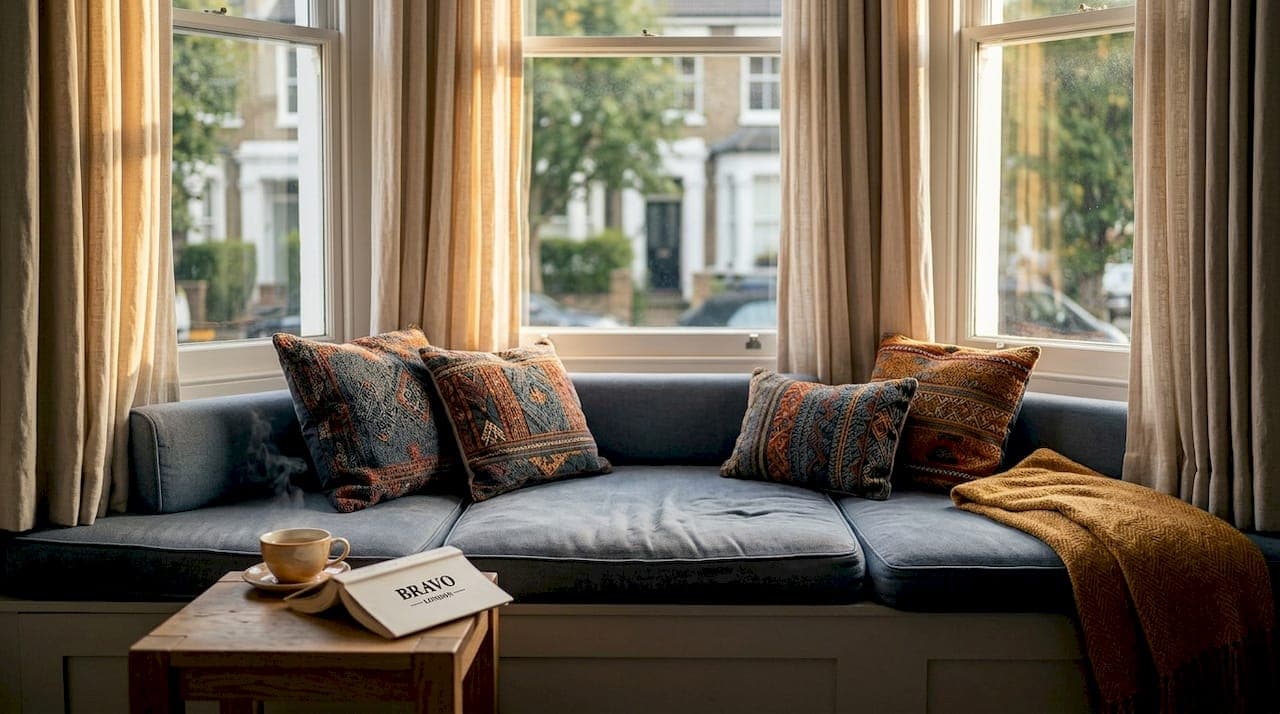
Fitted furniture for bay windows is defined as bespoke seating and storage built precisely to the angles, depths, and proportions of a bay window recess. Unlike freestanding pieces that leave awkward gaps, these custom solutions treat the bay as an architectural asset rather than a decorating problem. Specialists such as Bravo London, Sharps, and Tip Top Furniture have made this niche their focus, and with good reason: a well-executed bay window installation adds usable floor space, meaningful storage, and a polished look that off-the-shelf furniture simply cannot replicate.
1. Window seat with built-in storage
The window seat with integrated storage is the most popular and practical choice for bay window spaces. It sits flush with the sill, adds a comfortable perch, and hides clutter beneath the cushion. Built-in bench seats are widely regarded as the truly polished approach, combining aesthetics with genuine space-saving function.
- Lift-up lid for bulky items such as bedding, toys, or seasonal accessories
- Pull-out drawers with soft-close runners for everyday access
- Open cubbies at either end for books or decorative display
The seat becomes a room feature rather than an afterthought, and the storage beneath means you reclaim space that would otherwise be wasted.
2. Built-in bench with lift-up lid
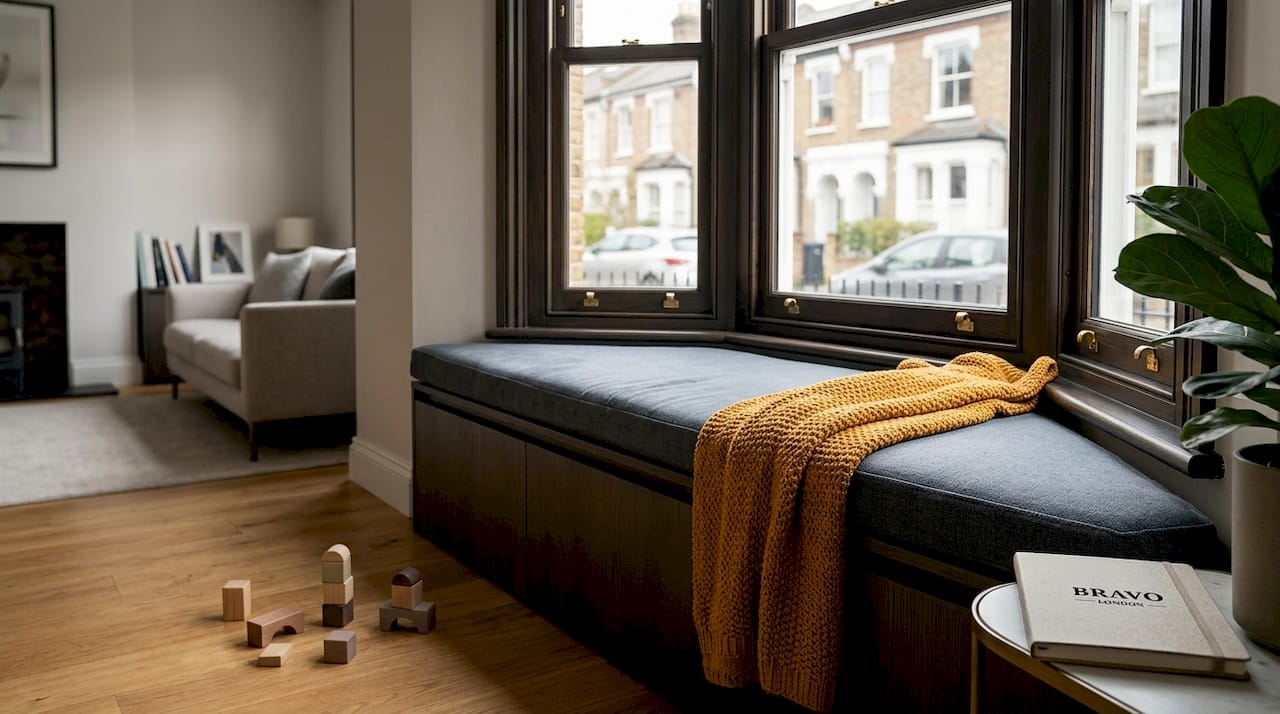
A bench with a lift-up lid is the go-to choice when you need to store large, infrequently used items. The full-width opening gives unobstructed access to the entire cavity beneath the seat. This configuration suits bedrooms and living rooms equally well, particularly where floor space is limited.
The trade-off is that you cannot access the storage while someone is seated. For households with children or pets, a gas-lift mechanism makes the lid easy and safe to operate without pinched fingers or dropped lids.
3. Pull-out drawer units
Pull-out drawers with soft-close hinges are the preferred option for heavier items and for homeowners who want frequent, easy access without lifting a seat cushion. Drawers can be sized individually to suit different contents, from shallow trays for stationery to deep drawers for folded clothing.
The cost is higher than a simple lift-lid bench because drawer runners, faces, and handles add both materials and labour. However, the result is a piece that feels more like furniture and less like a storage box.
4. Fitted bookshelf framing the bay
A fitted bookshelf for bay windows uses the vertical wall space on either side of the recess to create floor-to-ceiling shelving that frames the window. The shelves draw the eye upward, make the room feel taller, and provide substantial display or storage capacity without encroaching on the window itself.
This approach works particularly well in studies, home offices, and living rooms where books, media, or collectibles need a home. The key is to keep the shelving depth shallow enough that it does not block light from the side panes.
5. Daybed configuration
A daybed in a bay window converts the recess into a reading nook, a guest sleeping space, or a relaxation zone. The seat depth is extended beyond the standard 18 inches to allow a person to lie down comfortably, typically reaching 70 to 80 centimetres. This makes it one of the most multifunctional furniture ideas for bay windows.
The daybed works best in larger bays where the recess is deep enough to accommodate the extended platform without the cushion projecting into the room. Storage drawers beneath the platform make the most of the height available.
6. Custom bay window desk
A fitted desk built into a bay window is an underused but highly effective solution for home workers. The bay provides natural light from three sides, reduces eye strain, and creates a defined workspace without consuming the centre of the room. The desk surface can be built at standard desk height (approximately 73 centimetres) with a knee recess cut into the storage below.
Shelving above the desk, kept within the upper half of the window, retains the view and light while adding reference storage. This configuration suits Victorian and Edwardian bay windows particularly well, where the recess is deep and the ceiling height generous.
7. Upholstered window seat without storage
Not every bay window needs storage beneath the seat. An upholstered window seat without a storage cavity is simpler to build, lower in cost, and can be installed at a shallower depth where the bay does not permit a full storage box. The result is a clean, elegant perch that feels intentional and balanced.
Custom interior trim and window seat installations range roughly from £1,200 to £4,000 depending on design complexity and materials. A simpler upholstered seat sits at the lower end of that range, making it accessible for homeowners working within a tighter budget.
8. Corner window furniture and angled cabinetry
Bay windows create angled corners that standard rectangular furniture cannot fill. Angled cabinetry built to the precise geometry of the bay solves this problem cleanly. Modular construction with mitred angles produces gap-free results even in bays where the angles are irregular or asymmetric.
Corner window furniture of this kind is common in kitchens that open into a bay, where a banquette seating unit with a fitted table creates a breakfast nook. In living rooms, the same principle produces a curved or angled storage unit that feels built into the architecture.
9. How to measure bay windows correctly for fitted furniture
Accurate measurement is the single most important step before ordering any bespoke bay window furniture. Bay windows are rarely as symmetrical as they appear, and measuring each bay pane separately at the top, middle, and bottom is the correct approach. Dividing the total width equally between panes is a common and costly error.
Follow these steps for reliable measurements:
- Measure the width of each individual pane at three heights: top, middle, and bottom.
- Measure the depth of the recess from the window face to the room wall.
- Record the floor-to-sill height and compare it with the standard seat height of 18 inches, adjusting for cushion thickness.
- Measure the angle at each junction between panes using a digital angle finder.
- Note the position of window handles, vents, and trickle vents. Mechanical clearance for handles and shutters must be recorded per pane to prevent furniture from blocking operation.
Pro Tip: Photograph every measurement in context and share the images alongside your dimension sheet with your carpenter or designer. Bravo London's team uses this documentation to catch discrepancies before a single piece of timber is cut.
10. Materials and finishes for bay window furniture
The choice of material affects durability, finish quality, and cost in equal measure. The most common options for custom bay window furniture are Douglas fir, pine, and birch plywood, each with distinct characteristics:
- Douglas fir is strong, stable, and takes paint well. It is the preferred choice for painted satin finishes where a smooth, furniture-grade result is required.
- Pine is more affordable and widely available, though it is softer and more prone to denting. Suitable for painted finishes in lower-traffic rooms.
- Birch plywood offers excellent stability for carcass construction and resists warping in rooms with fluctuating humidity, such as kitchens.
For cushion fabric, Sunbrella offers stain resistance and UV protection, making it practical for a sun-facing bay. Velvet and linen blends suit north-facing rooms where fading is less of a concern. High-density foam at 4 to 5 inches thickness provides the comfort level expected of a proper window seat.
Pro Tip: Match your painted finish to the existing window trim. A consistent colour between the seat unit and the architrave makes the furniture read as part of the architecture rather than an addition to it.
Comparing storage types and seating styles
The table below summarises the key differences between the three main storage configurations for bay window seating.
| Configuration | Access | Storage capacity | Relative cost | Best suited for |
|---|---|---|---|---|
| Lift-up lid | Full width when open | High, good for bulky items | Low to moderate | Bedrooms, infrequent access |
| Pull-out drawers | Individual drawers | Moderate, organised sections | Moderate to high | Living rooms, daily use |
| Open cubbies | Always accessible | Low, display focused | Low | Studies, decorative storage |
| Daybed platform | Drawers beneath | High, full-length cavity | Moderate | Guest rooms, reading nooks |
Pull-out drawers suit households that use the storage daily. Lift-up lids are the better choice when the priority is maximum capacity for seasonal or bulky items. Open cubbies work as a complement to other storage rather than a primary solution.
Creative design tips for bay window furniture
Good design in a bay window is as much about what you leave uncovered as what you fill. Furniture should not block more than half the window height, as this preserves natural light and the view that makes a bay window worth having in the first place.
- Keep seat backs and shelving within the lower half of the window opening.
- Use cushions and throws in colours that complement the window trim and wall colour rather than competing with them.
- Add a wall sconce or pendant nearby to make the seat usable in the evening without relying on overhead lighting.
- Choose modular construction so that individual sections can be adjusted or replaced without dismantling the entire unit.
- Consider window treatment trends such as Roman blinds or plantation shutters that sit within the recess and do not interfere with the furniture below.
The result should feel intentional. A bay window fitted with the right furniture reads as a considered design decision, not a retrofit.
Key takeaways
Fitted furniture for bay windows delivers the best results when it is built to the precise geometry of the recess, uses appropriate materials, and balances storage with the preservation of natural light.
| Point | Details |
|---|---|
| Measure each pane individually | Bay angles vary; measuring pane by pane prevents gaps and misfits in the finished piece. |
| Choose storage type by use frequency | Drawers suit daily access; lift-up lids suit bulky, infrequent storage. |
| Match materials to finish and room | Douglas fir for painted satin; birch plywood for carcass stability in humid rooms. |
| Preserve window height | Keep furniture within the lower half of the window to retain light and views. |
| Account for mechanical clearance | Record handle and vent positions before ordering to avoid obstruction. |
What we have learned from over 1,000 bay window projects
Bay windows are one of the most underused architectural features in British homes. Homeowners often treat the recess as a place to push a sofa or hang curtains, when it is actually one of the most structurally generous spaces in the room. After working on more than 1,000 projects at Bravo London, the pattern is consistent: the clients who are happiest with their results are those who committed to a fully bespoke approach rather than adapting an off-the-shelf unit.
The measurement stage is where most problems originate. Bay window angles are rarely identical on both sides, and the floor is rarely perfectly level beneath the sill. These are not defects in the building; they are simply the reality of period and modern construction alike. A carpenter who measures once and assumes symmetry will produce a piece that rocks, gaps, or binds against the window frame. The solution is straightforward: measure every dimension independently and document it thoroughly before any design decisions are finalised.
For 2026, the trend among homeowners is toward multifunctional bay window furniture that serves more than one purpose. The daybed-with-storage configuration is growing in popularity, as is the fitted desk for home workers who want a dedicated workspace without sacrificing a whole room. These are not passing fashions. They reflect a genuine shift in how people use their homes, and bespoke furniture is the only category that can respond to those needs with precision.
The advice to choose custom over off-the-shelf is not self-serving. It is practical. A standard bench from a high street retailer will not fit a Victorian bay without modification, and the modification usually costs more than the difference in price between the two options. A piece built to your bay from the outset arrives ready to install, carries a proper warranty, and lasts for decades.
— Bravo
Explore bespoke bay window furniture with Bravo London
Bravo London designs and builds bespoke fitted furniture for bay windows across London, covering everything from upholstered window seats to full storage units with soft-close drawers and painted satin finishes. Every project begins with precise measurements taken by the Bravo London team, so the finished piece fits your bay exactly, with no gaps, no modifications, and no compromise on quality.
With over 1,000 completed projects and a 10-year warranty on all work, Bravo London brings the same level of craftsmanship to a single window seat as to a full room fit-out. Explore the full range of bay window seating and storage options, or browse fitted living room furniture to see how bespoke cabinetry transforms the spaces most homes underuse.
FAQ
What is fitted furniture for bay windows?
Fitted furniture for bay windows is bespoke seating, storage, or cabinetry built to the precise dimensions and angles of a bay window recess. Unlike freestanding furniture, it integrates with the architecture to eliminate gaps and maximise usable space.
How much does a custom bay window seat cost?
Custom window seat installations typically range from £1,200 to £4,000, depending on the size of the bay, the materials chosen, and whether storage features such as drawers or lift-up lids are included.
What is the correct seat height for a bay window seat?
The industry standard seat height is approximately 18 inches, measured from the floor to the top of the seat frame. This figure is then adjusted downward to account for the thickness of the cushion, which typically adds 10 to 13 centimetres.
Do I need to measure each bay pane separately?
Yes. Each bay pane should be measured at the top, middle, and bottom independently, as widths and angles vary between panes even in well-built properties. Assuming symmetry is the most common cause of poorly fitting bay window furniture.
What materials are best for painted bay window furniture?
Douglas fir and birch plywood are the most reliable choices for a painted finish. Douglas fir takes painted satin coatings particularly well and produces a smooth, furniture-grade surface. Birch plywood is preferred for carcass construction where dimensional stability matters most.