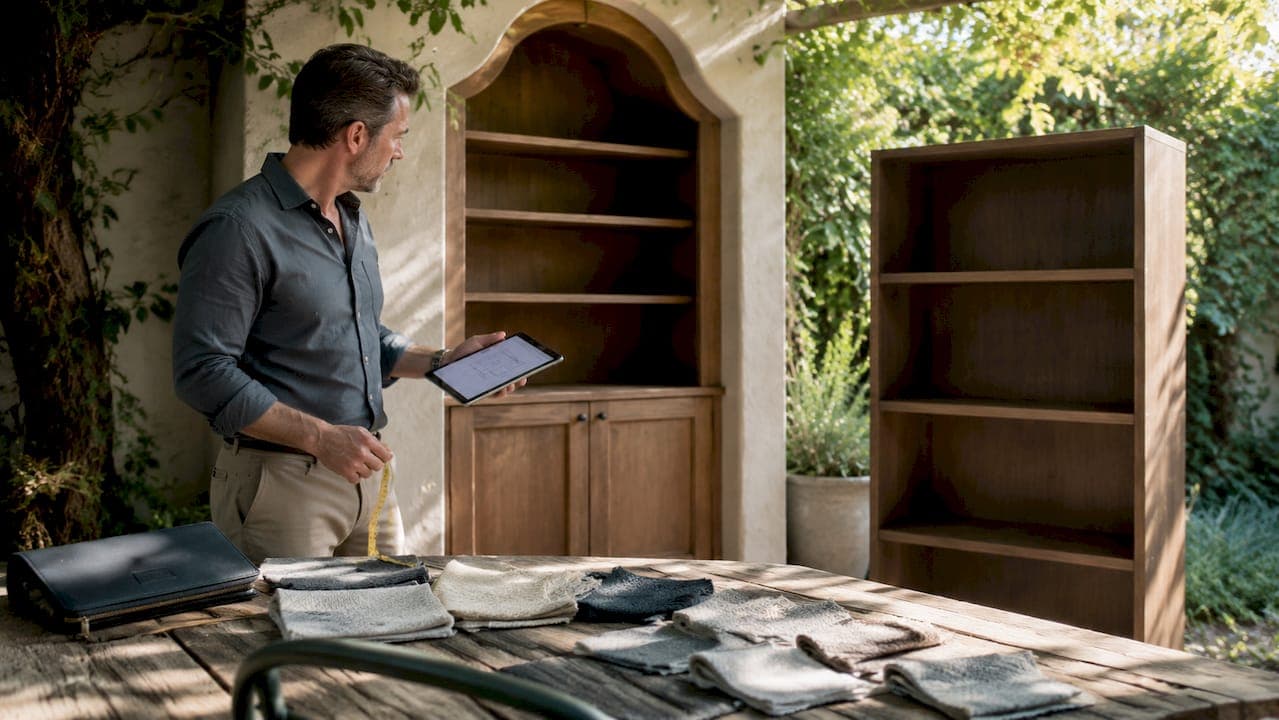
Fitted furniture is custom-built to your exact room dimensions and permanently installed, while ready-made furniture is mass-produced in standard sizes and sold as freestanding units. Understanding the fitted furniture vs ready-made differences matters because the wrong choice can leave you with wasted space, unexpected costs, or a room that never quite looks finished. The comparison covers six practical areas: spatial fit, material quality, installation, cost, flexibility, and aesthetics. Each factor carries different weight depending on whether you own your home or rent it.
1. How fitted furniture maximises space
Floor-to-ceiling built-ins provide approximately 35 to 40% more storage than equivalent freestanding furniture setups. That figure reflects a structural reality: fitted furniture occupies every centimetre from floor to ceiling and wall to wall, leaving no dead zones. Ready-made units, by contrast, are built to standard heights and widths, so they rarely align perfectly with your room.
The difference becomes most visible in awkward spaces. Alcoves, sloped ceilings, chimney breasts, and irregular wall angles are precisely where custom furniture fits to exact millimetre dimensions, providing architectural integration and maximised storage. A standard wardrobe placed in an alcove will leave visible gaps on either side and above. A fitted unit fills the same space completely, with clean lines and no filler panels wider than necessary.
- Built-in anchoring to walls, floors, and ceilings eliminates floor-to-furniture dust gaps, improving both room cleanliness and visual finish.
- Sloped loft ceilings and bay window recesses can be fully utilised with fitted joinery, something no off-the-shelf product achieves.
- Fitted units can incorporate internal configurations, such as pull-out drawers, hanging rails, and adjustable shelving, designed around your specific storage habits.
Pro Tip: When commissioning fitted furniture for an alcove, ask your designer to specify the exact filler panel width in the drawings. Made-to-order rigid units require filler panels of around 18mm, whereas poorly planned installations can leave gaps of 150mm or more, which undermines the whole point of going bespoke.
2. Material quality and construction
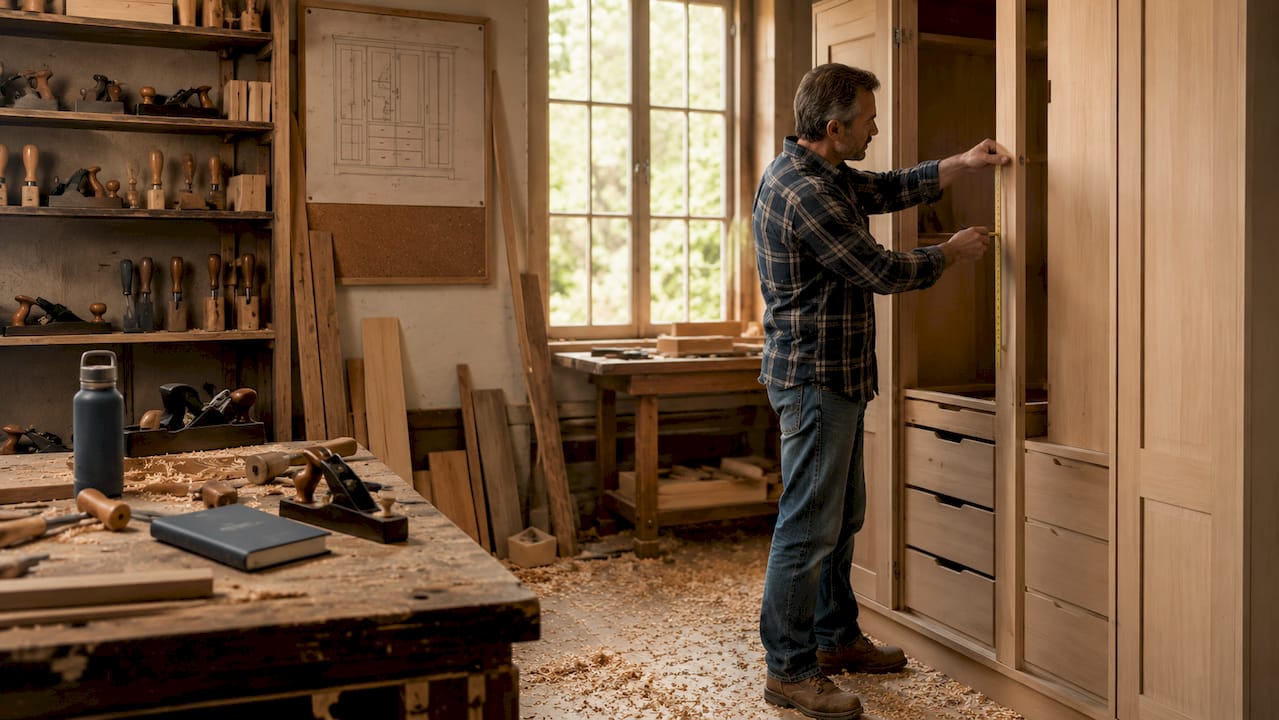
The boards and hardware inside a piece of furniture determine how long it lasts and how well it holds up to daily use. Cabinetry using 18mm Kronospan or Egger boards with Blum hardware produces stronger, longer-lasting furniture than typical flat-pack alternatives. These are the material standards Bravo London applies across its fitted furniture projects.
Ready-made furniture relies primarily on particleboard or low-density MDF with laminate finishes. These materials are susceptible to chipping and swelling, particularly in kitchens and bathrooms where moisture is present. Custom furniture, by comparison, commonly uses moisture-resistant high-density MDF, solid FSC-certified timbers, and robust joinery techniques such as mortise-and-tenon or dovetail construction.
The assembly method also matters. Factory-assembled rigid units arrive square and true, ready for installation. Flat-pack durability depends entirely on how carefully the unit is assembled on site, and any misalignment during that process compounds over time, leading to doors that drop, drawers that stick, and carcasses that rack.
- Board thickness: 18mm boards resist bowing under load; many budget ready-made units use 12 to 15mm boards.
- Hardware quality: Blum soft-close hinges and drawer runners are rated for 100,000 cycles; budget equivalents often fail within a few years.
- Joinery: Dovetail and mortise-and-tenon joints in solid timber fitted furniture outlast cam-lock fixings used in flat-pack assembly.
Pro Tip: When comparing quotes, ask specifically for the board thickness and hardware brand. If a supplier cannot confirm 18mm boards and a named hardware brand such as Blum or Hettich, the unit is almost certainly built to a lower standard.
3. Cost, installation time, and long-term value
Cost is where most people start the comparison, and ready-made furniture wins on upfront price. Custom furniture costs 40 to 60% more upfront than ready-made alternatives. That gap is real and should not be dismissed, but it tells only part of the story.
Ready-made pieces typically last three to five years before wear becomes noticeable. Custom fitted furniture, built with premium boards and quality hardware, regularly lasts 30 years or more. Across a 30-year period, you may replace a ready-made wardrobe six times at cumulative cost that exceeds a single fitted installation.
Installation time is another factor that shifts the cost calculation. Fitting flat-pack kitchens involves assembling each carcass on site, increasing labour time compared to fitting pre-assembled rigid units. Rigid kitchens arrive ready to position and fix, which means faster installation and less disruption to your home. The savings in labour can offset a meaningful portion of the higher unit cost.
| Factor | Fitted furniture | Ready-made furniture |
|---|---|---|
| Upfront cost | Higher (40 to 60% more) | Lower |
| Installation time | Faster (pre-assembled) | Slower (on-site assembly) |
| Lifespan | 30+ years | 3 to 5 years typical |
| Long-term value | Strong | Weaker over time |
| Fit to space | Exact | Approximate |
The economic gap between flat-pack and made-to-order narrows considerably when installation time and longevity are factored in. For homeowners planning to stay in a property for a decade or more, fitted furniture is the more cost-effective choice over the full ownership period.
4. Flexibility and permanence: renters vs homeowners
Fitted furniture is a permanent installation. It is fixed to the structure of the building, which makes it an asset for homeowners and a complication for renters. Renters are generally better served by freestanding furniture because fitted furniture is difficult to remove or resell at full value when you move.
Built-ins are fixed as part of a property. A renter who commissions fitted wardrobes either leaves them behind, potentially without compensation, or faces the cost and disruption of removal and reinstatement. Neither outcome is financially attractive. Freestanding furniture, by contrast, moves with you and can be resold, donated, or repurposed.
For homeowners, permanence is a benefit rather than a drawback. Fitted furniture adds to the perceived value of a property, particularly in bedrooms and living rooms where storage is a selling point. Many buyers actively seek homes with well-designed fitted storage because it removes a significant post-purchase expense.
- Homeowners benefit from fitted furniture's longevity, added property value, and tailored spatial efficiency.
- Renters are better served by quality freestanding pieces that travel with them and retain resale value.
- Mixed approaches work well: a homeowner might combine fitted bedroom storage with freestanding accent pieces to balance permanence with flexibility.
- Environmental consideration: freestanding furniture can be resold or donated; fitted furniture removed during a renovation typically goes to landfill.
5. Aesthetics and bespoke design
Fitted furniture creates a cohesive, architectural look that ready-made furniture cannot replicate. When units run floor to ceiling and wall to wall, the room feels intentional and balanced. There are no visible gaps, no mismatched heights, and no compromise on proportion. This is the defining visual advantage of bespoke joinery over standard retail products.
Ready-made furniture offers broad stylistic variety and is easy to refresh. You can change a room's look by replacing a sideboard or swapping a bookcase without any structural work. For renters or homeowners who enjoy updating their interiors regularly, this flexibility has genuine appeal. Brands such as IKEA, Loaf, and Made.com offer well-designed freestanding pieces across a wide range of styles.
The limitation of ready-made furniture appears most clearly in unusual spaces. Custom furniture eliminates wasted space in irregular alcoves and awkward layouts where standard sizes simply do not fit. A fitted unit in a chimney breast alcove, for example, can be designed with precise depth, height, and internal configuration to match the architecture of the room. No off-the-shelf product achieves that result.
- Fitted furniture allows custom finishes including painted MDF, veneered panels, and solid timber fronts that match existing joinery or cabinetry.
- Bespoke proportions mean door heights, drawer ratios, and cornice profiles can be designed to complement the room's architecture rather than fight it.
- Ready-made furniture suits rooms with standard dimensions and straightforward layouts where standard sizing is not a constraint.
- For fitted living room furniture, built-in media units and bookshelves create a far more considered look than freestanding alternatives placed against the same wall.
Pro Tip: If you are considering fitted furniture for a room with period features such as cornices, dado rails, or skirting boards, ask your designer to incorporate matching profiles into the unit design. This single detail is what separates a fitted installation that looks purpose-built from one that looks like a wardrobe pushed into a corner.
6. How to choose the right furniture type for your home
The decision between fitted and ready-made furniture comes down to three questions: How long are you staying? What does the space demand? What is your total budget over the next decade, not just today?
If you own your home and plan to stay for five years or more, fitted furniture is the stronger investment for any room with storage requirements or awkward dimensions. The upfront cost is higher, but the lifespan, fit, and finish justify it. If you rent, or if you move frequently, quality freestanding furniture from a reputable retailer is the practical choice. It travels with you and retains value.
For spaces with irregular dimensions, such as loft conversions, period properties, or rooms with alcoves, fitted furniture is not just preferable. It is often the only way to use the space properly. Ready-made furniture in these contexts produces a result that looks unfinished regardless of how well it is styled. For bespoke fitted storage in challenging spaces, the difference in outcome is significant.
A hybrid approach suits many homeowners well. Fitted wardrobes and storage in bedrooms and living rooms, combined with freestanding pieces in dining rooms or studies, gives you the spatial efficiency of built-ins where it matters most while retaining some flexibility elsewhere.
Key takeaways
The best choice between fitted and ready-made furniture depends on your tenure, budget horizon, and the spatial demands of your home, because fitted furniture delivers superior fit, materials, and longevity while ready-made offers immediacy and portability.
| Point | Details |
|---|---|
| Spatial fit | Fitted furniture fills awkward spaces precisely; ready-made leaves gaps in irregular rooms. |
| Material quality | Fitted units use 18mm boards and quality hardware; ready-made typically uses thinner particleboard. |
| Cost over time | Custom furniture costs more upfront but lasts 30+ years versus 3 to 5 years for ready-made. |
| Flexibility | Renters benefit from freestanding furniture; homeowners gain more from permanent fitted installations. |
| Aesthetics | Fitted furniture creates a cohesive, architectural finish that standard retail products cannot match. |
What experience teaches you about this choice
Having worked on over 1,000 fitted furniture projects across London, the pattern we see most often is homeowners who delayed commissioning fitted furniture, lived with ready-made units for several years, and then replaced them anyway. The total spend in those cases almost always exceeded what a single fitted installation would have cost at the outset.
The other pattern worth noting is renters who commission fitted furniture without thinking through the implications. Permanence is not a minor detail. It is the central factor in this decision. If there is any realistic chance you will move within three years, freestanding furniture is the right call, regardless of how much you love the idea of floor-to-ceiling wardrobes.
What I find genuinely underappreciated is the hybrid approach. Most rooms do not need to be entirely fitted or entirely freestanding. A fitted wardrobe wall in the bedroom, combined with a freestanding chest of drawers, gives you the storage efficiency of built-ins alongside the flexibility to refresh the room without a full refurbishment. That balance suits the majority of homeowners we work with far better than an all-or-nothing approach.
The emerging trend worth watching is modular fitted furniture, which sits between the two categories. Systems like those offered by made-to-measure joinery specialists allow some degree of reconfiguration while still achieving a precise fit. For homeowners who want the look of fitted furniture with slightly more adaptability, this is a direction worth exploring with your designer.
— Bravo
Explore bespoke fitted furniture from Bravo London
Bravo London designs and manufactures bespoke fitted wardrobes and storage solutions tailored to your exact space, from alcove wardrobes in period properties to full bedroom and living room fitted schemes. Every project uses premium 18mm boards, Blum hardware, and finishes chosen to complement your home's architecture. With over 1,000 completed projects, a 10-year warranty, and a design process built around your specific requirements, Bravo London removes the guesswork from choosing fitted furniture. Explore the full range of luxury bespoke furniture and request a free consultation to see what a tailored solution looks like for your home.
FAQ
What is the main difference between fitted and ready-made furniture?
Fitted furniture is custom-built to your room's exact dimensions and permanently installed, while ready-made furniture is mass-produced in standard sizes and sold as freestanding units. The core distinction is precision of fit and permanence versus portability and convenience.
Is fitted furniture worth the extra cost?
Custom furniture costs 40 to 60% more upfront but typically lasts 30 years or more, compared to three to five years for ready-made pieces. For homeowners staying in a property long term, the lifetime cost of fitted furniture is generally lower.
Can renters have fitted furniture installed?
Renters are generally better served by freestanding furniture because fitted furniture is permanent and difficult to remove or resell at full value. If a renter does commission fitted furniture, they should confirm with their landlord in writing before proceeding.
How much more storage does fitted furniture provide?
Floor-to-ceiling built-in furniture provides approximately 35 to 40% more storage than equivalent freestanding setups. This gain comes from eliminating the dead space above, below, and beside standard freestanding units.
What materials should I look for in fitted furniture?
Quality fitted furniture uses 18mm Kronospan or Egger boards, moisture-resistant MDF where needed, and hardware from brands such as Blum or Hettich. Ready-made furniture typically uses thinner particleboard with laminate finishes that are more prone to chipping and swelling over time.