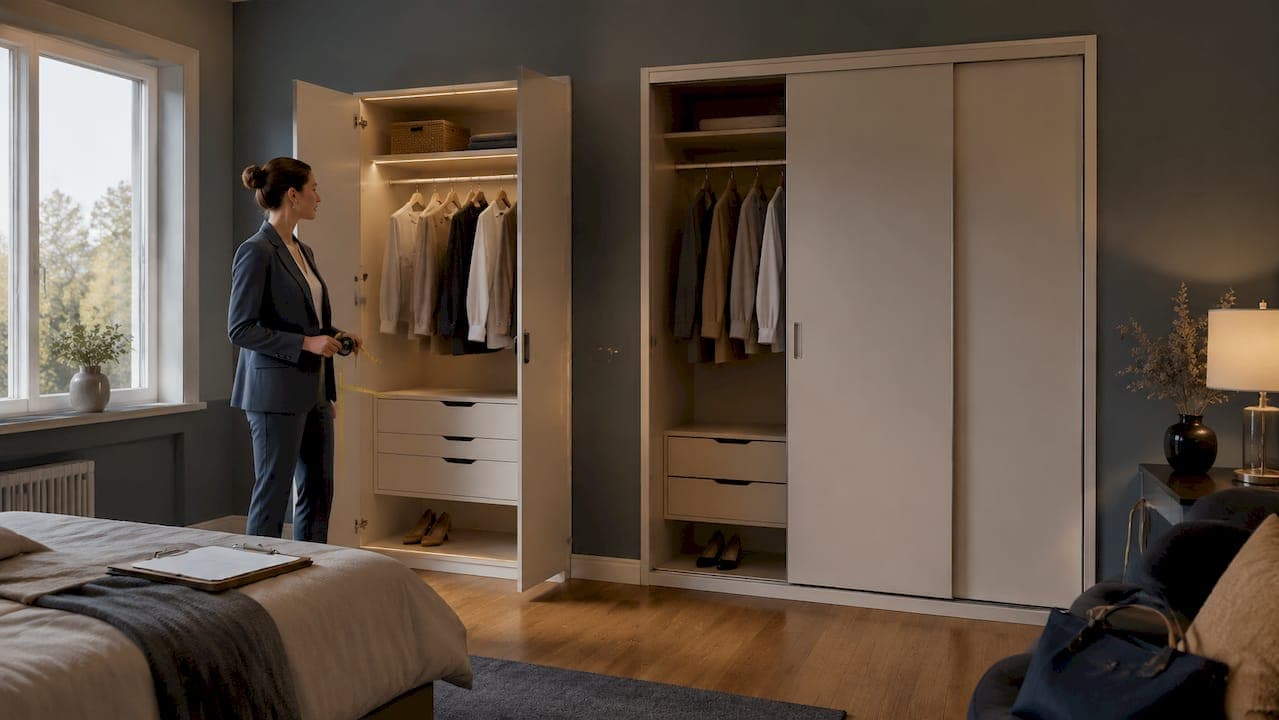
Hinged and sliding wardrobes are defined by one fundamental difference: how their doors open. Hinged doors swing outward on fixed pivots, requiring clear floor space in front of the unit. Sliding doors glide sideways along tracks, fitting neatly within the wardrobe's own footprint. Understanding why hinged vs sliding wardrobes differ goes well beyond the door mechanism. The choice affects your room layout, daily routine, storage organisation, and the overall feel of your bedroom. Getting this decision right from the start saves you from costly adjustments later.
How does space requirement differ between hinged and sliding wardrobes?
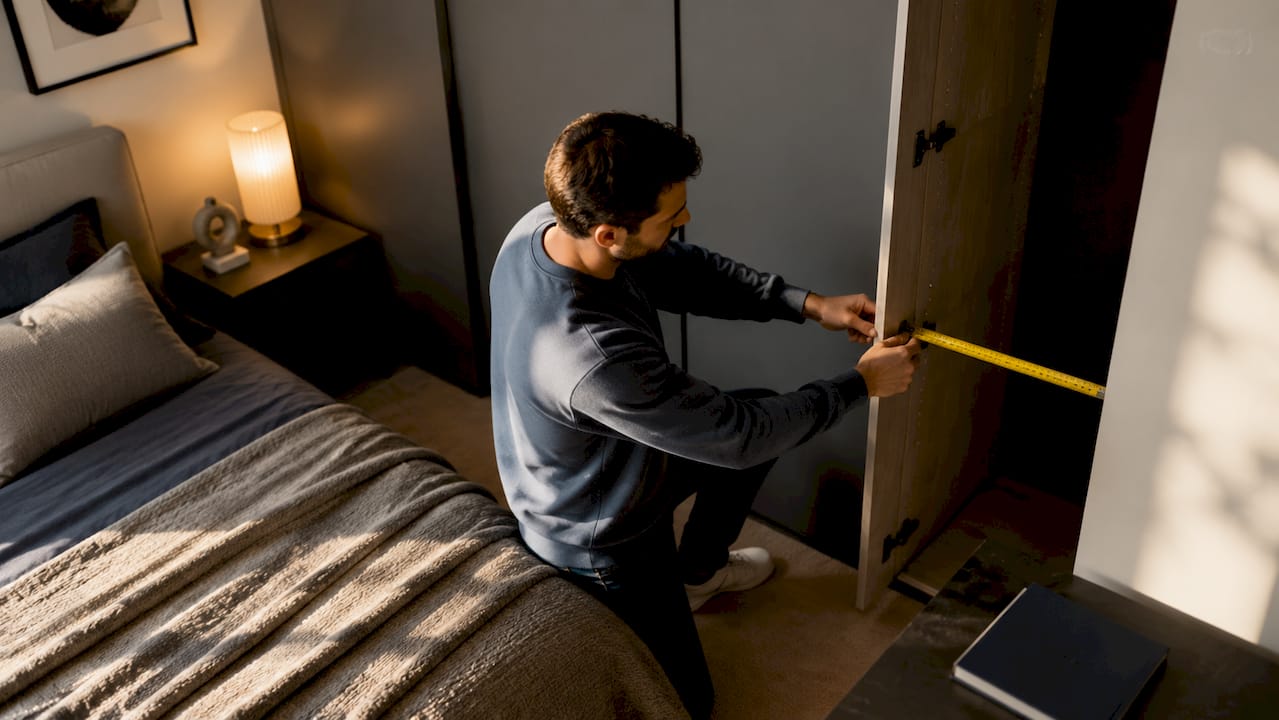
The single biggest practical difference between these two wardrobe types is floor clearance. Hinged doors require 45–60 cm of clear space in front of them to open fully. That is roughly the depth of a bedside table or a small chest of drawers. In a compact bedroom, that clearance can dictate where every other piece of furniture sits.
Sliding doors require no swing clearance because the panels move along internal or external tracks within the wardrobe's own width. This makes them a natural fit for rooms where the bed, dressing table, or desk sits close to the wardrobe. The floor space in front stays completely free.
Here is how the spatial trade-off plays out in practice:
- Small bedrooms (under 10 sq m): Sliding wardrobes preserve walking space and prevent the room from feeling cramped.
- Medium bedrooms (10–15 sq m): Either type works, but hinged wardrobes give you more flexibility in interior access.
- Large bedrooms (over 15 sq m): Hinged wardrobes become a practical option without the clearance concern becoming a problem.
- Alcoves and recesses: Sliding doors are almost always the better fit, as hinged doors in a recess can block the surrounding wall space entirely.
Pro Tip: Measure the distance between your wardrobe wall and the nearest obstacle before choosing a door type. If that gap is less than 60 cm, sliding doors are the safer choice.
Sliding wardrobes suit small bedrooms better precisely because they make the room appear more open. This is not just about physical space. A room without swinging doors simply feels less obstructed and more considered in its layout.
What are the access and usability differences?
Access is where the advantages of hinged vs sliding designs become most apparent in daily use. The two systems work in fundamentally opposite ways, and each has clear strengths depending on how you use your wardrobe.
Hinged doors allow full simultaneous access to the entire interior. Open both doors and every shelf, rail, and drawer is visible and reachable at once. This makes it far easier to plan outfits, locate items quickly, and keep the interior organised without hunting through sections.
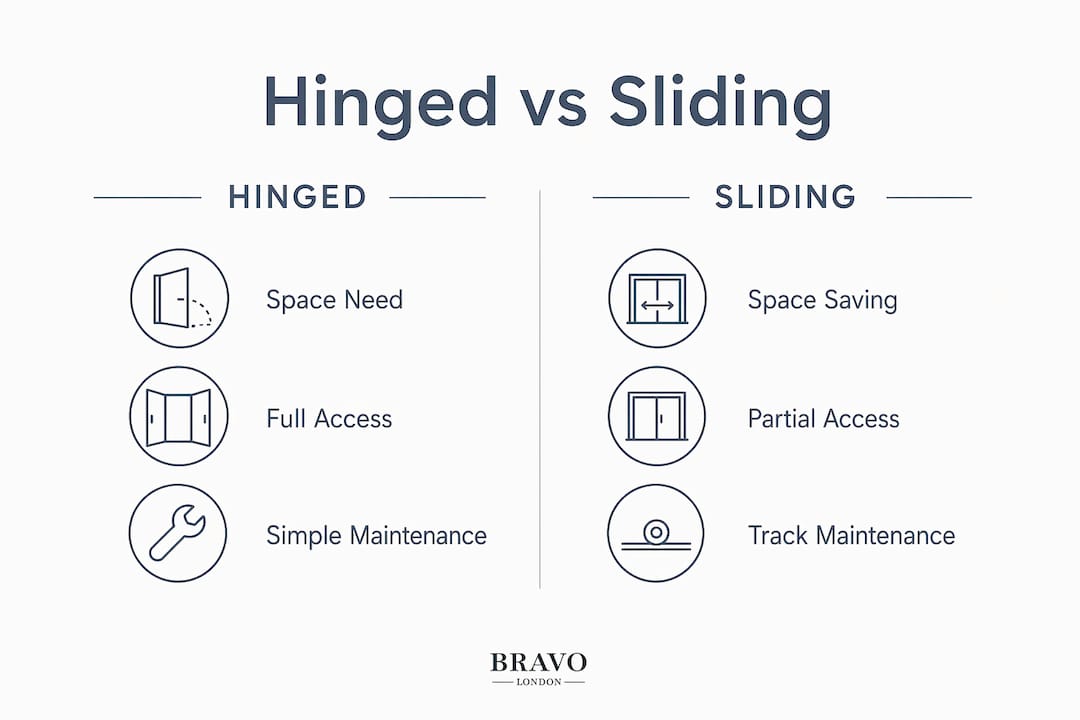
Sliding wardrobes work differently. Because the panels overlap on their tracks, only part of the wardrobe is accessible at any one time. You slide one door to reach the left section, then slide it back to reach the right. This is manageable with good planning, but it does require a more deliberate approach to interior layout.
To get the most from a sliding wardrobe, follow this approach:
- Zone your storage by frequency of use. Keep everyday items in the most accessible section and seasonal or occasional items behind the overlapping panel.
- Use pull-out rails and drawers. These bring items forward without requiring you to reach deep into a partially obscured section.
- Label or colour-code sections. A simple system helps you locate items without opening both sides repeatedly.
- Avoid overcrowding. A packed sliding wardrobe becomes frustrating quickly. Leave breathing room in each zone.
Interior organisation inside sliding wardrobes is not optional. It is the factor that determines whether the wardrobe works well day to day or becomes a source of daily irritation. Hinged wardrobes are more forgiving of a less structured interior because everything is visible at once.
How do maintenance and durability compare?
Both wardrobe types require some upkeep, but the nature of that maintenance differs considerably. Understanding what each system demands helps you choose the one you are actually willing to maintain.
Sliding wardrobes rely on their track systems for smooth operation. Top track systems are preferred over bottom tracks because bottom tracks collect dust, hair, and debris over time, causing doors to stick and judder. A quality top-hung system keeps the floor clear and reduces this problem significantly. That said, poor installation or misaligned tracks can cause sticking and require more frequent adjustments than a well-fitted hinged door ever would.
Common maintenance issues for each type include:
- Sliding wardrobes: Roller wear, track dust accumulation, door misalignment, and noise from worn bearings.
- Hinged wardrobes: Hinge sagging over time, occasional tightening required, and door warping in humid conditions.
Hinged door repairs tend to be straightforward. A loose hinge takes minutes to tighten or replace. Sliding door repairs can be more involved if the track itself needs realigning or a roller assembly needs replacing. Hinged wardrobes generally cost less upfront due to simpler hardware, and their ongoing maintenance costs tend to stay lower too.
Pro Tip: When specifying a sliding wardrobe, always ask whether the system uses a top-hung or bottom-track mechanism. Top-hung systems from reputable manufacturers last significantly longer with far less day-to-day maintenance.
For a deeper look at wardrobe door customisation options, including hardware grades and track specifications, it is worth consulting a specialist before committing to a system.
What aesthetic differences influence the choice?
Door style shapes the entire visual character of a bedroom. This is one area where personal taste and room design carry as much weight as practical function.
Sliding doors offer a modern, minimalistic appearance, often finished in glass, mirror, or lacquered panels. Mirrored sliding doors are particularly popular in smaller rooms because they reflect light and create the impression of a larger space. The clean, unbroken surface of a sliding wardrobe reads as contemporary and uncluttered.
Hinged wardrobes offer more variety in style. Shaker-style doors, raised panel designs, veneered finishes, and painted wood all sit naturally within a hinged door frame. This makes them a better match for traditional, country, or period-style interiors where decorative detailing matters.
| Feature | Hinged Wardrobes | Sliding Wardrobes |
|---|---|---|
| Style | Traditional, versatile, decorative | Modern, minimal, sleek |
| Finishes | Painted, veneered, Shaker, panelled | Glass, mirror, lacquer, wood effect |
| Room feel | Warm, classic, characterful | Open, light, contemporary |
| Mirror option | Available on individual doors | Full-width mirrored panels common |
| Design flexibility | High, suits varied decor | Best in modern or neutral schemes |
The right choice depends on the room you are working with. A Victorian terrace bedroom with cornicing and original floorboards will look more coherent with hinged Shaker doors. A new-build apartment with clean lines and neutral walls will benefit from the unbroken surface of a sliding wardrobe. For guidance on choosing sliding door wardrobes for specific room types, Bravo London's resource covers the key considerations in detail.
How do you decide which wardrobe type suits your space?
Choosing between these two wardrobe styles comes down to a clear set of practical questions. Work through each one honestly before making a decision.
- How much floor clearance do you have? Measure the distance from the wardrobe wall to the nearest furniture or obstacle. Less than 60 cm means sliding doors are the practical choice.
- How do you use your wardrobe? If you like to see everything at once when getting dressed, hinged doors suit your habits better.
- What is your room's design style? Match the door style to the existing aesthetic rather than fighting against it.
- What is your budget? Hinged wardrobes carry lower upfront costs. Sliding wardrobes may require a higher initial investment, particularly for quality top-hung hardware.
- How much maintenance are you prepared to do? Hinged doors are simpler to maintain. Sliding systems reward careful installation and occasional track cleaning.
- Is the wardrobe going into a recess or alcove? Sliding doors are almost always the right answer in these situations.
For renters, hinged freestanding wardrobes offer flexibility since they can move with you. For homeowners investing in fitted storage, both types work well when specified correctly. Bravo London's hinged wardrobe guide and sliding wardrobe features pages walk through the specific considerations for each in more detail.
Key takeaways
The most important factor in choosing between hinged and sliding wardrobes is floor clearance: hinged doors need 45–60 cm of swing space, while sliding doors need none.
| Point | Details |
|---|---|
| Floor clearance is decisive | Hinged doors need 45–60 cm of clear space; sliding doors require none in front. |
| Access style affects daily use | Hinged doors open fully for complete visibility; sliding doors reveal one section at a time. |
| Interior organisation matters more with sliding | Zoned storage compensates for the overlap that limits access in sliding wardrobes. |
| Track quality determines longevity | Top-hung sliding systems outperform bottom-track designs by resisting dust and sticking. |
| Style should match the room | Sliding doors suit modern interiors; hinged doors offer more decorative versatility. |
What we have learned after 1,000+ wardrobe projects
After completing over 1,000 bespoke wardrobe installations, the pattern we see most often is this: clients choose a door type based on appearance, then discover the practical implications only after installation. A mirrored sliding wardrobe looks stunning in a showroom. In a bedroom where the owner keeps seasonal clothing, formal wear, and everyday items all in one unit, the limited access becomes a genuine daily frustration.
The clients who are happiest with their wardrobes are those who thought about their actual morning routine before choosing a door style. How many times do you open the wardrobe? Do you pull out one item or stand and survey the whole interior? Do you share the wardrobe with a partner? These questions matter more than aesthetics.
We have also seen the consequences of poor sliding door hardware more times than we would like. A budget track system installed without proper levelling will stick within a year. The repair is rarely simple. Specifying quality hardware from the outset, and insisting on a top-hung mechanism, is not a luxury. It is the difference between a wardrobe that works for a decade and one that becomes a source of frustration within months.
One more thing worth saying: the interior layout of a sliding wardrobe deserves as much attention as the doors themselves. We always advise clients to plan their storage zones before the unit is built, not after. A well-zoned sliding wardrobe is genuinely excellent. A poorly organised one is not a sliding door problem. It is a planning problem.
— Bravo London
Discover bespoke wardrobes designed around your space
Whether you are drawn to the clean lines of a sliding wardrobe or the full-access practicality of a hinged design, the right solution depends on your specific room, your storage habits, and the finish that feels right for your home.
Bravo London designs and installs bespoke fitted wardrobes tailored precisely to your space, with both hinged and sliding door options available across a full range of finishes. Every project is backed by a 10-year warranty and handled by an experienced team that has completed over 1,000 installations across London. From initial design consultation through to final fitting, the process is straightforward and the results are built to last. You can also explore replacement wardrobe door options if you are looking to refresh an existing unit rather than start from scratch.
FAQ
How much clearance do hinged wardrobe doors need?
Hinged wardrobe doors require approximately 45–60 cm of clear floor space in front of them to open fully. This clearance must be free of furniture, doors, and other obstacles.
Are sliding wardrobes better for small bedrooms?
Sliding wardrobes are generally better suited to small bedrooms because they require no swing clearance, keeping the floor space in front of the unit completely free and making the room feel more open.
Which wardrobe type gives better access to the interior?
Hinged wardrobes provide full simultaneous access to the entire interior when both doors are open. Sliding wardrobes only expose one section at a time due to the overlapping door panels on the track.
Do sliding wardrobes require more maintenance than hinged ones?
Sliding wardrobes require more attention to their track systems, particularly if a bottom-track mechanism is used. Top-hung systems reduce maintenance significantly, but track cleaning and roller checks are still needed periodically.
Which wardrobe door type costs less?
Hinged wardrobes typically cost less upfront due to simpler hardware and installation requirements. Sliding wardrobes involve more complex track systems and precision fitting, which increases the initial investment.