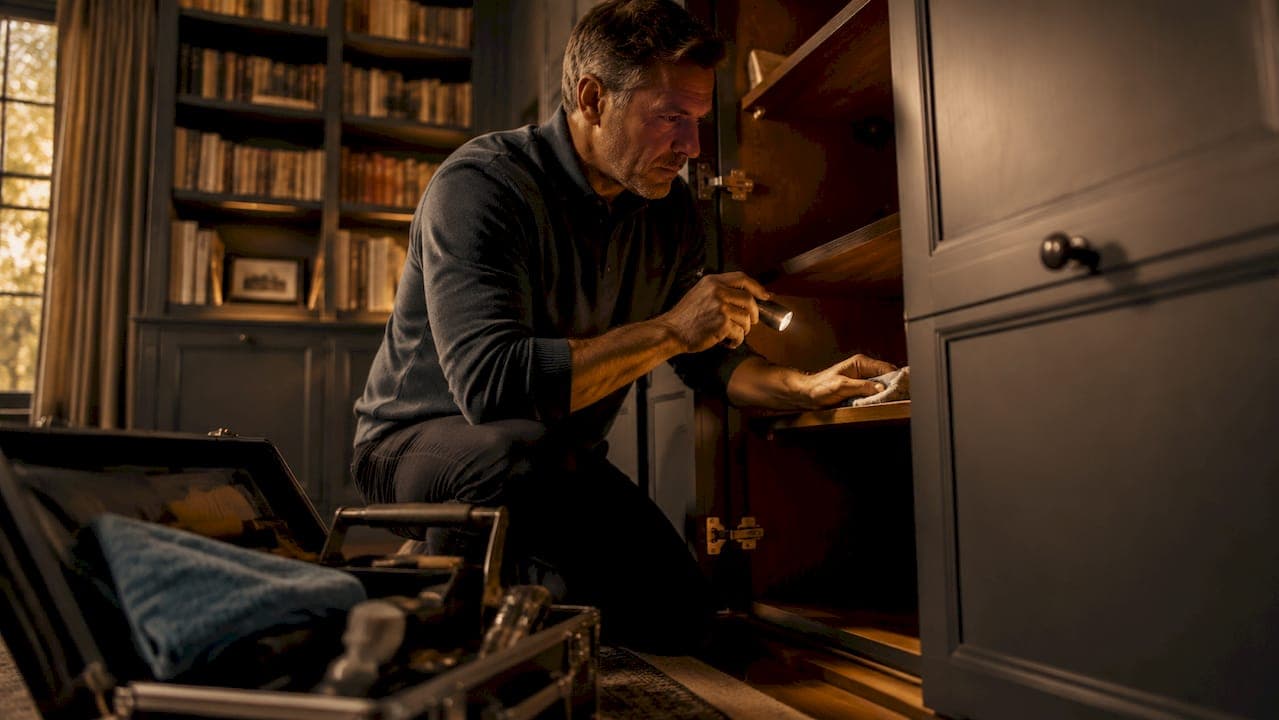
Fitted wardrobes, known in the trade as built-in or bespoke joinery, are a long-term investment that can last 15 to 20 years or considerably longer when maintained correctly. The difference between a wardrobe that looks tired after a decade and one that still feels purposeful after two comes down to a handful of consistent habits: regular cleaning, hardware checks, humidity control, and sensible loading. This guide covers every practical step you need to maintain fitted wardrobes for longevity, from the tools you should keep to hand to the mistakes that quietly shorten a wardrobe's life. Whether your fitted wardrobe is a floor-to-ceiling sliding design or a bespoke walk-in configuration, the principles are the same.
What tools and materials do you need for wardrobe maintenance?
Good wardrobe upkeep does not require a professional toolkit, but having the right materials to hand makes the difference between a five-minute job and a frustrating one. Gathering these before you start any maintenance routine saves time and protects your finishes from accidental damage.
Here is what you should keep in your maintenance kit:
- Vacuum cleaner with a soft brush attachment for clearing dust and debris from sliding tracks and internal corners without scratching surfaces
- Microfibre cloths for wiping down shelves, hanging rods, and door panels without leaving lint or micro-scratches on melamine or veneered finishes
- Silicone-based lubricant spray (such as WD-40 Specialist Silicone or a comparable product) for sliding door tracks and hinge pivot points. Avoid oil-based lubricants, which attract dust and cause build-up over time
- A set of small screwdrivers, both Phillips and flat-head, for tightening handles, hinges, and soft-close mechanisms
- Mild, pH-neutral cleaner formulated for melamine or polyurethane surfaces. Products designed for kitchen cabinetry, such as those from the Astonish or Method ranges, work well on most wardrobe finishes
- Wooden toothpicks and PVA wood glue for repairing stripped screw holes in particleboard panels, a technique covered in more detail later in this guide
Pro Tip: Label a small bag or box with all your wardrobe maintenance supplies and store it inside the wardrobe itself. You are far more likely to carry out quick monthly checks if the tools are already there.
How to maintain fitted wardrobes for longevity through cleaning and inspection
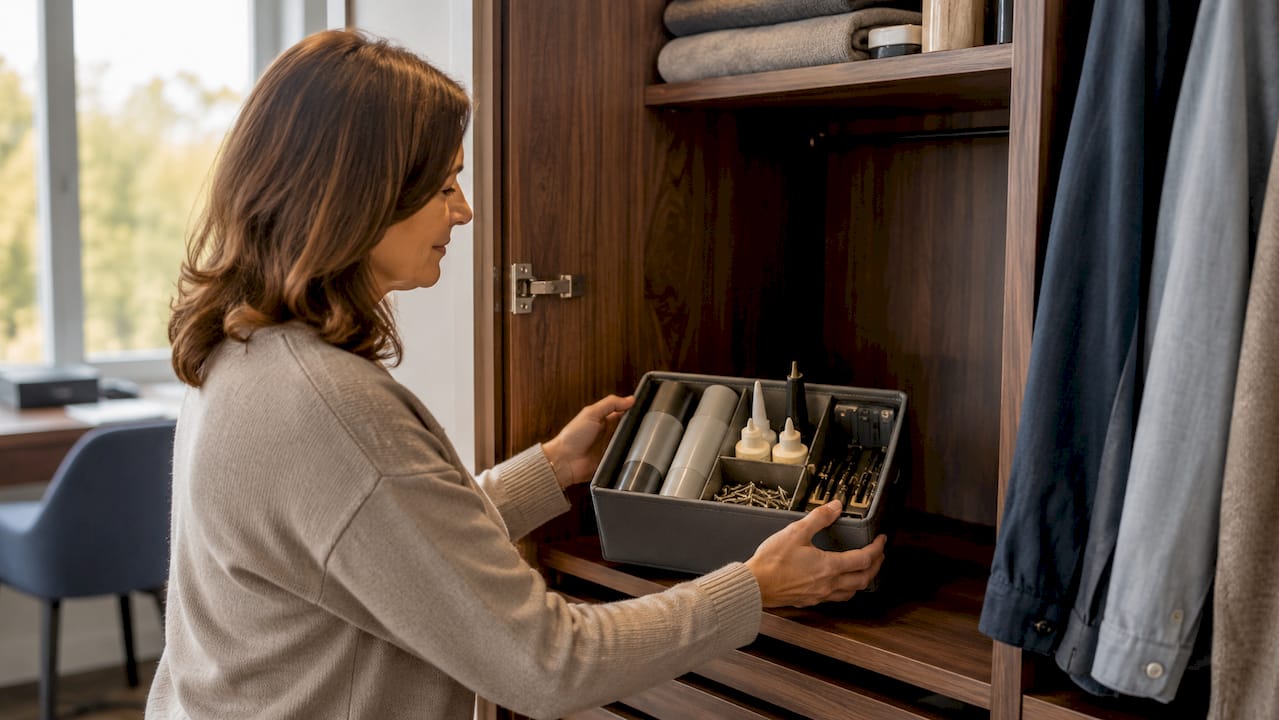
Cleaning is the foundation of any wardrobe upkeep guide, and the sequence matters as much as the frequency. Working from top to bottom and inside to outside prevents you from re-depositing dust onto surfaces you have already cleaned.
Follow this step-by-step routine for thorough, finish-safe results:
-
Vacuum tracks every two to four weeks. Dust accumulation in sliding tracks causes doors to stick, judder, and eventually derail. Use the soft brush attachment to clear both the upper and lower channels before wiping with a dry microfibre cloth.
-
Wipe internal shelves and hanging rods monthly. Dust settles on horizontal surfaces and, over time, can transfer onto clothing and attract moisture. A dry microfibre cloth is sufficient for routine dusting; use a lightly dampened cloth for any marks or residue.
-
Clean door panels with a suitable product. Apply your mild cleaner to the cloth first, not directly to the surface, and wipe in the direction of any grain or texture. This prevents streaking and avoids saturating any joins or edges.
-
Avoid bleach, ammonia, and abrasive pads entirely. Household cleaners containing bleach or ammonia permanently damage the protective layer on melamine and polyurethane finishes, dulling the surface and, in many cases, voiding the manufacturer's warranty.
-
Inspect hinges, handles, and runners during every clean. Run your hand along each door as you open and close it. Any wobble in a handle, resistance in a hinge, or grinding in a runner is a signal to act before the problem worsens.
-
Check edges and panel joins for swelling or delamination. Moisture is the primary cause of edge damage in fitted wardrobes. If you notice any lifting at the edges of shelves or door panels, seal the affected area promptly with an appropriate edge repair adhesive.
Pro Tip: Take a photograph of your wardrobe interior every six months. Comparing images over time makes it far easier to spot gradual changes like shelf sag or finish discolouration that are easy to miss day to day.
How do you maintain and adjust wardrobe hardware correctly?
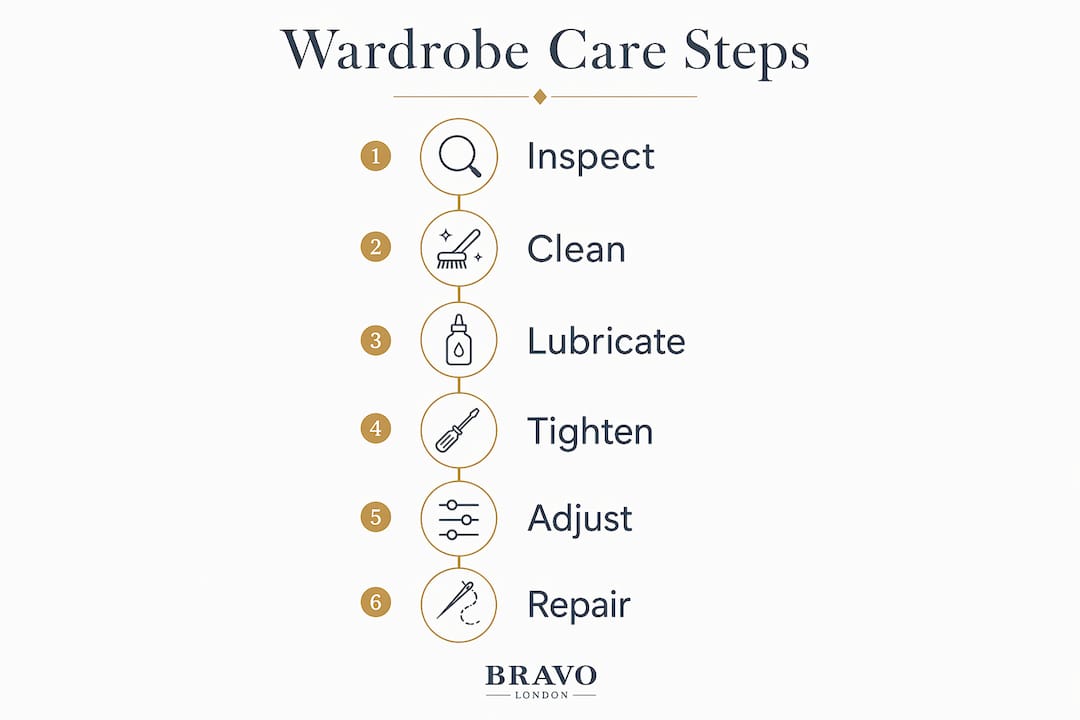
Hardware is the mechanical heart of any fitted wardrobe. Hinges, handles, soft-close mechanisms, and sliding door rollers all experience wear, and small adjustments made annually prevent the kind of cumulative damage that requires professional repair.
Annual tightening and inspection
Tightening door handles annually takes no more than five minutes per door and prevents the wobbling that gradually strips the fixing holes in particleboard. Work through every handle, hinge plate, and shelf bracket with a screwdriver, applying firm but controlled pressure. Over-tightening is as damaging as under-tightening, particularly in particleboard, where screws can strip the surrounding material if forced.
Lubricating sliding tracks
Lubricate sliding door tracks every six months using a silicone-based spray. Apply a thin, even coat along the full length of both the upper and lower channels, then run the door back and forth several times to distribute the lubricant. If you have a sliding door wardrobe, also check the rollers at the base of each door panel. Worn or cracked rollers are the most common cause of doors that jump off their tracks, and replacement rollers are inexpensive if caught early.
Adjusting soft-close hinges
Soft-close hinge dampers can be recalibrated using the small adjustment dials built into the hinge body. Most European-style concealed hinges, including those from Blum and Grass, have two or three dials that control closing speed, lateral alignment, and depth. A quarter-turn adjustment is usually sufficient to restore a door that has started closing too slowly or slamming shut. This annual calibration significantly extends hinge life.
Repairing stripped screw holes
When a screw no longer grips in particleboard, the standard professional fix is to fill with wood glue and wooden toothpicks, allow the repair to cure fully, then re-drill and re-screw. This restores structural strength without visible patching and avoids the need to replace the panel entirely.
Pro Tip: Keep a small supply of replacement rollers and hinge screws that match your wardrobe's hardware. Sourcing them at the point of need can take weeks; having them ready means a five-minute fix rather than a fortnight of a sticking door.
Why do humidity management and loading practices matter so much?
Proper ventilation and humidity control are the most underestimated factors in extending wardrobe life. Most homeowners focus on cleaning and hardware, but moisture and overloading cause structural damage that no amount of polishing can reverse.
"Reasonable loading is the most overlooked factor affecting wardrobe longevity. Misuse causes damage beyond what routine maintenance can repair." — Maxi Home
Here is how to protect your wardrobe from the inside out:
- Leave doors slightly ajar when the wardrobe is not in use. This promotes air circulation, reduces condensation on internal surfaces, and significantly lowers the risk of mould forming on clothing or panel edges.
- Use a small dehumidifier in deeply packed sections or in wardrobes built against external walls. External walls in UK homes are prone to cold bridging, which creates the conditions for condensation inside enclosed furniture.
- Distribute weight evenly across shelves. Overloading shelves beyond their design weight causes bowing and permanent structural damage. Fitted wardrobes designed for clothing fail quickly when used to store heavy archives, tools, or stacked boxes in overhead sections.
- Avoid placing heavy items on the top shelf. The top shelf bears the most leverage stress. Keep it for lightweight items like bags, hats, or folded knitwear.
- Seal any edge damage immediately. Once the protective edge banding lifts, moisture penetrates the particleboard core rapidly. A small tube of edge repair adhesive costs very little and prevents a minor cosmetic issue from becoming a structural one.
Proper humidity management and light regular maintenance can add a decade or more to a wardrobe's lifespan beyond initial expectations. That is a significant return on a small investment of time.
What are the most common wardrobe maintenance mistakes to avoid?
Even homeowners who clean regularly make errors that quietly shorten their wardrobe's life. Knowing what not to do is as useful as knowing the correct routine.
- Using the wrong cleaning products. Bleach, ammonia, and multi-surface sprays not formulated for cabinetry finishes strip the protective coating from melamine and polyurethane surfaces. Once the finish is compromised, the panel absorbs moisture and stains far more readily.
- Forcing sticking doors. A door that resists opening or closing is signalling a problem with the track, roller, or hinge alignment. Forcing it transfers stress to the fixing points and accelerates wear. Clean the track and check the rollers before applying any force.
- Ignoring small wobbles in handles or hinges. A handle that moves slightly when you grip it has already begun stripping its fixing hole. Left unaddressed for a few months, what was a two-minute tightening job becomes a repair requiring the toothpick-and-glue method described above.
- Overloading hanging rails. Hanging rails have a finite load capacity. Packing them beyond that capacity bends the rail brackets and, over time, pulls the fixing points out of the side panels.
Pro Tip: Check your wardrobe's warranty documentation for any specific cleaning or usage restrictions. Many manufacturers, including those supplying bespoke joinery, specify approved cleaning products. Using an unapproved product can void coverage even on a relatively new installation.
When a problem goes beyond a DIY fix, such as a panel that has swollen significantly or a door that will not align despite adjustment, call a professional joiner rather than attempting a patch repair. Good bespoke joinery is worth protecting with the right level of care.
Key takeaways
Consistent, light-touch maintenance is the single most effective strategy for keeping fitted wardrobes functional and attractive for 20 years or more.
| Point | Details |
|---|---|
| Clean tracks regularly | Vacuum sliding tracks every two to four weeks to prevent sticking and derailment. |
| Use finish-safe products | Avoid bleach and ammonia; use only cleaners formulated for melamine or polyurethane surfaces. |
| Tighten and lubricate annually | Tighten all handles and hinges yearly; lubricate sliding tracks with silicone spray every six months. |
| Control humidity and loading | Leave doors ajar for airflow, use a dehumidifier if needed, and never overload shelves beyond design weight. |
| Act on small problems quickly | Seal edge damage, repair stripped screw holes, and replace worn rollers before minor issues become structural ones. |
What we have learned from over 1,000 wardrobe projects
After completing more than 1,000 bespoke fitted wardrobe installations across London, the pattern we see most often is not dramatic failure. It is gradual neglect. A handle that wobbles for six months. A track that has not been cleaned in two years. A shelf loaded with shoeboxes that was only ever designed for folded clothing. None of these things feel urgent in the moment, and that is precisely why they cause so much damage over time.
The homeowners whose wardrobes still look and function beautifully after 15 years are not doing anything complicated. They are doing a small number of simple things consistently. They wipe down surfaces monthly. They tighten screws once a year. They do not pack their wardrobes beyond capacity. That is genuinely all it takes when the underlying joinery is built to a proper standard.
One thing we would push back on is the idea that maintenance is primarily about cleaning. In our experience, loading and humidity cause far more structural damage than dust ever does. A wardrobe in a well-ventilated room that is loaded sensibly will outlast a spotlessly clean one that is packed to the ceiling with heavy items.
If you are choosing materials for a new wardrobe, prioritise finishes with a durable protective layer, such as high-pressure laminate or a quality polyurethane paint finish, over raw or lightly sealed wood. The maintenance burden is significantly lower, and the finish holds its appearance far longer. Bespoke joinery, built with quality materials and proper fixings from the outset, simply gives you more to work with when it comes to long-term care.
— Bravo London
Built to last: bespoke fitted wardrobes from Bravo London
A wardrobe that is built well is far easier to maintain. Bravo London's bespoke fitted wardrobes are designed and crafted to the precise dimensions of your space, using premium materials and hardware chosen for durability as much as aesthetics. Every installation comes with a 10-year warranty and practical aftercare guidance so you know exactly how to care for your wardrobe from day one. With over 1,000 completed projects across London, Bravo London brings the same meticulous approach to a compact bedroom alcove as to a full walk-in wardrobe design. If you are ready to invest in storage that genuinely lasts, get in touch for a free consultation and tailored design proposal.
FAQ
How long do fitted wardrobes last with proper care?
A well-built fitted wardrobe lasts 15 to 20 years with consistent maintenance; high-specification bespoke joinery can exceed this significantly. Mass-market units without regular care typically show wear within five to seven years.
How often should I clean fitted wardrobe tracks?
Vacuum or wipe sliding tracks every two to four weeks to prevent dust build-up that causes doors to stick or derail. Regular track cleaning is one of the simplest and most effective fitted wardrobe maintenance tips you can follow.
What cleaning products are safe for fitted wardrobe finishes?
Use only mild, pH-neutral cleaners formulated for melamine or polyurethane cabinetry surfaces. Bleach and ammonia-based products permanently damage protective finishes and may void your warranty.
How do I stop my fitted wardrobe doors from sticking?
Clean the tracks thoroughly, then apply a silicone-based lubricant spray along the full length of both channels. If the door continues to stick after lubrication, inspect the rollers for wear and replace them if cracked or flattened.
Can I repair a stripped screw hole in a fitted wardrobe myself?
Yes. Fill the hole with PVA wood glue and several wooden toothpicks, allow it to cure fully, then re-drill and re-screw. This toothpick repair method restores structural strength without patching or panel replacement.