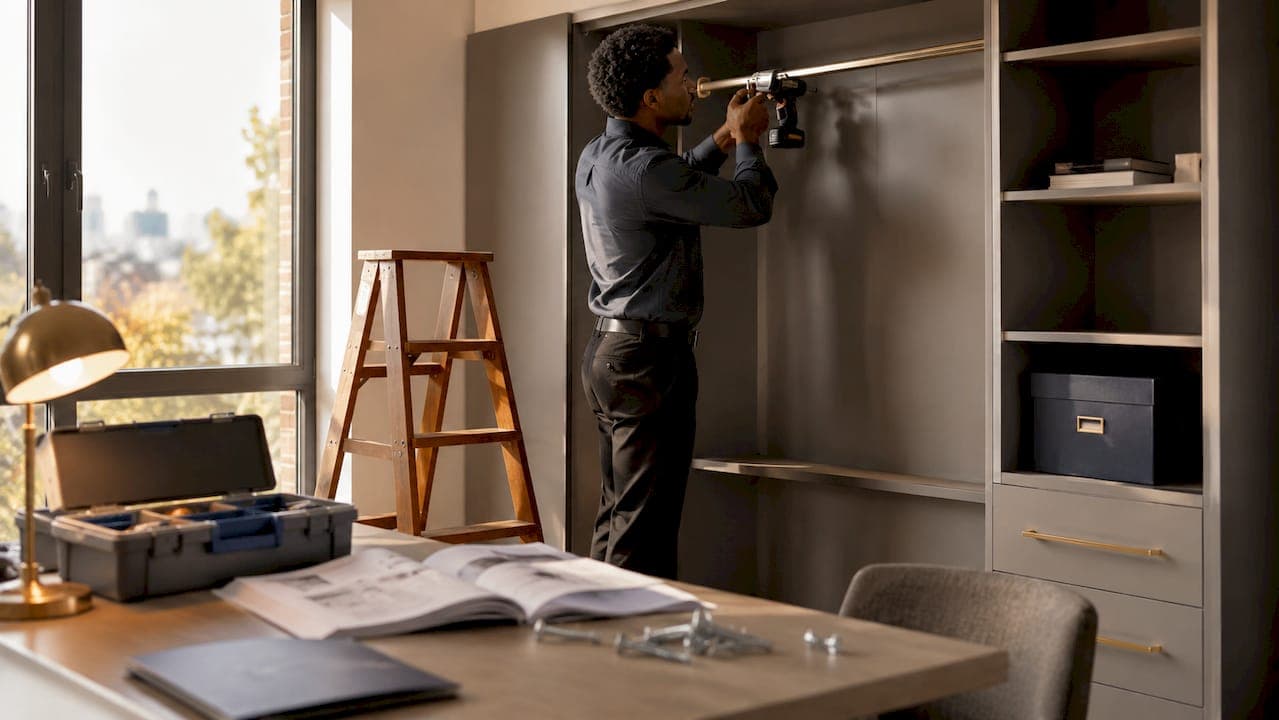
Internal wardrobe fittings are the components that transform a bare wardrobe shell into a functional, durable storage system tailored to how you actually live. The role of internal wardrobe fittings explained simply: rails, shelves, drawers, and hardware work together to determine how much you can store, how easily you can access it, and how long the whole unit lasts. Most homeowners focus on door styles and finishes, yet the internal configuration decides whether a wardrobe genuinely works. Get the fittings right, and every item has a place. Get them wrong, and even the most beautiful exterior hides wasted space.
What are the common types of internal wardrobe fittings?
Internal wardrobe fittings fall into four main categories: hanging rails, shelving, drawers, and accessories. Each serves a distinct purpose, and the best wardrobe designs combine all four in a layout matched to your clothing and lifestyle.
Hanging rails divide into two types. A full-height rail runs the full height of the wardrobe and suits long garments such as dresses, coats, and suits. A double-hang zone splits the same vertical space into two shorter rails, one positioned at roughly 90 cm and one at 45 cm, which works well for shirts, jackets, and folded trousers. Double-hang rails can increase hanging capacity by 40–50% within the same vertical footprint. That gain alone justifies the configuration for most homeowners with large mixed wardrobes.
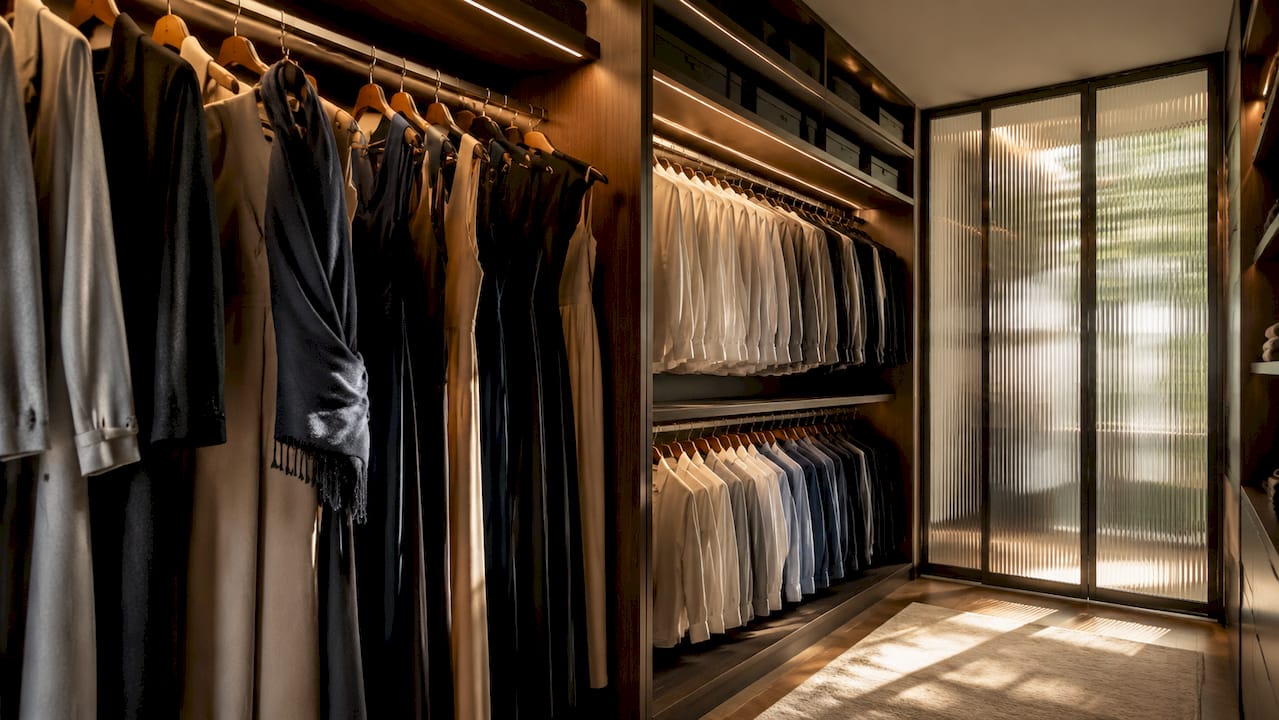
Shelving is the most versatile fitting. Fixed shelves suit stable storage such as folded jumpers and shoe boxes. Adjustable shelves let you reconfigure the wardrobe as your needs change. Shelf spacing of 30–40 cm suits folded clothing and shoe boxes, while structured bags need 45–50 cm of clearance to sit without crushing. That detail is frequently overlooked in standard wardrobe planning.
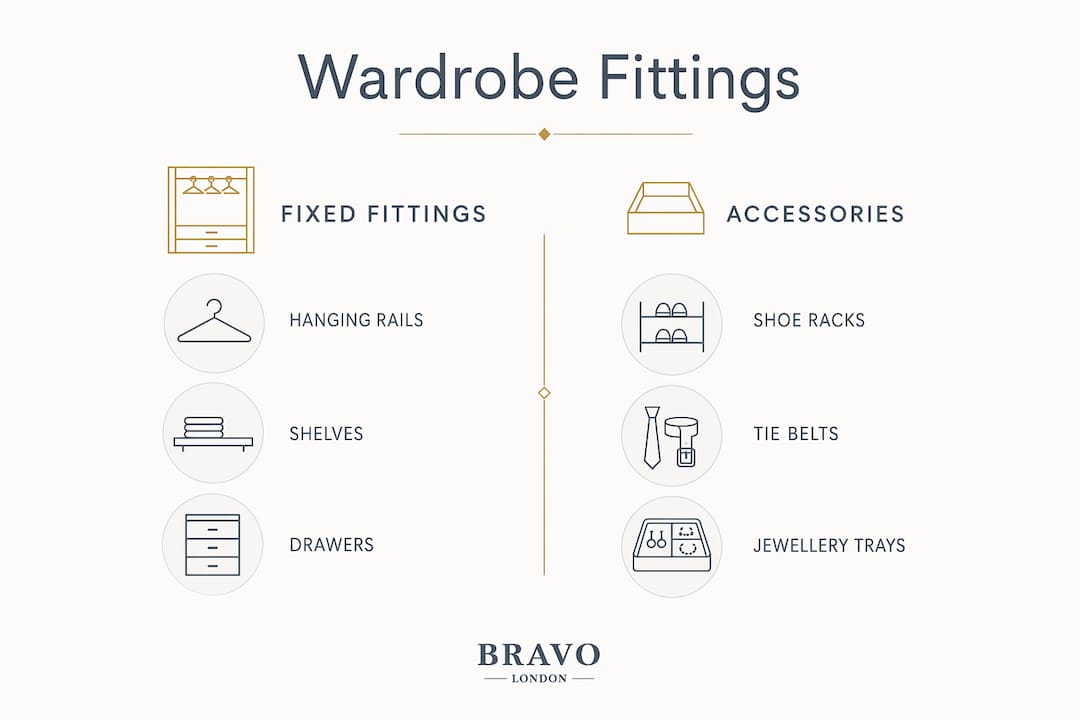
Drawers consolidate smaller items. Drawer modules typically span 45–60 cm in width and hold 3–5 drawers, making them ideal for underwear, socks, and folded knitwear. Positioning drawers at mid-height keeps them ergonomically accessible without bending to the floor.
Accessories include pull-out shoe racks, tie and belt carousels, jewellery trays, and valet rods. These are not extras. They convert dead corners and narrow bays into genuinely usable storage.
Pro Tip: Map your clothing by category before planning your fittings. Count how many items hang full-length, how many hang short, and how many fold. That ratio directly determines how much rail, shelf, and drawer space you need.
Does material quality affect how wardrobe fittings perform?
Material quality determines both how a wardrobe feels to use and how long it lasts. The difference between a wardrobe that still feels solid after ten years and one that sags within three comes down almost entirely to the substrate and hardware chosen at the outset.
High-density MDF is the preferred material for carcass construction because it resists bowing under heavy loads. Standard particleboard absorbs moisture and loses structural integrity over time, particularly in bedrooms where humidity fluctuates. A shelf loaded with heavy folded jumpers will deflect noticeably on a low-density board within a few years.
Hardware quality matters just as much as the substrate. Soft-close under-mounted drawer runners deliver silent, frictionless operation and prevent the impact damage that loosens carcass joints over time. Soft-close mechanisms are not a luxury finish. They are a durability necessity that protects the wardrobe structure with every use.
The common pitfalls of low-quality hardware include:
- Side-mounted runners that wobble under load and wear unevenly
- Hinges without dampers that slam doors and stress the carcass
- Thin shelf pins that allow shelves to tip forward when loaded
- Cheap rail brackets that flex under the weight of heavy coats
Pro Tip: Ask your fitter to specify the brand and load rating of drawer runners before installation. Quality runners from manufacturers such as Blum or Hettich carry published weight ratings and multi-year guarantees. That specification tells you far more than a finish sample.
How do 2026 design standards shape wardrobe space planning?
Current ergonomic standards give precise dimensions that make a wardrobe genuinely comfortable to use every day. These are not arbitrary figures. They come from years of practical installation data and human factors research.
Full-height hanging zones should measure 170–180 cm to accommodate long garments without the hem dragging on the base. Anything shorter forces you to fold or bunch items that should hang freely.
| Zone | Recommended dimension | Purpose |
|---|---|---|
| Full-height hang | 170–180 cm | Long dresses, coats, suits |
| Upper double-hang rail | 90 cm from base | Jackets, shirts, folded trousers |
| Lower double-hang rail | 45 cm from base | Short items, children's clothing |
| Shelf spacing (folded) | 30–40 cm | Jumpers, jeans, shoe boxes |
| Shelf spacing (bags) | 45–50 cm | Structured handbags, clutches |
| Drawer module width | 45–60 cm | Underwear, socks, knitwear |
Pull-out trays and modular layouts add another layer of efficiency. A pull-out shoe rack, for example, uses the full depth of the wardrobe rather than just the front 20 cm that a fixed shelf provides. Corner carousels recover space that a standard layout simply abandons. These fittings translate directly into daily convenience. You stop moving items to reach others, and everything stays visible.
Pro Tip: Plan your wardrobe depth at a minimum of 58 cm internally. Anything shallower forces coat hangers to sit at an angle, which wastes rail space and damages garment shoulders over time.
Bespoke versus modular wardrobe fittings: which is better?
Bespoke and modular fittings each suit different situations. The right choice depends on your room geometry, budget, and how long you plan to stay in the property.
A well-designed modular wardrobe can deliver 30–40% more usable storage than a traditional wardrobe of similar external size, provided the internal layout uses double-hang zones and corner accessories effectively. Modular systems are also reconfigurable, which suits renters or homeowners who move frequently.
Bespoke fittings, however, solve problems that modular systems cannot. Scribing and custom trimming allow panels to follow irregular walls and ceilings precisely, eliminating the filler strips that signal poor planning in a modular installation. A bespoke wardrobe in a room with a sloped ceiling, a chimney breast, or an alcove uses every centimetre. A modular system leaves gaps.
| Factor | Bespoke fittings | Modular fittings |
|---|---|---|
| Fit to room geometry | Exact, no filler strips | Approximate, may need fillers |
| Material quality | Specified to brief | Fixed by manufacturer |
| Reconfigurability | Limited after installation | High |
| Cost | Higher upfront | Lower upfront |
| Longevity | Typically longer | Varies by brand |
| Aesthetic integration | Fully tailored | Standardised finishes |
For homeowners with awkward spaces, a bespoke corner fitted wardrobe recovers storage that a modular unit simply cannot reach. The upfront investment pays back in usable space and a finish that feels built for the room rather than placed in it.
How to choose the right internal fittings for your wardrobe
Choosing fittings starts with an honest audit of what you own and how you use your wardrobe. Generic layouts rarely match real wardrobes because real wardrobes hold a mix of long garments, folded items, shoes, bags, and accessories in proportions unique to each person.
Follow these steps to make the right choices:
- Count your hanging items by length. Separate full-length garments from short ones. This ratio tells you how much full-height rail versus double-hang space you need.
- Assess your folded clothing volume. Bulky knitwear needs deeper, more widely spaced shelves than folded T-shirts. Plan shelf spacing accordingly.
- Decide on drawer count early. Drawers are the most used fittings in most wardrobes. Under-specifying them forces folded items onto shelves where they become untidy quickly.
- Account for accessories and special items. Structured bags need taller shelf clearance. Shoes need either a dedicated rack or shelves spaced for shoe boxes. Jewellery needs a shallow tray, not a deep drawer.
- Plan for future change. Adjustable shelf pins cost almost nothing extra at the design stage. They let you reconfigure the wardrobe as your storage needs shift over the years.
- Check ergonomics. Place the fittings you use daily at between 90 cm and 160 cm from the floor. Reserve high shelves for seasonal items and low drawers for items you access less frequently.
For a deeper look at how layout choices affect the whole wardrobe, the internal wardrobe layout guide from Bravo London covers the planning process in detail.
Key takeaways
Internal wardrobe fittings determine storage capacity, daily usability, and long-term durability far more than any external finish or door style.
| Point | Details |
|---|---|
| Fittings define function | Rails, shelves, drawers, and accessories together determine how much a wardrobe holds and how easily you access it. |
| Double-hang zones save space | Splitting vertical space with rails at 90 cm and 45 cm increases hanging capacity by 40–50% without widening the wardrobe. |
| Material quality drives longevity | High-density MDF carcasses and soft-close under-mounted runners prevent bowing and impact damage over years of daily use. |
| Bespoke beats modular in awkward rooms | Scribing and custom trimming eliminate filler strips and recover space that modular systems cannot reach in irregular rooms. |
| Audit your wardrobe before specifying | Counting hanging items, folded clothing, and accessories before design prevents under-specifying drawers and over-specifying rails. |
What I have learned from designing wardrobes that actually work
After working on over 1,000 fitted wardrobe projects, the pattern is consistent. Homeowners who invest in quality internal fittings from the start never regret it. Those who cut costs on hardware almost always come back asking whether the runners can be replaced or the shelves reinforced.
The most common error I see is treating the internal layout as an afterthought. A client will spend weeks choosing door finishes and handle styles, then accept a default internal configuration that does not match how they dress. The result is a wardrobe that looks beautiful and works poorly. The fittings are where the wardrobe either earns its place in your home or fails quietly every morning.
The trend I find genuinely useful in 2026 is the move toward modular internal frameworks within bespoke carcasses. You get the precision fit of a bespoke shell with the flexibility to adjust shelves and drawer positions as your life changes. That combination suits most homeowners far better than either a fully fixed bespoke interior or a purely modular system.
One thing I would push back on is the idea that soft-close hardware is a premium add-on for high-budget projects only. The cost difference between standard runners and quality soft-close runners is modest. The difference in how the wardrobe feels and how long the carcass lasts is significant. Specify soft-close from the start on every project, regardless of budget.
— Bravo
Explore bespoke wardrobe solutions with Bravo London
Bravo London designs and installs bespoke fitted wardrobes with internal configurations built around your specific storage needs, room geometry, and lifestyle. Every project uses high-density MDF carcasses, soft-close hardware, and layouts planned to the dimensional standards covered in this article.
With over 1,000 completed projects and a 10-year warranty on all work, Bravo London brings the same level of detail to a single bedroom wardrobe as to a full walk-in dressing room. If you have an awkward alcove, a sloped ceiling, or simply a wardrobe that has never quite worked, a bespoke wardrobe consultation is the clearest way to understand what is possible in your space.
FAQ
What are internal wardrobe fittings?
Internal wardrobe fittings are the components inside a wardrobe carcass that create usable storage. They include hanging rails, fixed and adjustable shelves, drawer units, and accessories such as pull-out shoe racks and jewellery trays.
How high should a wardrobe hanging rail be?
A full-height hanging rail should sit at 170–180 cm from the wardrobe base to accommodate long garments comfortably. Double-hang configurations use rails at approximately 90 cm and 45 cm to maximise shorter items.
Are soft-close drawers worth the extra cost?
Soft-close under-mounted drawer runners prevent impact damage to the carcass and extend the wardrobe's lifespan. The cost difference over standard runners is modest, making them a practical choice for any budget.
What is the difference between bespoke and modular wardrobe fittings?
Bespoke fittings are cut and configured to fit your exact room dimensions, eliminating gaps and filler strips. Modular fittings use standard-sized components that offer flexibility but cannot adapt to irregular walls or ceilings.
How do I know how many drawers my wardrobe needs?
Count the folded items you currently store in drawers or on shelves. A standard drawer module of 45–60 cm width with 3–5 drawers suits most single wardrobes. Under-specifying drawers is the most common planning mistake in wardrobe design.