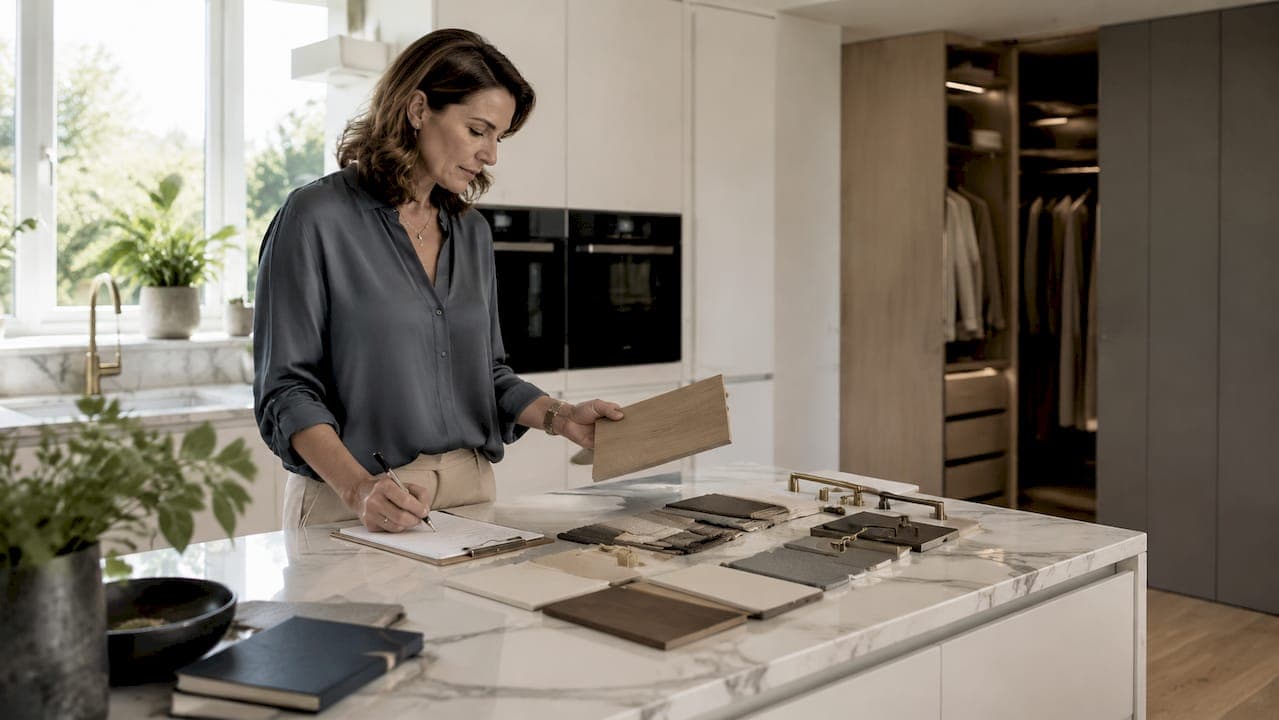
A premium fitted wardrobe is a bespoke storage solution that combines high-quality materials, intelligent design, and tailored features to enhance your home's functionality and style. Unlike off-the-shelf alternatives, these wardrobes are built to your exact dimensions, lifestyle, and aesthetic preferences. Costs range from a few thousand pounds for mid-range builds to up to £10,000 for high-end bespoke configurations. Whether you are buying fitted wardrobes for the first time or upgrading an existing bedroom, this guide covers every decision point you need to get it right.
1. What makes a wardrobe truly premium: features and materials
The industry term for what most people call a "premium fitted wardrobe" is a bespoke fitted wardrobe, and the distinction matters. Bespoke means every element, from the carcass depth to the internal layout, is designed around your specific needs rather than adapted from a standard template.
Materials define quality more than any other single factor. At the budget end, veneered MDF delivers a clean finish at a lower cost. Mid-range builds use lacquered boards with real wood veneer doors. At the premium level, you find high-grade lacquer, solid timber panels, brushed metal accents, and glass inserts. Each step up the material ladder changes not just the look but the weight, durability, and tactile experience of the wardrobe.
Beyond materials, the defining features of a luxury wardrobe include:
- Soft-close mechanisms on every door and drawer, producing a whisper-quiet close that signals quality with every use
- Motion-sensor LED lighting that activates when doors open, with adjustable colour temperature for accurate colour matching of clothing
- Valet rods that pull out horizontally to hold the next day's outfit
- Velvet-lined jewellery inserts and dedicated watch drawers that protect accessories and keep them visible
- Pull-out shoe racks and angled shelving that display footwear rather than stacking it
Soft-close and handleless systems have become standard expectations in luxury wardrobes, not optional extras. If a supplier treats them as upgrades, that tells you something about their baseline quality.
Pro Tip: Ask your supplier to demonstrate the soft-close mechanism on a physical sample before committing. A genuinely premium hinge closes smoothly from any angle, not just when pushed gently from the centre.
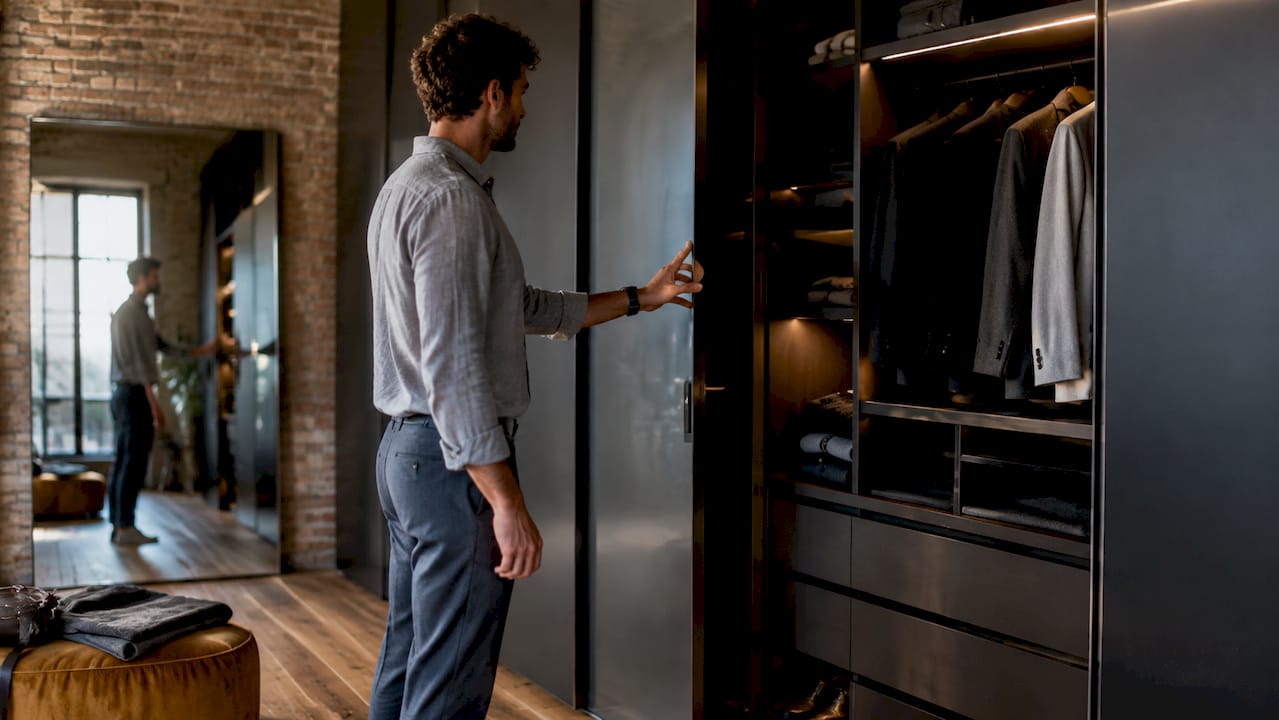
2. Door styles compared: sliding, hinged, and pivot
Door choice shapes how your wardrobe feels to use every single day, and it affects the room layout more than most buyers anticipate.
| Door style | Best for | Space requirement | Access | Aesthetic |
|---|---|---|---|---|
| Sliding | Smaller bedrooms | Minimal floor clearance needed | Partial (one side at a time) | Contemporary, clean lines |
| Hinged | Larger rooms | Requires clearance in front | Full opening, unrestricted | Classic, traditional or modern |
| Pivot | Statement bedrooms | Moderate clearance needed | Wide, dramatic opening | Architectural, high-end |
Sliding doors save space but limit access because you can only open one panel at a time. Hinged doors offer full, unrestricted access to the entire interior but require enough floor space in front to swing open fully. Pivot doors sit between the two: they open with a satisfying, architectural sweep and work well in rooms with moderate clearance. This is a practical decision, not just a stylistic one.
Hardware choices matter just as much as the door type itself. Handleless systems use a recessed groove or push-to-open mechanism, producing a flat, uninterrupted facade that suits contemporary interiors. Recessed grip handles offer a subtle tactile element without protruding into the room. Bar handles in brushed brass or matte black add a deliberate design statement. For made-to-measure wardrobe doors, the hardware finish should coordinate with other metalwork in the room, such as light fittings and door furniture, to create a cohesive result.
Durability is worth considering here too. Soft-close hinges on a hinged door will outlast standard hinges by years under daily use. Sliding door track systems vary considerably in quality; aluminium floor tracks with nylon rollers are quieter and more durable than steel-on-steel systems.
3. Storage layout and customisation: tailoring to your lifestyle
The internal configuration of your wardrobe is where bespoke design delivers its clearest advantage. A standard wardrobe assumes a generic mix of hanging space and shelving. A bespoke interior starts with an inventory of what you actually own.
Before your design consultation, count your long-hanging garments (coats, dresses, suits), short-hanging items (shirts, jackets, folded trousers), folded knitwear, shoes, and accessories. This inventory directly determines the proportion of each compartment type. Most people underestimate how much short-hanging space they need and overestimate their requirement for long-hanging rails.
A well-planned interior typically includes:
- Double hanging rails for shirts, jackets, and folded trousers, which use vertical space far more efficiently than a single rail
- Deep drawers with internal dividers for folded knitwear and casual wear
- Shallow drawers lined in velvet for jewellery, cufflinks, and small accessories
- Angled shoe shelving or pull-out shoe racks that keep footwear visible and accessible
- Open shelving at eye level for bags, hats, and frequently used items
- A pull-out valet rod for preparing outfits in advance
Integrated dressing tables and vanity mirrors are a particularly effective addition when bedroom space is limited. A fold-down or recessed dressing table built into the wardrobe end panel combines grooming and storage in a single footprint, which is especially useful in smaller rooms.
Pro Tip: If you have a corner bedroom, do not dismiss that space as awkward. Corner fitted wardrobes are specifically designed to reclaim those angles and can add significant hanging and shelving capacity without encroaching on the main floor area.
Smart features are increasingly integrated into bespoke interiors. App-controlled lighting and biometric locks blend technology with elegance for the modern luxury wardrobe, allowing you to adjust illumination from your phone or secure valuables without a key.
4. Budgeting and installation: understanding the real costs
Fitted wardrobe costs in the UK range from £400 to £800 per linear metre for mid-range builds, rising above £1,000 per metre for fully bespoke, premium designs. Those figures cover manufacture and supply but not always installation, which is a separate and significant line item.
| Configuration | Typical cost range | Notes |
|---|---|---|
| Mid-range modular (3-door) | £1,200 to £2,500 | Limited customisation, standard finishes |
| Bespoke fitted (3-door) | £3,000 to £6,000 | Full layout control, premium materials |
| High-end bespoke (4-door) | £6,000 to £10,000 | Luxury finishes, smart features, complex interiors |
| Professional installation (3-door) | Around £1,000 | Rises to £1,500 for a 4-door unit |
Professional installation for a 3-door premium fitted wardrobe typically costs around £1,000, rising to £1,500 for a 4-door unit. These figures assume a straightforward rectangular room. Awkward room shapes, sloped ceilings, chimney breasts, or alcoves increase labour time and cost considerably, so always get a site survey before accepting a quote.
Practical tips for managing your budget without compromising quality:
- Prioritise the carcass and mechanism quality over decorative finishes. A solid carcass with premium hinges will outlast a beautiful but poorly constructed unit.
- Choose one or two statement upgrades, such as LED lighting or velvet-lined drawers, rather than specifying every premium feature at once.
- Factor in the full timeline: bespoke wardrobes typically take four to eight weeks from design sign-off to installation. Plan around this if you are decorating or moving.
- Ask about the warranty. A 10-year warranty, as offered by Bravo London, is a reliable indicator of confidence in build quality.
For guidance on maximising storage in compact bedrooms, smart layout choices at the design stage can offset the need for expensive add-ons later.
5. Design trends and sensory features defining luxury wardrobes in 2026
Premium fitted wardrobes have evolved into personalised spaces that enhance daily routines rather than simply storing clothes. The most notable shift in recent years is the move from purely functional interiors to sensory, considered environments where every detail is deliberate.
The features that define luxury wardrobes right now include:
- Layered LED lighting with warm and cool temperature settings, allowing you to check colour accuracy under daylight-equivalent light before leaving the house
- Glass-fronted display sections for bags, shoes, or folded knitwear, which bring a boutique retail quality to the bedroom
- Mirrored interior panels that make the wardrobe feel larger and double as a full-length dressing mirror
- Tactile material contrasts, such as a matte lacquer exterior paired with a warm oak interior, creating a sense of depth and craftsmanship
- Handleless facades with push-to-open or touch-latch mechanisms that produce a clean, unbroken surface across the full width of the wardrobe
- Biometric or digital locking on specific drawers for securing valuables, integrated invisibly into the design
The motion-sensor LED lighting standard in premium wardrobes is not just a convenience feature. It eliminates the need to fumble for a light switch and ensures the interior is always well-lit the moment you open the door. Combined with adjustable colour temperature, it makes the wardrobe genuinely useful at any time of day.
Key takeaways
A premium fitted wardrobe delivers lasting value only when material quality, internal configuration, and installation are all specified to match your actual lifestyle and room constraints.
| Point | Details |
|---|---|
| Material quality drives cost and longevity | Choose high-grade lacquer, solid timber, or veneered finishes over basic MDF for durability and tactile quality. |
| Internal layout should reflect your wardrobe inventory | Count your garments before design to allocate hanging, shelving, and drawer space accurately. |
| Door style affects daily usability | Sliding doors suit smaller rooms; hinged doors offer full access; pivot doors add architectural presence. |
| Installation costs are a significant budget line | Budget around £1,000 to £1,500 for professional fitting, more for complex room shapes. |
| Smart features add daily value | Motion-sensor lighting, soft-close mechanisms, and biometric locks justify their cost through consistent daily use. |
What we have learned from over 1,000 bespoke wardrobe projects
After completing more than 1,000 bespoke wardrobe projects, the single most consistent finding is this: the clients who are happiest with their wardrobes are those who spent time on the brief, not just the budget.
Most people come to us knowing what they want it to look like. Far fewer have thought carefully about how they actually use their wardrobe each morning. Do you dress in low light? Do you have more shoes than hanging space? Do you share the wardrobe with a partner whose storage needs are completely different from yours? These questions shape the internal configuration far more than any trend or material choice.
There is also a tendency to over-specify on visible features and under-invest in the structural elements that determine how long the wardrobe lasts. A beautifully lacquered door on a poorly constructed carcass will frustrate you within two years. The opposite, a simple, well-built unit with quality hinges and a thoughtful interior, will serve you for decades.
My honest advice: treat the design consultation as the most important part of the process. A good supplier will ask you questions you have not thought to ask yourself. If they go straight to finishes and colours without asking about your lifestyle, that is a signal worth heeding.
The fitted wardrobe trend continues to grow precisely because people are recognising that bespoke storage is not a luxury in the traditional sense. It is a practical investment in a room you use every single day.
— Bravo London
Transform your bedroom with Bravo London's bespoke wardrobes
Bravo London designs and builds bespoke fitted wardrobes made to your exact dimensions, lifestyle, and aesthetic. Every project begins with a detailed design consultation, and every wardrobe is backed by a 10-year warranty and delivered with a quick turnaround that sets Bravo London apart in the bespoke furniture market.
From luxury wardrobe interiors with velvet-lined drawers and integrated LED lighting to space-saving configurations for compact rooms, Bravo London's team brings over 1,000 completed projects of experience to every brief. If you are ready to move from browsing to building, get in touch for a free consultation and see what a truly bespoke wardrobe can do for your home.
FAQ
What is the average cost of a premium fitted wardrobe in the UK?
Premium bespoke fitted wardrobes typically cost between £3,000 and £10,000 depending on size, materials, and internal features. Professional installation adds around £1,000 to £1,500 on top of the supply cost.
How long does it take to have a fitted wardrobe made and installed?
Most bespoke fitted wardrobes take four to eight weeks from design sign-off to installation. Complex designs or rooms with architectural features may extend this timeline.
Are sliding or hinged doors better for a fitted wardrobe?
Sliding doors are better for smaller rooms where floor clearance is limited, while hinged doors suit larger rooms and provide unrestricted access to the full interior. The right choice depends on your room size and how you prefer to access your wardrobe.
What internal features should I prioritise in a luxury wardrobe?
Prioritise soft-close mechanisms, motion-sensor LED lighting, and a bespoke internal layout based on your actual clothing inventory. Velvet-lined drawers, pull-out valet rods, and adjustable shelving add significant daily utility.
Does a fitted wardrobe add value to a home?
A well-designed, professionally installed fitted wardrobe adds both functional storage and visual appeal to a bedroom, which buyers and renters consistently value. Bespoke units built to the room's exact dimensions feel intentional and permanent, which distinguishes them from freestanding furniture.