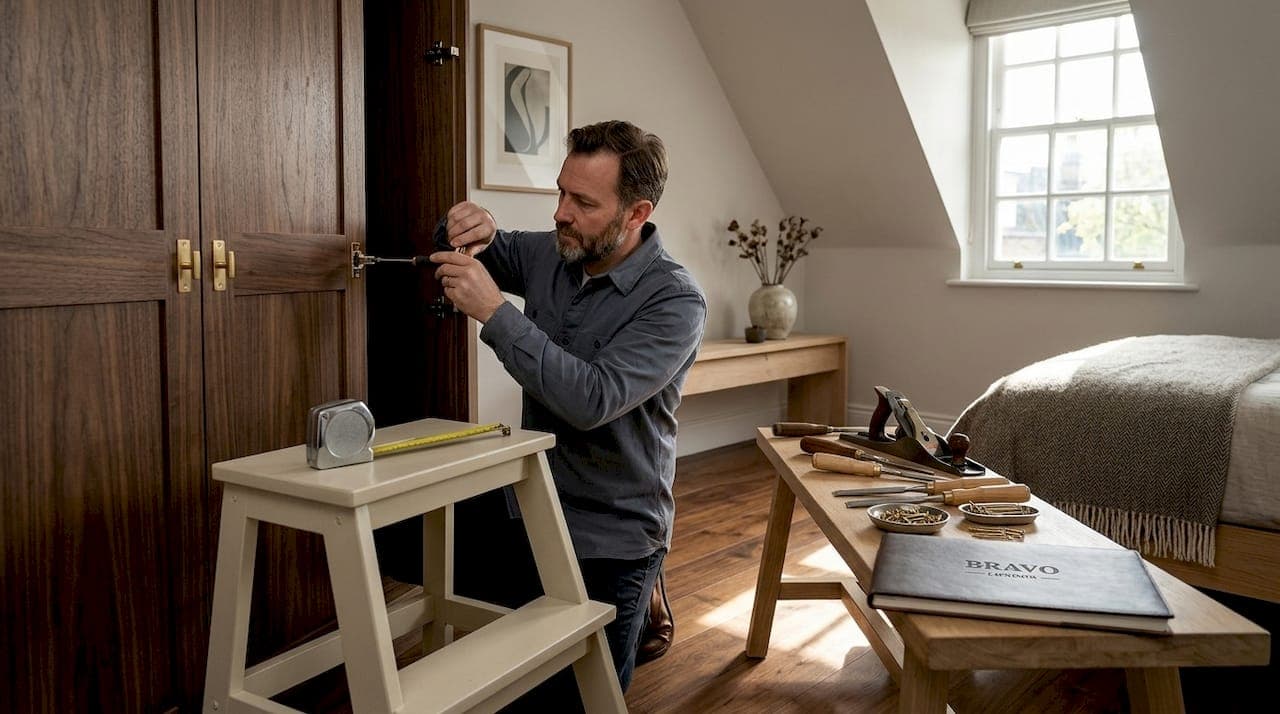
Custom wardrobes are purpose-built storage solutions designed to fit your exact space, and they consistently outperform flatpack wardrobes in fit, durability, and long-term value. The industry term for this category is bespoke fitted joinery, though "custom wardrobes" is the phrase most homeowners use when researching their options. Whether you live in a Victorian terrace with a chimney breast eating into your bedroom wall, or a modern flat with ceilings that slope at an awkward angle, the case for why custom wardrobes outperform flatpack becomes clear the moment you try to fit a standard-sized unit into a non-standard room.
How do custom wardrobes achieve a superior fit compared to flatpack?
The biggest practical advantage of bespoke fitted wardrobes is their ability to perfectly fit non-standard rooms that flatpack furniture simply cannot address, even with modifications. Most British homes were not built to uniform dimensions. Alcoves, sloped ceilings, chimney breasts, and irregular corners are the norm rather than the exception, and flatpack wardrobes are manufactured to fixed, standard sizes that take none of this into account.
When you place a flatpack unit in a room that is not perfectly square, you are left with gaps at the sides, the top, or both. Those gaps collect dust, look untidy, and make the wardrobe feel like an afterthought rather than part of the room. Built-in wardrobes install flush without these dust traps, sitting cleanly against walls and ceilings regardless of the room's geometry. The result feels intentional and balanced in a way that a freestanding unit rarely achieves.
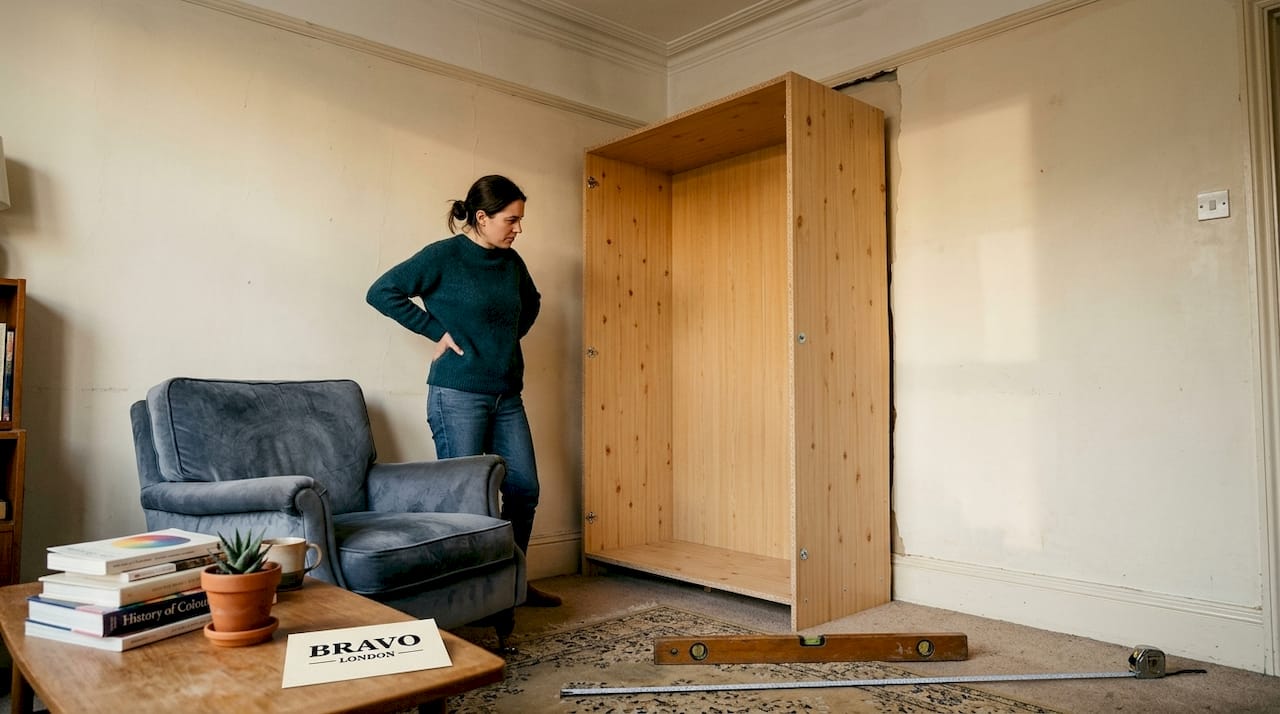
Custom wardrobes also turn genuinely unusable niches into efficient storage. That awkward recess beside the chimney breast? A bespoke wardrobe fills it completely, giving you floor-to-ceiling hanging space where previously there was only wasted wall. Flatpack options require you to compromise: either the unit is too narrow and leaves a gap, or it is too wide and will not fit at all.
Here is what a proper custom fit delivers that flatpack cannot match:
- Floor-to-ceiling height: Every centimetre of vertical space is used, with no gap at the top collecting dust or reducing storage capacity.
- Wall-to-wall width: The wardrobe fills the exact width of the alcove or wall, with no side gaps.
- Sloped ceiling accommodation: Bespoke joinery can follow a roofline or loft conversion angle precisely, something no flatpack unit offers.
- Corner and awkward space solutions: Custom corner units use space that would otherwise be completely inaccessible.
- Integrated skirting and architrave: Bespoke wardrobes are built around existing room features rather than fighting against them.
Pro Tip: Before measuring for any wardrobe, check all four corners of your room with a spirit level and a right-angle tool. Most rooms are not perfectly square, and knowing the exact deviation helps a bespoke designer plan the fit correctly from the start.
Why do custom wardrobes outperform flatpack in build quality and durability?
The construction difference between a bespoke wardrobe and a flatpack unit is not subtle. Flatpack wardrobes rely on particleboard and cam-lock fittings that weaken with movement and reassembly. Every time the unit is knocked, moved, or disassembled, those fittings loosen slightly. Over time, the structure wobbles, shelves sag, and the doors no longer hang straight.
Custom wardrobes use traditional joinery techniques, including dovetail joints and mortise-and-tenon construction, that actually tighten under stress rather than loosening. The materials are also categorically different. Solid wood, high-grade MDF with veneered finishes, and engineered timber boards are standard in bespoke joinery. These materials hold screws reliably, resist warping, and maintain their structural integrity under years of daily use.
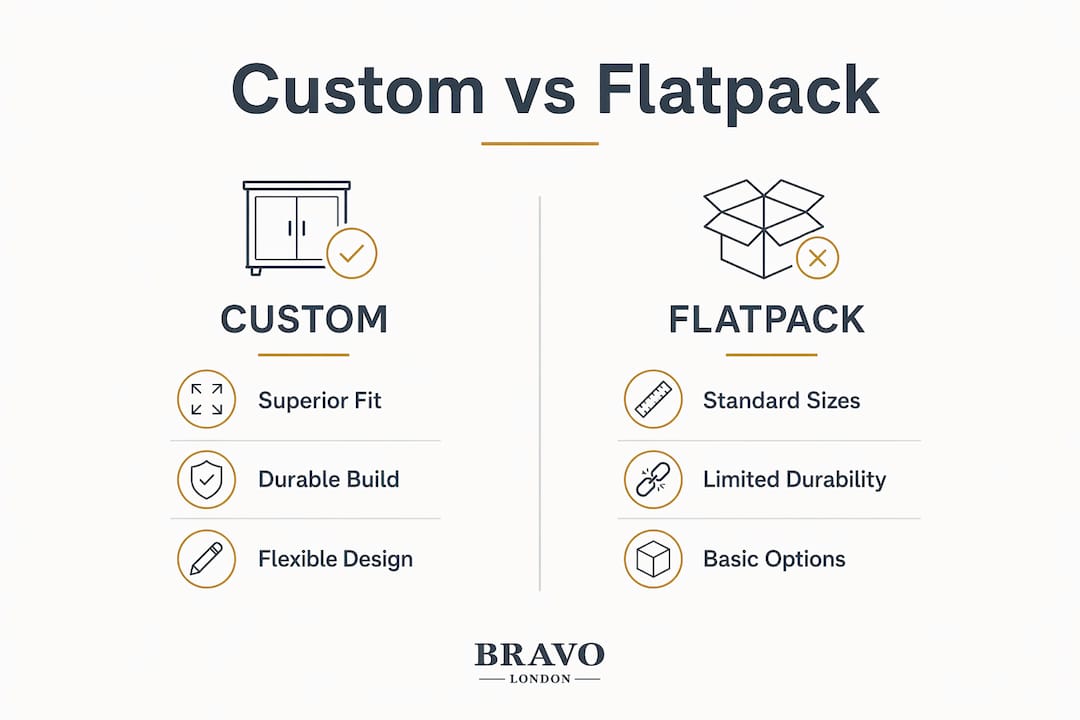
The lifespan difference is significant and worth quantifying:
| Feature | Custom wardrobe | Flatpack wardrobe |
|---|---|---|
| Typical lifespan | 20 to 30+ years | 3 to 5 years |
| Joint type | Dovetail, mortise-and-tenon | Cam-lock, dowel |
| Core material | Solid wood or high-grade MDF | Particleboard |
| Structural response to stress | Tightens | Loosens |
| Repairability | High | Low to none |
A flatpack wardrobe that lasts five years before needing replacement will cost you more over two decades than a single bespoke unit installed once and maintained. The cost per year of use for a custom wardrobe is significantly lower when you account for the full lifespan. This is the financial argument that many homeowners overlook when comparing upfront prices.
Bravo London backs this with a 10-year warranty on every fitted wardrobe it produces, which reflects the confidence that comes from using quality materials and skilled craftsmanship. That kind of guarantee is simply not available with flatpack furniture.
What design and customisation benefits make bespoke wardrobes preferable?
Flatpack wardrobes offer a limited menu of options: a handful of door styles, two or three finishes, and a fixed interior layout of shelves and hanging rails. Custom wardrobes support sliding doors, walk-in configurations, and a full range of cabinetry styles that flatpack ranges cannot replicate. This design freedom is one of the most compelling custom wardrobe advantages for homeowners who want their bedroom to feel cohesive rather than assembled from a catalogue.
The interior layout is where bespoke design makes the most practical difference. A custom wardrobe designer will ask how you actually use your wardrobe: how many suits do you hang, how many folded jumpers do you store, do you need a dedicated shoe rack or a pull-out trouser rail? Custom layouts accommodate specific items and folding patterns to optimise accessibility in a way that a fixed flatpack interior never can.
The design benefits extend well beyond the interior:
- Door styles: Choose from hinged, sliding, or pocket doors in any finish, including painted, lacquered, mirrored, or veneered options.
- Hardware choices: Soft-close drawers, push-to-open mechanisms, integrated LED lighting, and pull-out accessories are all available in bespoke joinery and largely absent from flatpack ranges.
- Finish matching: A bespoke wardrobe can be painted or finished to match your existing room colour scheme precisely, including period-appropriate styles for older properties.
- Walk-in wardrobes: A walk-in wardrobe designed to your room's exact footprint creates a dressing room that a flatpack solution cannot replicate.
- Integrated features: Dressing tables, bedside cabinets, and window seats can all be incorporated into a bespoke design as part of a unified scheme.
For renters, sliding door wardrobe designs are worth exploring, as they can be designed with future removal in mind while still delivering a far superior result to any flatpack alternative during your tenancy.
Are custom wardrobes worth it for long-term value and sustainability?
The upfront cost of a bespoke wardrobe is higher than a flatpack equivalent, and there is no point pretending otherwise. The question worth asking is not "which costs less today?" but "which costs less over ten or twenty years?" When you factor in the replacement expenses and reduced lifespan of flatpack furniture, the total ownership cost of a custom wardrobe is consistently lower.
Here is how the long-term value case builds:
- Single installation cost: A bespoke wardrobe is installed once by a professional and requires no reassembly. Flatpack wardrobes are often moved, disassembled, and reassembled when tenants relocate, each cycle degrading the structure further.
- Repairability: A custom wardrobe with a damaged hinge, drawer, or panel can be repaired by a joiner. A flatpack unit with a broken cam-lock fitting or swollen particleboard shelf is effectively at the end of its useful life.
- Property value: Fitted wardrobes are treated as fixtures in property valuations. A well-designed bespoke wardrobe adds measurable value to a home in a way that a freestanding flatpack unit does not.
- Environmental cost: Flatpack furniture's disposable nature results in frequent discarding and replacement cycles with a real environmental cost. Custom wardrobes, built to last decades, reduce the volume of furniture waste entering landfill.
The sustainability argument is one that the furniture industry is only beginning to take seriously. Buying once and buying well is the most straightforward way to reduce your household's furniture footprint. A bespoke wardrobe built with quality materials and traditional joinery is, by design, a low-waste choice.
Pro Tip: When comparing quotes for custom versus flatpack wardrobes, divide the total cost by the expected lifespan in years. A £2,000 bespoke wardrobe lasting 25 years costs £80 per year. A £400 flatpack unit lasting 4 years costs £100 per year, before accounting for the time and disruption of replacement.
A hybrid approach can also work well: bespoke built-in joinery for the most challenging parts of a room, combined with quality freestanding pieces elsewhere. This gives you the permanence of custom joinery where it matters most, with some flexibility for spaces that may change over time.
Key takeaways
Custom wardrobes outperform flatpack in every meaningful measure: fit, build quality, design flexibility, long-term cost, and environmental impact.
| Point | Details |
|---|---|
| Superior fit | Bespoke wardrobes fill awkward rooms precisely, eliminating gaps and wasted space. |
| Longer lifespan | Custom joinery lasts 20 to 30+ years versus 3 to 5 years for flatpack. |
| Lower cost per year | Higher upfront cost is offset by decades of use without replacement. |
| Design freedom | Bespoke options include sliding doors, walk-in layouts, and matched finishes unavailable in flatpack. |
| Sustainability | One long-lasting wardrobe produces far less waste than repeated flatpack replacements. |
What I have learned from over 1,000 bespoke wardrobe projects
After completing more than 1,000 fitted wardrobe projects across London, the pattern we see most often is this: homeowners who chose flatpack first come to us after the third or fourth replacement, frustrated by gaps, wobbling doors, and wasted corners. The money they spent on flatpack units over five or six years would, in most cases, have covered a bespoke wardrobe that would still be performing perfectly today.
The most common mistake is treating a non-standard room as if it were standard. Victorian and Edwardian properties in particular have walls that are rarely plumb, floors that are rarely level, and alcoves that are rarely symmetrical. Pushing a flatpack unit into that environment and hoping for the best is a decision that shows in the finished result every single day.
What surprises many clients is how transformative a properly fitted wardrobe is in a room they had given up on. A sloped ceiling in a loft conversion, a deep alcove beside a chimney breast, a narrow bedroom where every centimetre matters. These are exactly the spaces where bespoke joinery earns its cost most clearly.
For renters, the conversation is more nuanced. Permanence is not always the goal. But even for a two or three-year tenancy, a well-designed fitted wardrobe adds daily quality of life that a flatpack unit simply does not. The fitted wardrobe trend is growing precisely because more people are recognising that storage is not a minor detail. It shapes how a room feels every morning.
— Bravo
Bespoke wardrobes designed for your space by Bravo London
Bravo London designs and installs bespoke fitted wardrobes tailored to your exact room dimensions, storage needs, and style preferences. Every project begins with a detailed measurement and design consultation, ensuring the finished wardrobe fits your space precisely, whether that means filling an alcove, accommodating a sloped ceiling, or creating a full corner wardrobe solution. With over 1,000 completed projects, a 10-year warranty, and a range that includes sliding door wardrobes, walk-in dressing rooms, and fully integrated bedroom furniture, Bravo London delivers custom storage solutions built to last. Explore the full range and request your consultation at bravolondon.co.uk.
FAQ
How long do custom wardrobes last compared to flatpack?
Custom wardrobes built with solid wood or high-grade MDF and traditional joinery typically last 20 to 30 years or more. Flatpack wardrobes, which rely on particleboard and cam-lock fittings, have a typical useful life of 3 to 5 years before the structure degrades noticeably.
Are custom wardrobes worth the higher upfront cost?
Yes, when assessed on cost per year of use. A bespoke wardrobe installed once and maintained properly costs significantly less annually than replacing flatpack units every few years, and it adds property value as a fitted fixture.
Can custom wardrobes fit awkward spaces like alcoves or sloped ceilings?
Custom wardrobes are specifically designed for non-standard rooms. Bespoke joinery suits awkward dimensions like alcoves, sloped ceilings, and chimney breasts far better than any freestanding flatpack unit.
What design options are available with bespoke wardrobes that flatpack does not offer?
Bespoke wardrobes support sliding doors, walk-in configurations, integrated lighting, soft-close hardware, and fully matched finishes. Flatpack ranges are limited to a small selection of standard door styles and fixed interior layouts.
Is a custom wardrobe a good option for renters?
Yes, particularly sliding door designs that can be planned with future removal in mind. The daily storage quality and room aesthetics of a fitted wardrobe far exceed what a flatpack unit delivers, even over a shorter tenancy period.