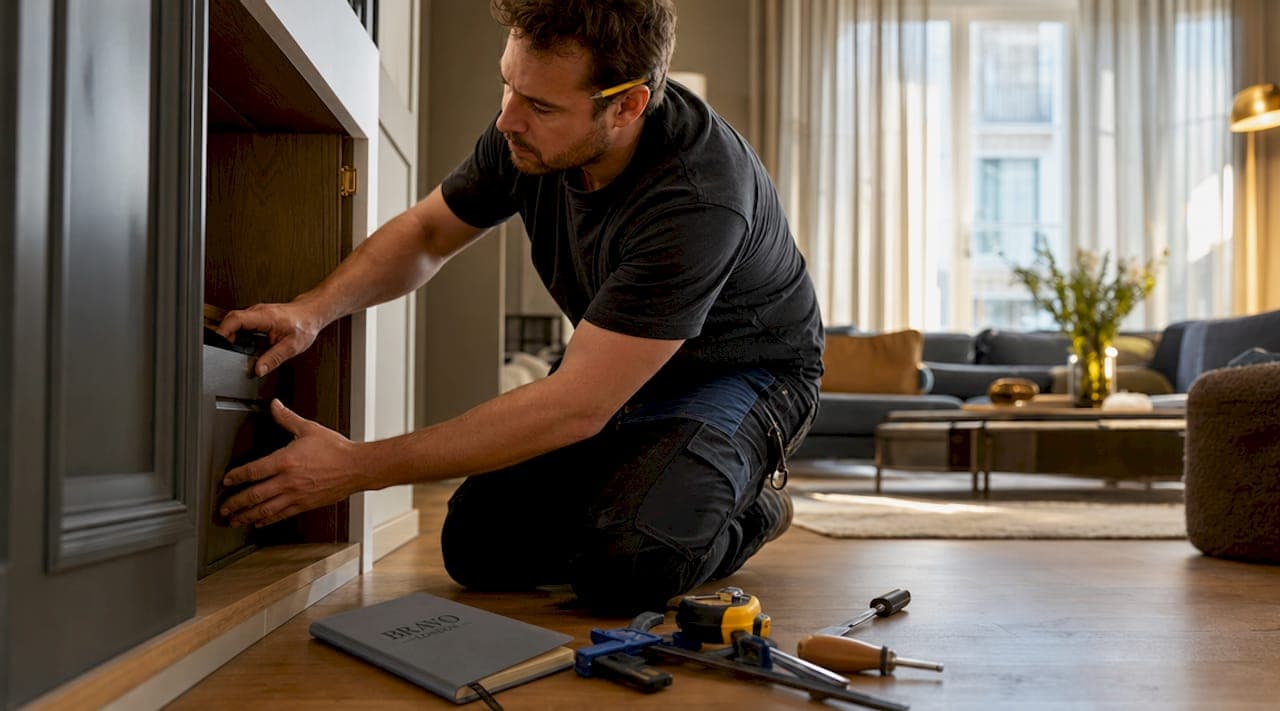
Fitted furniture is defined as storage built precisely to the dimensions of a specific room, and it consistently outperforms freestanding storage in space efficiency, visual cohesion, and long-term home value. Unlike freestanding units, which arrive in standard sizes and leave awkward gaps at ceilings, corners, and alcoves, fitted solutions are designed around your room rather than placed inside it. Specialists such as Timber Design + Build, LS Furniture, and Furniture in Fashion consistently point to the same conclusion: for homeowners committed to a space, fitted storage is the more practical and rewarding investment.
Why fitted furniture beats freestanding storage on space
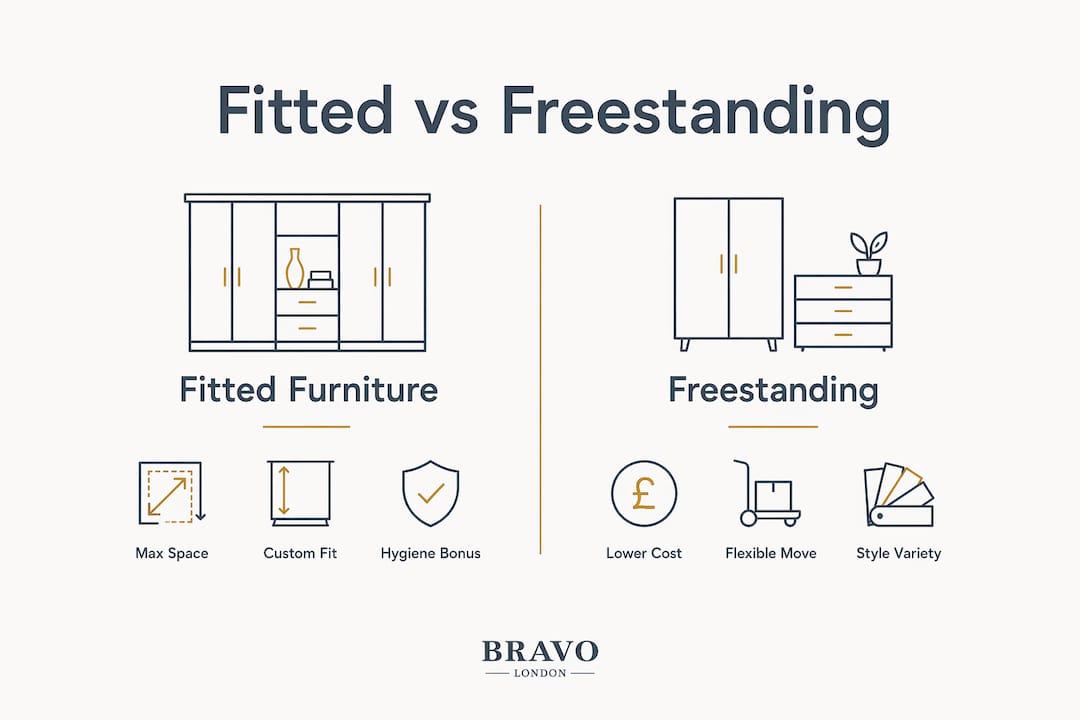
The single most compelling argument for fitted furniture is raw storage capacity. Floor-to-ceiling fitted units use the full wall height, while standard freestanding units typically occupy only 60 to 70 per cent of the same wall space. The practical result is a 35 to 40 per cent increase in storage efficiency. In a typical bedroom or living room, that difference can translate to several hundred litres of additional usable storage.
Fitted cabinetry also solves the problem of awkward architecture. Alcoves beside chimney breasts, angled ceilings in loft conversions, and narrow recesses beside doorways are all spaces that freestanding furniture simply cannot fill. A bespoke unit built into an alcove uses every centimetre of depth and height, whereas a freestanding bookcase leaves dead space above, beside, and behind it. For homeowners in London, where rooms are often compact and irregularly shaped, this precision matters enormously.
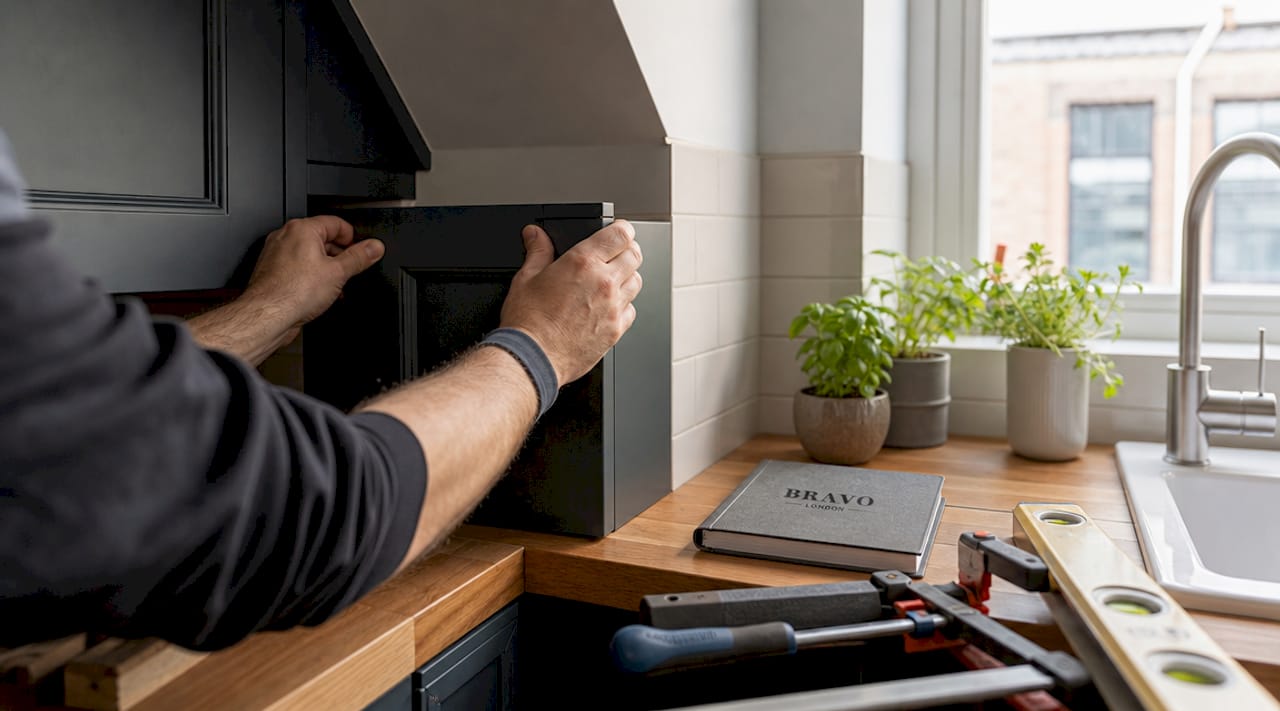
There is also a practical hygiene benefit that is easy to overlook. Fitted furniture eliminates the gaps beneath and behind units where dust accumulates. A toe kick or base moulding flush to the floor removes those hard-to-reach areas entirely, making cleaning faster and more thorough.
Pro Tip: Before commissioning fitted storage, photograph every corner, alcove, and ceiling angle in the room. These are the spaces a skilled designer will convert into usable storage that a freestanding unit would waste entirely.
| Feature | Fitted furniture | Freestanding furniture |
|---|---|---|
| Wall height used | 100% (floor to ceiling) | 60–70% |
| Alcove and corner fit | Fully customised | Approximate or impossible |
| Dust accumulation gaps | Eliminated by base moulding | Present beneath and behind units |
| Storage efficiency gain | 35–40% more than freestanding | Baseline |
How does fitted furniture improve a room's appearance?
Fitted furniture does not sit in a room. It becomes part of the room. Built-in cabinetry relates directly to the architectural features around it, blending with ceiling profiles, skirting boards, and cornicing in a way that freestanding pieces never can. The result is a space that feels intentional and considered rather than assembled from separate purchases.
Timber Design + Build describes this effect as spatial order: the visual calm that comes from storage that appears to belong to the walls rather than stand in front of them. When shelving, cabinetry, and drawers share a continuous line from floor to ceiling, the eye reads the room as larger and more organised. Freestanding furniture, however well chosen, introduces visual interruptions at every edge and gap.
"The spatial order achieved by fitted furniture significantly calms the visual atmosphere of rooms." — Timber Design + Build
Finish details reinforce this effect. Fitted units can be specified with crown moulding that meets the ceiling, flush panel doors that align with wall panelling, and paint colours matched precisely to the room's scheme. Freestanding furniture arrives with its own proportions and finishes, which may complement the room but will rarely integrate with it at this level of detail.
Pro Tip: Mix open shelving with closed cabinetry in a fitted design. Open sections display objects and add warmth; closed sections conceal clutter. The combination creates a balanced, layered look that neither all-open nor all-closed storage achieves.
Fitted vs freestanding furniture: cost, flexibility, and trade-offs
The fitted versus freestanding furniture comparison is not one-sided. Freestanding furniture costs less upfront, requires no installation, and can be moved, sold, or reconfigured whenever your needs change. For renters, frequent movers, or anyone in a transitional living situation, freestanding furniture suits those who prioritise flexibility above all else.
Fitted furniture requires a higher initial investment covering design, materials, and professional installation. That cost, however, is better understood as a home improvement than a furniture purchase. Fitted furniture is a long-term investment that integrates with the architecture and enhances resale value in a way that freestanding pieces cannot. Homeowners staying in a property for three or more years typically recover a significant portion of that cost through increased property appraisal value.
When freestanding furniture is the right choice:
- You rent your home and cannot make structural alterations
- You move frequently and need furniture that travels with you
- You are furnishing a temporary space or a room likely to change purpose
- You want to experiment with layouts before committing to a permanent design
- Your budget does not currently support bespoke installation
When fitted storage is the better decision:
- You own your home and plan to stay for several years
- The room has alcoves, angled ceilings, or awkward proportions
- You need to maximise storage in a compact space
- You want a cohesive, finished interior that adds value to the property
- Built-in furniture often lasts decades and you want durability over the long term
How to combine fitted and freestanding furniture effectively
The most practical approach for many homeowners is not a binary choice. Fitted and freestanding furniture work well together when each type is used where it performs best. A bedroom with fitted wardrobes along one wall gains permanent, maximised storage without sacrificing the flexibility of a freestanding dressing table or bedside tables that can be changed as tastes evolve.
A hybrid approach works well in the following sequence:
- Identify the fixed architectural challenges in each room: alcoves, chimney breasts, low ceilings, and narrow recesses. These are the spaces where fitted cabinetry delivers the greatest return.
- Assign fitted storage to the walls and spaces that will not change: wardrobes, media units, home office shelving, and utility storage.
- Use freestanding furniture for pieces that benefit from flexibility: sofas, beds, dining tables, and accent chairs that you may wish to replace or reposition.
- Consider semi-custom flat-packed fitted systems as a middle ground. Flat-packed fitted systems provide a professional aesthetic at a lower cost than fully bespoke cabinetry, making them a practical option for rooms where full bespoke is not yet within budget.
- Review the overall scheme for visual consistency. Fitted and freestanding pieces should share a colour palette or material language so the room reads as a coherent whole rather than a collection of separate decisions.
For living rooms in particular, fitted living room furniture that incorporates media storage, display shelving, and concealed cabinetry alongside a freestanding sofa and coffee table creates a room that is both practical and visually settled.
What should you look for in quality fitted furniture?
Not all fitted furniture is equal. The difference between a unit that lasts thirty years and one that warps or loosens within five comes down to materials, joinery, and the precision of the installation.
Key quality indicators to assess:
- Solid joinery: Dovetail joints, mortise and tenon construction, and dowel-reinforced carcasses are signs of craftsmanship. Stapled or glued-only construction is a warning sign.
- Material quality: Solid timber or high-grade MDF with veneered finishes outperforms low-density particleboard, which swells with moisture and chips at edges over time.
- Precise measurement: A professional designer should survey the room in person, accounting for walls that are not perfectly square, floors that are not perfectly level, and ceiling heights that vary across a span.
- Hardware specification: Soft-close drawer runners and hinges from manufacturers such as Blum or Hettich indicate a commitment to long-term performance. Budget hardware fails quickly under daily use.
- Finish consistency: Paint, lacquer, or veneer should be applied in controlled conditions for an even, durable result. On-site painting rarely achieves the same quality as factory-applied finishes.
For homeowners weighing fully bespoke against semi-custom options, the key distinction is fit and finish. Semi-custom flat-packed fitted furniture reduces cost and installation complexity but involves some compromise on dimensions and detailing. Fully bespoke joinery, as offered by Bravo London, is designed and built to the exact measurements of your space with no compromise on proportion or finish. You can explore the range of bespoke fitted storage options to understand what full customisation delivers in practice.
Key takeaways
Fitted furniture consistently outperforms freestanding storage because it uses the full geometry of a room, integrates with its architecture, and adds measurable long-term value to the property.
| Point | Details |
|---|---|
| Storage efficiency | Fitted units deliver 35–40% more storage than freestanding by using full wall height. |
| Architectural integration | Fitted cabinetry blends with mouldings and ceiling profiles, creating a cohesive interior. |
| Long-term value | Fitted furniture increases home resale potential and is built to last decades. |
| Flexibility trade-off | Freestanding suits renters and frequent movers; fitted suits long-term homeowners. |
| Hybrid approach | Combining fitted and freestanding furniture by room function delivers the best practical outcome. |
What working with fitted furniture has taught us
After completing over 1,000 projects across London, the pattern we see most consistently is this: homeowners who invest in fitted storage early in a renovation rarely regret it. Those who delay it in favour of freestanding pieces often return to us a few years later, having realised that the freestanding furniture they bought as a stopgap never quite solved the problem.
The decision between fitted and freestanding is, at its core, a lifestyle question. If you are settled in a home you intend to keep, fitted cabinetry is not an expense. It is a structural improvement that changes how the space feels every single day. A well-designed fitted wardrobe or living room unit does not just store things. It makes a room feel finished in a way that no freestanding piece can replicate.
That said, we are not dismissive of freestanding furniture. It has a genuine role in any home, particularly for pieces that benefit from being moved or replaced as life changes. The mistake is using freestanding storage as a permanent solution in spaces where the architecture demands something more considered. Alcoves, loft rooms, and narrow hallways are not problems to be worked around with off-the-shelf units. They are opportunities for fitted design that transforms a functional challenge into a defining feature of the room.
If you are unsure where to start, the most useful first step is not a catalogue. It is a conversation with a designer who can look at your specific space and tell you honestly where fitted storage will make the greatest difference.
— Bravo
Bespoke fitted furniture from Bravo London
Bravo London designs and manufactures bespoke fitted furniture for homeowners across London, covering wardrobes, living room cabinetry, home offices, and utility storage. Every project begins with a detailed survey of your space, so the finished unit fits precisely, regardless of how irregular the room's dimensions may be.
With over 1,000 completed projects, a 10-year warranty on all work, and a design process built around your specific needs, Bravo London delivers fitted storage that is built to last and designed to impress. Explore the full range of made-to-measure wardrobes and bespoke storage solutions, or visit the fitted furniture and joinery page to see how a custom approach transforms the way your home works.
FAQ
What is the main advantage of fitted over freestanding furniture?
Fitted furniture uses the full height and width of a wall, delivering 35 to 40 per cent more storage than a freestanding unit in the same space. It also integrates with the room's architecture, creating a cohesive finish that freestanding pieces cannot match.
Does fitted furniture add value to a home?
Yes. Fitted furniture is treated as a permanent home improvement and can increase a property's appraisal value, particularly when it is well designed and professionally installed. Freestanding furniture does not contribute to resale value in the same way.
Is fitted furniture worth it for small rooms?
Fitted furniture is especially effective in small rooms because it eliminates wasted space at corners, alcoves, and ceiling height. Floor-to-ceiling cabinetry in a compact bedroom or living room can dramatically increase usable storage without reducing floor space.
Can I combine fitted and freestanding furniture in the same room?
Combining both types works well when fitted storage is used for fixed architectural spaces such as alcoves and chimney recesses, while freestanding pieces handle flexible functions such as seating, beds, and accent furniture that may change over time.
How long does fitted furniture last compared to freestanding?
Quality fitted furniture built with solid joinery and professional-grade materials typically lasts several decades. Freestanding furniture, particularly flat-packed or particleboard units, has a significantly shorter lifespan under daily use.