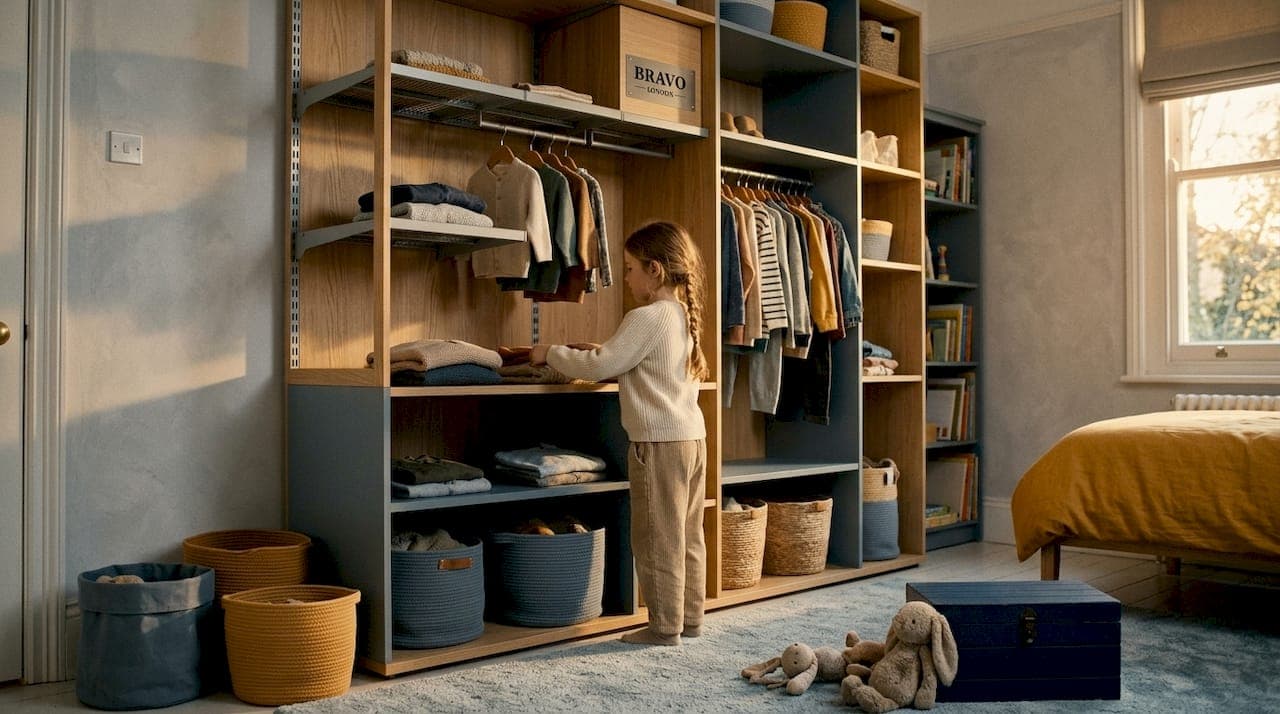
A flexible wardrobe for children is defined as a storage system with adjustable components, including modular shelving, repositionable hanging rods, and removable drawers, that reconfigures as a child grows from toddler to teenager. The reason why kids wardrobes need flexible design is straightforward: children's storage requirements change faster than any other room in the house. A three-year-old needs low, open access to a handful of items; a twelve-year-old needs hanging space, drawer organisation, and somewhere for sports kit. Buying a fixed wardrobe for a five-year-old and expecting it to serve a fifteen-year-old is a false economy. Adaptable storage solutions, sometimes called modular children's furniture in the trade, solve this by building reconfigurability into the structure from day one.
Why flexible wardrobe design matters for children's independence
Reachability is more critical than storage capacity in a child's wardrobe. A closet inaccessible to children simply becomes a parent-managed storage problem, which defeats the purpose of giving a child their own space entirely.
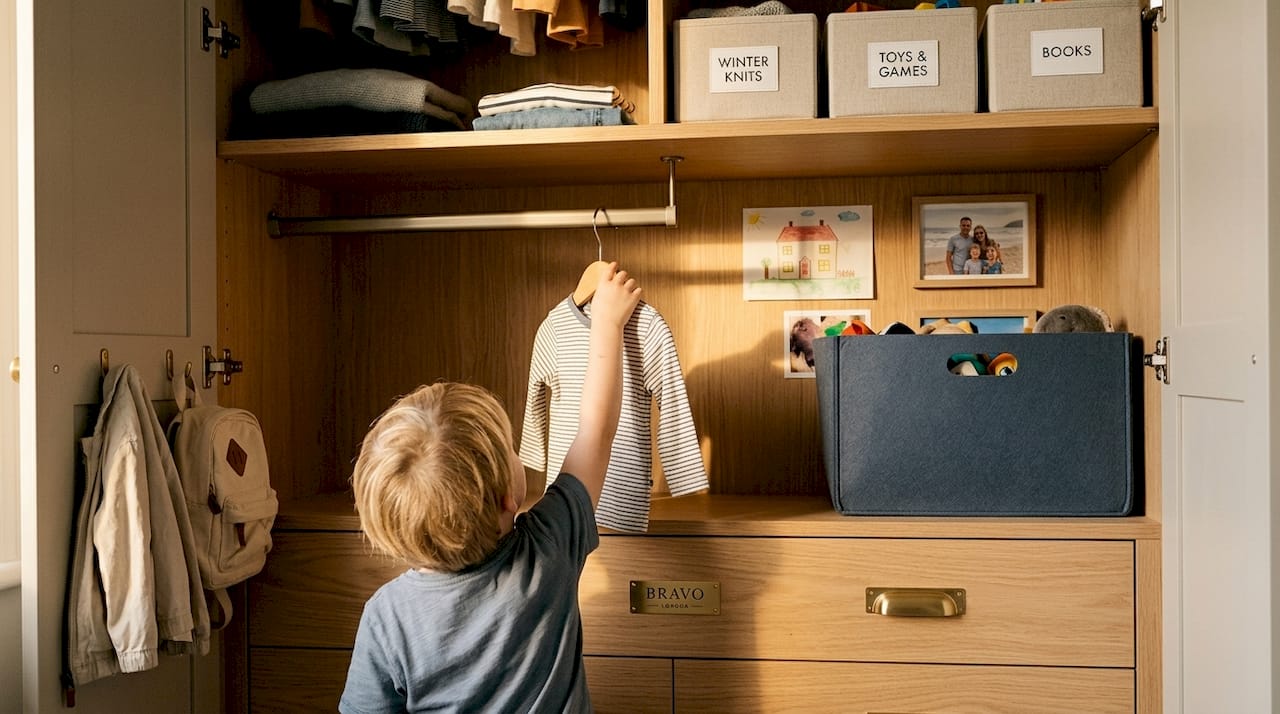
Montessori-informed design makes this concrete. Rod heights vary by age: 35 to 45 cm for very young toddlers, 55 to 65 cm for children aged two to three, and 75 to 85 cm for ages four to five. These are not arbitrary numbers. They reflect the shoulder height at which a child can reach, select, and replace a garment without adult help. When a rod is set at the right height, children dress themselves. When it is set at adult height, they ask for help every morning.
Open wardrobes and labelled bins extend this principle further. Pre-readers respond well to picture labels on storage zones, and limiting the number of visible choices reduces the overwhelm that leads to clothes scattered across the floor. The goal is a wardrobe that a child can use independently, not one that impresses adults.
- Set hanging rods at the child's shoulder height, not at adult convenience
- Use open shelving or open-fronted bins for frequently used items
- Apply picture labels for pre-readers; word labels for school-age children
- Limit visible clothing choices to three or four options per category
- Keep shoes and accessories in dedicated, low-level spaces
Pro Tip: If your child cannot reach the hanging rod without a step, lower the rod rather than buying a step stool. A step stool introduces a trip hazard and an extra task; a correctly positioned rod removes both.
What adjustable features allow wardrobes to grow with your child?
Modular wardrobes allow growth through toddler, school-age, and teenage stages without major structural changes. The key components that make this possible are adjustable double hanging rods, re-stackable modular shelving units, and removable drawer inserts that can be swapped for open shelving as needs change.
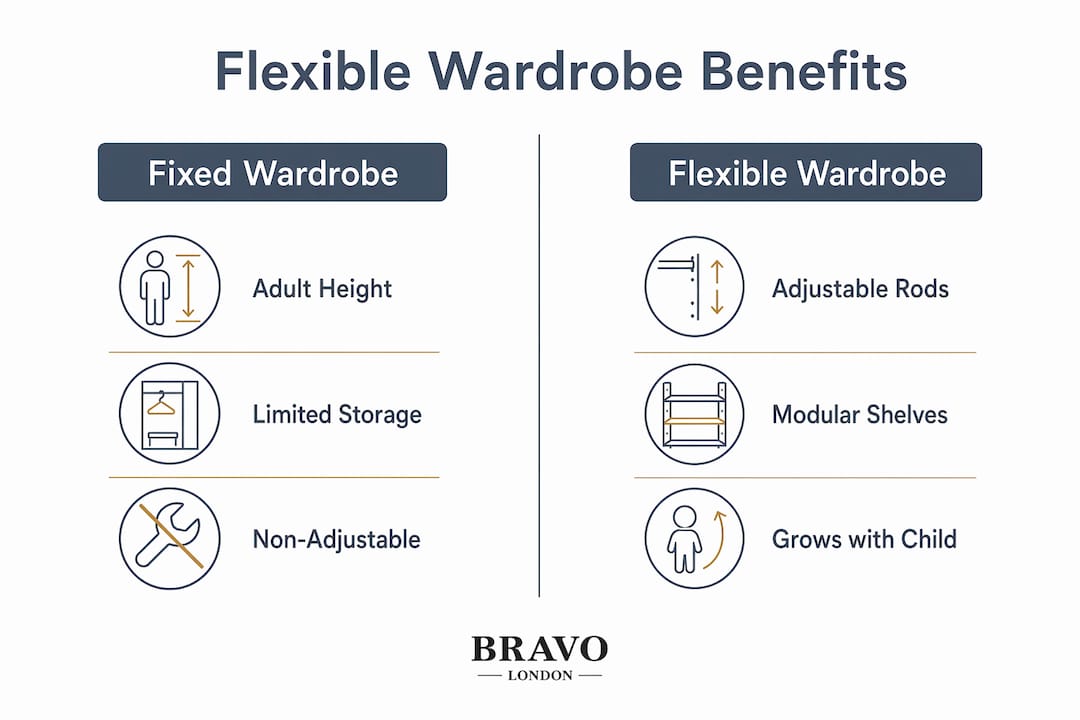
A double hanging rod system is particularly useful in the early years. The lower rod holds a toddler's items at reachable height; the upper rod stores out-of-season clothing or items managed by parents. As the child grows, the lower rod rises and the upper rod takes on more active use. This single adjustment can extend a wardrobe's usability by four to six years without any structural modification.
The comparison between fixed and flexible storage is worth examining directly.
| Feature | Fixed wardrobe | Flexible wardrobe |
|---|---|---|
| Hanging rod position | Set at adult height | Adjustable to child's shoulder height |
| Shelving | Fixed at installation | Repositionable or modular |
| Drawers | Permanent configuration | Removable or interchangeable |
| Lifespan across childhood | Requires replacement or significant modification | Adapts through multiple stages |
| Cost over 10 years | Higher due to replacements | Lower due to reconfiguration |
One caution worth raising: adjustment mechanisms that are too complex or fragile frequently undermine the entire flexible design goal. If reconfiguring a shelf requires specialist tools or risks damaging the unit, parents simply stop adjusting it. The wardrobe reverts to a fixed layout, and the child's independence suffers. Prioritise systems where rods and shelves can be repositioned in under ten minutes with standard household tools.
Pro Tip: When evaluating a modular wardrobe, physically test the adjustment mechanism in the showroom. If it feels stiff, fiddly, or requires two people to operate, it will not be reconfigured at home. Choose a system you will actually use.
How do you keep a child's wardrobe safe?
Safety in children's wardrobe design centres on three factors: wall anchoring, drawer height, and material stability. Each one is non-negotiable, regardless of how well-designed the storage system is.
Drawers above 90 cm require wall anchoring to prevent tipping. Drawers above 110 cm are unsafe for primary-age children to access without climbing, which introduces a serious fall risk. The practical rule is to assign adult-managed items to any drawer or shelf above 110 cm and reserve the middle and lower zones for children's active use.
Wall anchoring itself must be done correctly. Anchors must fix to wall studs or solid masonry, not plasterboard alone. A plasterboard fixing will hold under normal conditions but can fail under the sudden lateral force of a child pulling on an open drawer. In a UK home with standard stud-and-plasterboard walls, this means locating the studs before installation, not after.
| Height zone | Recommended use | Safety consideration |
|---|---|---|
| 0 to 60 cm | Child's active daily items | Fully accessible; no climbing required |
| 60 to 90 cm | Child's secondary items | Reachable for most school-age children |
| 90 to 110 cm | Transitional zone | Wall anchoring required; monitor access |
| Above 110 cm | Adult-managed storage | Not for unsupervised child access |
Material choice also matters. Solid wood and high-density MDF with quality fixings outperform lightweight flat-pack constructions in stability. A wardrobe that wobbles when a drawer is pulled open is a wardrobe that will eventually tip. For adaptable storage in compact bedrooms, fitted solutions anchored directly to the wall eliminate the tipping risk entirely by removing the freestanding element.
How should you organise a child's wardrobe by zone?
Effective wardrobe organisation for children relies on clearly defined zones, each dedicated to a specific clothing category. Zoning and picture labels foster independence and order even for pre-readers, and they reduce the daily friction that makes mornings difficult for the whole family.
A practical zone structure for a school-age child looks like this:
- School zone: Uniforms, school shoes, and bags in one dedicated section, ideally at the front of the wardrobe or in the most accessible position
- Weekend zone: Casual clothes, trainers, and leisure items grouped separately so the child is not sifting through uniforms on a Saturday morning
- Seasonal zone: Out-of-season items stored in the upper section or in vacuum storage bags, rotated twice a year
- Accessories zone: Hooks on the inside of the wardrobe door or a small rail for belts, hats, and bags
Limiting the number of items in each zone is as important as the zone structure itself. A child presented with thirty tops will not make a decision independently. A child presented with five will. Rotating clothing seasonally keeps the active wardrobe manageable and reduces the visual clutter that undermines the entire system.
Hooks deserve more credit than they typically receive in wardrobe planning. A row of low-level hooks on the inside of a wardrobe door handles school bags, sports bags, and coats in a way that no shelf or drawer can match. They are accessible, visible, and require no fine motor skill to use, which matters for younger children.
Does flexible wardrobe design actually save money long-term?
The financial case for adaptable storage solutions is direct. A fixed wardrobe bought for a five-year-old will likely need replacing or significantly modifying by age ten, and again by age fourteen. A modular system bought once and reconfigured three times costs less in total and generates far less disruption.
Here is how the long-term value compounds:
- No replacement purchases. A well-built modular wardrobe bought at age three can serve the same child at age sixteen with rod and shelf adjustments costing nothing beyond time.
- Sibling transfer. A neutral, modular design passes from one child to the next without redecorating. The configuration changes; the wardrobe does not.
- Reduced redecorating stress. Modular design lowers financial and physical stress by adapting over time rather than requiring full replacement, which also means fewer disrupted weekends and fewer arguments about what the new wardrobe should look like.
- Multifunctional use. A wardrobe with removable drawers and adjustable shelving can transition from a child's clothing storage to a teenager's study and hobby storage without any structural change.
The upfront cost of a quality modular or bespoke wardrobe is higher than a flat-pack alternative. The ten-year cost is almost always lower. That is the importance of flexible wardrobes stated in purely financial terms, and it does not account for the daily time saved by a child who can dress independently.
Key takeaways
Flexible wardrobe design for children delivers lasting value by combining adjustable components, child-appropriate reachability, and clear organisation to support independence at every stage of growth.
| Point | Details |
|---|---|
| Reachability over capacity | Set rods at shoulder height for the child's age group to enable genuine independence. |
| Adjustable components extend lifespan | Double rods, modular shelving, and removable drawers allow one wardrobe to serve from toddler to teen. |
| Safety is non-negotiable | Anchor tall units to wall studs and keep active storage below 90 cm for unsupervised child access. |
| Zone-based organisation reduces friction | Dedicated zones for school, weekend, and seasonal clothing simplify daily routines for children and parents alike. |
| Long-term cost is lower | A modular wardrobe reconfigured three times costs less than three fixed wardrobes bought over the same period. |
What experience has taught us about flexible wardrobes
The most common mistake we see in children's wardrobe projects is prioritising aesthetics over reachability. Parents choose a beautiful floor-to-ceiling design, the child cannot reach the hanging rod, and within three months the wardrobe is being managed entirely by adults. The independence the design was supposed to support never materialises.
The second mistake is buying adjustable systems that nobody adjusts. Fragile or complicated mechanisms discourage reconfiguration in practice, regardless of how well they work in a showroom. We always recommend testing the adjustment mechanism before committing to a system. If it takes more than ten minutes and a degree of patience to reposition a shelf, it will not happen at home.
What works, in our experience, is a bespoke fitted wardrobe with a small number of genuinely simple adjustable features: a rod that slides to a new position with one hand, shelves that reposition on a standard pin system, and drawers that pull out cleanly without wobble. The children's bedroom storage projects we are most proud of are the ones where a parent tells us their seven-year-old gets dressed without being asked. That is the measure of a well-designed wardrobe.
One final point: involve the child in the organisation from the start. A child who helped decide where their school uniform lives is far more likely to put it back there. Ownership of the system is what makes it work day to day, and no amount of clever design substitutes for that.
— Bravo
Bespoke fitted wardrobes designed to grow with your child
If this article has confirmed what you already suspected, that a standard flat-pack wardrobe is not going to serve your child well for long, then a bespoke fitted solution is worth serious consideration.
At Bravo London, we design fitted wardrobes for children's rooms that are built around your child's current age and your family's long-term needs. Every unit is anchored safely to the wall, configured with adjustable rods and shelving, and finished to a standard that lasts well beyond childhood. With over 1,000 completed projects and a 10-year warranty, we bring the same craftsmanship to a child's bedroom as we do to any room in the house. Explore our full range of bespoke fitted wardrobes or book a free consultation to discuss your specific requirements.
FAQ
What makes a wardrobe design flexible for children?
A flexible wardrobe includes adjustable hanging rods, repositionable shelving, and removable drawers that can be reconfigured as a child grows. These components allow one wardrobe to serve from toddlerhood through the teenage years without structural replacement.
At what height should a child's hanging rod be set?
Rod heights vary by age: 35 to 45 cm for very young toddlers, 55 to 65 cm for ages two to three, and 75 to 85 cm for ages four to five. The rod should sit at the child's shoulder height so they can reach, select, and replace clothing without adult help.
How do you anchor a tall wardrobe safely in a child's bedroom?
Anchors must fix to wall studs or solid masonry rather than plasterboard alone. Any unit with drawers or shelves above 90 cm requires wall anchoring to prevent tipping if a child pulls on an open drawer.
Is a modular wardrobe more cost-effective than a fixed one?
Yes. A modular wardrobe reconfigured several times across childhood costs less in total than replacing a fixed wardrobe every four to five years. The upfront investment is higher, but the ten-year cost is lower and the disruption is significantly reduced.
How do you organise a child's wardrobe to support independence?
Divide the wardrobe into clearly labelled zones for school, weekend, and seasonal clothing. Use picture labels for pre-readers, limit visible choices to a manageable number, and place the most-used items at the child's shoulder height or below.