
TL;DR:
- Selecting hardware early ensures bespoke cabinetry performs reliably over decades. Choosing appropriate material quality, finish, size, and load ratings prevents costly failures and mismatched aesthetics. Proper planning and sampling in situ are essential for long-term satisfaction and seamless project execution.
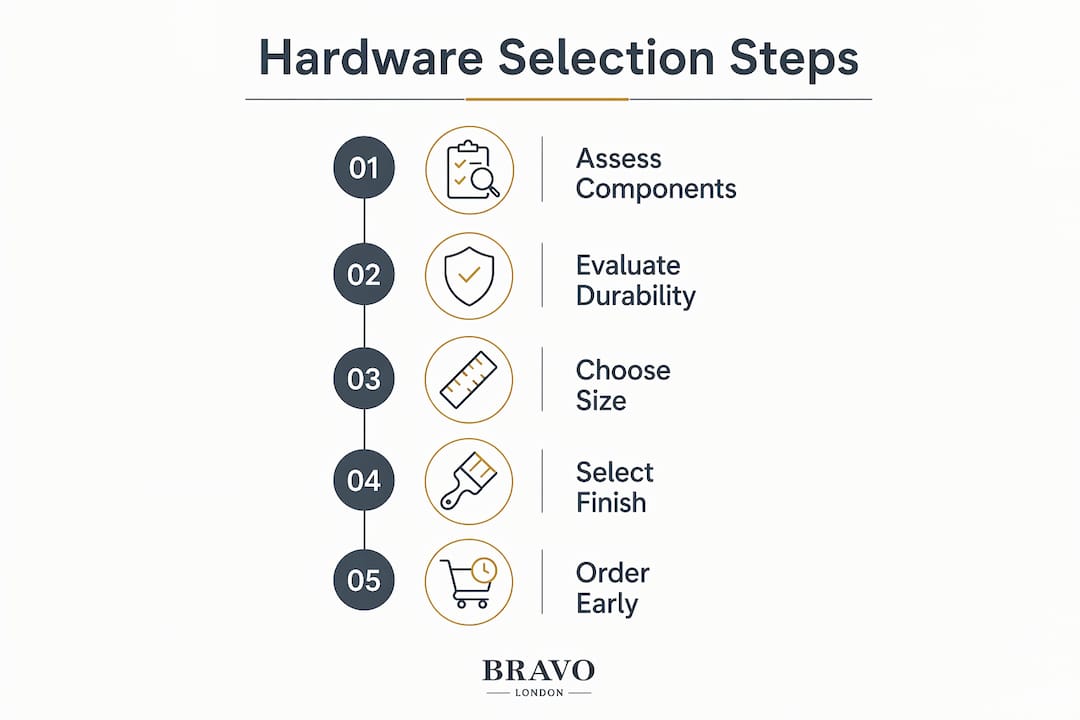
Hardware selection is the single most consequential decision in any bespoke cabinetry project. The right fittings determine how long your cabinets last, how smoothly they operate every day, and whether the finished piece looks considered or cobbled together. Whether you are a homeowner planning a fitted kitchen or an interior designer specifying a full bedroom suite, knowing how to select hardware for bespoke cabinetry before a single panel is cut will save you time, money, and regret. This guide covers every stage, from essential component types through to finish families and architectural problem-solving.
What are the essential hardware components for bespoke cabinetry?
Bespoke cabinetry relies on four core hardware categories: hinges, drawer slides, handles, and motion technology. Each category serves a distinct function, and choosing the wrong type in any one of them undermines the whole piece.
Hinges come in three main types for cabinet use:
- Concealed hinges (also called European hinges): mounted inside the cabinet, invisible when the door is closed, and adjustable in three axes. The industry standard for most fitted cabinetry.
- Butt hinges: surface-mounted on the door edge and frame. Traditional in appearance, used on inframe cabinetry and period-style pieces.
- Overlay hinges: designed for doors that sit over the cabinet face rather than inside it. The overlay amount (full or half) must match the door construction precisely.
Drawer slides divide into two main types. Side-mount slides attach to the cabinet wall and are straightforward to fit. Undermount slides sit beneath the drawer box, are invisible in use, and typically carry higher load ratings. Full-extension undermount slides support full drawer access and better weight distribution. That matters when a drawer holds heavy kitchen equipment or files.
Knobs versus pulls is partly ergonomic and partly stylistic. Knobs suit smaller doors and upper cabinets where a single-point grip is sufficient. Pulls give better leverage on wide drawers and lower cabinets, where you reach down and pull outward. Ergonomically, a pull is easier on the wrist for repeated daily use.
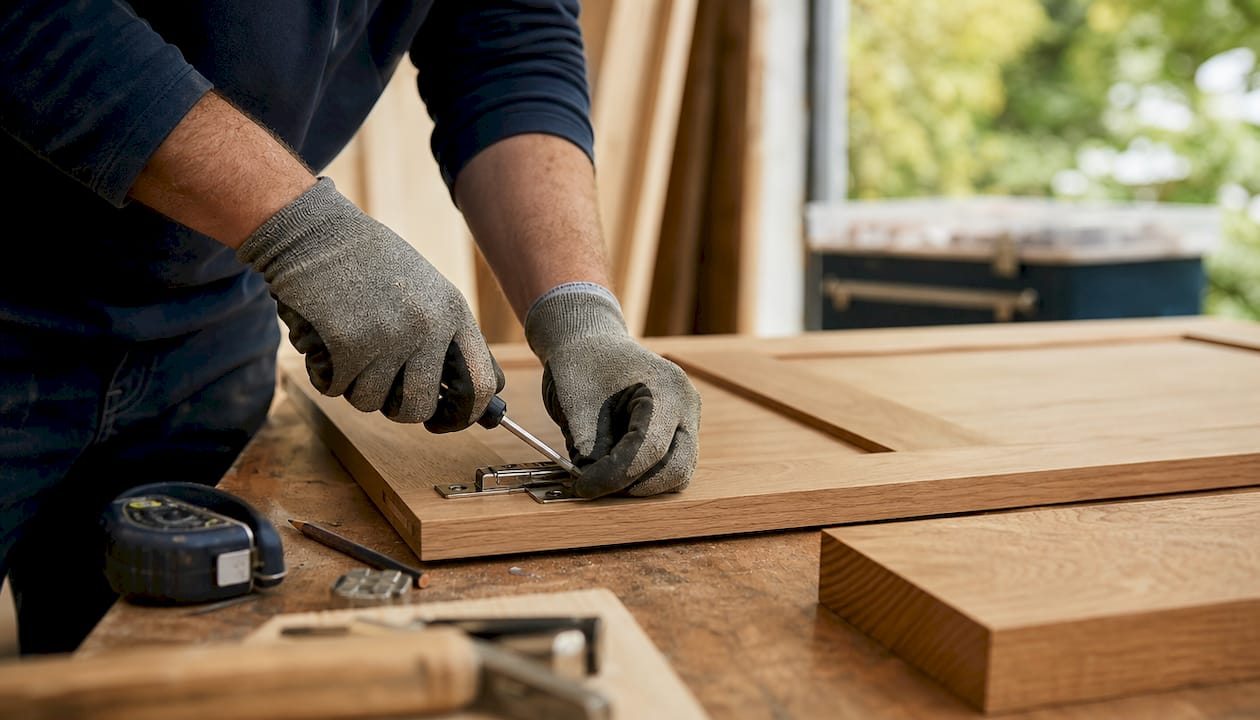
Motion technology is where bespoke cabinetry earns its premium. Soft-close hinges reduce frame wear by 70% compared with standard hinges. Push-to-open mechanisms eliminate handles entirely, which suits handleless kitchen designs and keeps surfaces visually clean.
Pro Tip: Specify soft-close on every moving part from the outset. Retrofitting it later requires removing drawer boxes and re-drilling, which adds unnecessary cost and disruption.
How do you assess hardware durability for bespoke cabinetry?
Durability in cabinet hardware is not a vague quality claim. It is measurable, and the benchmark is clear.
-
Cycle rating: Quality hardware carries a 50,000-plus operation cycle rating. Over a ten-year lifespan, that equates to roughly 13 open-and-close actions per day, which is realistic for a busy kitchen. Hardware without a published cycle rating is a risk.
-
Load capacity: Fully stocked kitchen drawers regularly exceed 50 lbs. Slides rated below that weight will sag, stick, and eventually fail. Always match the slide's rated capacity to the anticipated loaded weight of the drawer, not the empty weight.
-
Material quality: Solid machined brass or bronze outlasts die-cast zinc and plated alternatives. Plated hardware can look identical at point of purchase but the plating wears through at contact points within a few years. Solid brass maintains its integrity and develops a consistent patina.
-
Environmental suitability: Humidity affects hardware performance significantly. Normal indoor humidity sits in the 30–50% range, but bathrooms and utility rooms exceed that regularly. In those spaces, stainless or epoxy-coated hardware resists corrosion where standard brass or zinc would tarnish or seize. Bravo London specifies corrosion-resistant fittings as standard for all fitted bathroom furniture projects.
-
Following weight ratings prevents premature failure: Using hardware rated to its intended load reduces the risk of early mechanical failure significantly. The discipline of checking ratings before ordering is one of the simplest ways to protect a long-term investment.
Pro Tip: Order at least 10% more hardware than your count requires. Defects, damage during installation, and future replacements are all easier to manage when you have matching stock from the same production batch.
How do you choose the right hardware size and finish?
Sizing and finish are where function and aesthetics converge. Get either wrong and the cabinet looks off, even if you cannot immediately identify why.
Sizing rules that actually work
The rule of thirds for pull length is the most reliable starting point: a pull should measure approximately one-third of the drawer's width. A 600mm wide drawer suits a 200mm pull. Going shorter makes the pull look lost; going longer makes it look clumsy.
For knobs, the standard diameter is 1.25 inches (approximately 32mm). That size fits most adult hands comfortably and reads correctly against standard door sizes. Larger knobs on small doors create visual imbalance. Smaller knobs on wide doors look undersized and are harder to grip.
Custom handle sizing matched to door dimensions avoids both problems. For bespoke cabinetry with non-standard door widths, this is not optional. It is the difference between hardware that looks designed and hardware that looks bought off a shelf.
Choosing a finish family
Finish selection is one of the most permanent decisions in a cabinetry project. Hardware finishes are difficult to change post-installation and must harmonise with every other metal surface in the room.
The three finish families are:
- Warm metals: honey bronze, antique brass, unlacquered brass, antique pewter. These suit cream, off-white, and wood-toned cabinetry. They read well under warm incandescent or filament lighting.
- Cool metals: polished nickel, chrome, brushed steel. These pair with white, grey, and dark cabinetry. They perform well under cooler LED lighting.
- Neutrals: matte black, gunmetal. These work across both warm and cool palettes and are particularly effective in high-contrast schemes.
The finish must also coordinate with adjacent fixtures: tap fittings, light fittings, and door furniture. A brushed brass cabinet pull next to a chrome tap creates a clash that no amount of good cabinetry can overcome.
Pro Tip: Always sample hardware finishes in the actual room, at different times of day. A finish that looks warm and rich under a showroom's lighting can appear flat or cold under your kitchen's LEDs. Test before you commit.
For designers working across multiple rooms, the tips for choosing a bespoke kitchen resource from Bravo London covers finish coordination across connected spaces in practical detail.
How does hardware solve unique architectural challenges in bespoke cabinetry?
Bespoke cabinetry exists precisely because standard solutions do not fit every space. Hardware plays a direct role in making non-standard spaces work, not just aesthetically but mechanically.
Adjustable concealed hinges correct up to 90% of misalignment cases without re-mortising the cabinet. In older London properties where walls settle and floors are rarely level, this is not a luxury feature. It is a practical necessity. Bravo London builds adjustability into every hinge specification for this reason.
Specific architectural challenges call for specific hardware solutions:
- Sloped ceilings and loft conversions: Bi-fold door mechanisms allow full door opening in spaces where a standard swing door would hit the ceiling or an adjacent wall.
- Narrow alcoves: Sliding door hardware eliminates the swing arc entirely. Pocket door systems take this further by retracting the door into the cabinet body.
- Secure storage: Lockable cam locks and deadbolt mechanisms integrate cleanly into bespoke drawer and door fronts without visible hardware on the exterior.
- Handleless designs: Push-to-open or touch-latch mechanisms require precise tolerance between door and frame. The gap must be consistent to within 1–2mm for the mechanism to engage reliably.
- Maintenance access: Quality adjustable hinges allow door realignment without dismantling the cabinet. A three-way adjustable hinge can correct vertical, horizontal, and depth alignment from the front, with a screwdriver, in under two minutes.
Hardware provides flexibility and on-site adjustment that keeps cabinetry aligned over time, even as buildings move. For homeowners considering how space-efficient furniture design applies across different room types, the same hardware principles transfer directly.
Hardware timing matters as much as hardware selection. Made-to-order custom pieces carry lead times of approximately four weeks. Ordering after installation begins creates delays that push back the entire project. Hardware decisions belong at the design stage, not the finishing stage.
Key takeaways
Selecting the right cabinet fittings requires matching material quality, load ratings, sizing rules, and finish families to your specific project before installation begins.
| Point | Details |
|---|---|
| Cycle rating is the durability benchmark | Specify hardware rated to 50,000-plus cycles to ensure ten years of reliable daily use. |
| Material quality determines longevity | Solid machined brass or bronze outlasts plated and die-cast alternatives at every contact point. |
| Size hardware to the rule of thirds | Pull length should equal one-third of drawer width; standard knobs measure 32mm in diameter. |
| Finish families must coordinate with fixtures | Choose warm, cool, or neutral metals and match them to taps, lighting, and door furniture throughout. |
| Order hardware at the design stage | Custom pieces carry four-week lead times; late orders delay installation and risk finish mismatches. |
What I have learned from specifying hardware across 1,000-plus projects
Hardware is consistently the last decision clients want to make and the first one that causes problems when it is left too late. After more than 1,000 completed bespoke projects, the pattern is clear: the clients who spend time on hardware early end up with cabinetry that performs well for decades. The ones who treat it as a finishing detail often come back to us within a few years with stiff drawers, misaligned doors, or a finish they have grown to dislike.
The most common mistake is prioritising appearance over mechanical specification. A beautiful knob on a poorly rated hinge is a poor investment. The hinge is what you interact with every single day. The knob is what you glance at. Get the mechanics right first, then choose the finish.
Sampling hardware in situ is non-negotiable. We always send physical samples to clients before sign-off. A finish that photographs beautifully can look entirely different under the actual lighting conditions of a room. This is not a minor detail. It is the difference between a finish you love for twenty years and one you tolerate.
The other lesson is that quality hinges in bespoke cabinetry are a long-term investment, not a cost to reduce. Bespoke furniture is already a considered purchase. Specifying inferior hardware to save a small percentage of the total project cost undermines everything else. The cabinet carcass may last thirty years. The hardware must keep pace with it.
— Bravo
Bravo London's approach to hardware in bespoke cabinetry
Bravo London specifies hardware as an integral part of every design consultation, not as an afterthought. Every project draws on coordinated finish families, load-rated slides, and adjustable concealed hinges selected to match the specific demands of each space.
For homeowners and designers who want hardware that performs as well as it looks, Bravo London provides physical samples at the design stage, so finish decisions are made under real conditions. With over 1,000 completed projects and a 10-year warranty, every fitting is chosen to last. Explore Bravo London's full range of bespoke cabinet furniture to see how hardware specification integrates with the design process from day one.
FAQ
What hardware durability standard should I specify for bespoke cabinets?
Specify hardware rated to a minimum of 50,000 operation cycles. This benchmark covers approximately ten years of regular daily use in a busy household.
How do I choose the right pull length for a drawer?
Apply the rule of thirds: the pull should measure roughly one-third of the drawer's width. A 600mm drawer suits a 200mm pull for balanced proportion and comfortable grip.
Which hardware materials last longest in bespoke cabinetry?
Solid machined brass and bronze offer the greatest longevity. Die-cast zinc and plated alternatives wear at contact points and are not recommended for high-use cabinetry.
What hardware works best in bathrooms and humid spaces?
Stainless steel and epoxy-coated hardware resist corrosion in environments where humidity regularly exceeds the standard 30–50% indoor range. Standard brass or zinc fittings will tarnish or seize in damp conditions.
When should hardware be ordered in a bespoke cabinetry project?
Order hardware at the design stage. Made-to-order custom pieces carry lead times of approximately four weeks, and late orders delay installation across the entire project.