TL;DR:
- High-quality hinges determine how long fitted wardrobes function without repairs by distributing door weight evenly and handling stress.
- Choosing hinges with high cycle ratings, proper materials, and three-axis adjustment increases longevity and prevents costly failures over time.
Wardrobe hinges are the primary determinant of how long your fitted wardrobe functions without fault. Most homeowners focus on finishes, internal layouts, and door styles, yet high-quality hardware typically represents only 8–12% of the total furniture budget while determining longevity and operational success over 15 years. That ratio makes hinges one of the highest-return decisions in any wardrobe project. Understanding why quality hinges matter in wardrobes means understanding that every door opening and closing is a structural event, not just a mechanical one.
Why quality hinges matter in wardrobes
Quality hinges are a structural decision, not a cosmetic one. Premium hinges with proper bearings and thicker steel distribute door weight evenly and handle lateral stress, protecting doors, cabinet carcases, and surrounding walls from cumulative damage. A budget hinge transfers that stress unevenly, and the wardrobe frame absorbs the difference over thousands of cycles. The result is a wardrobe that looks fine on day one but deteriorates steadily from the inside out.
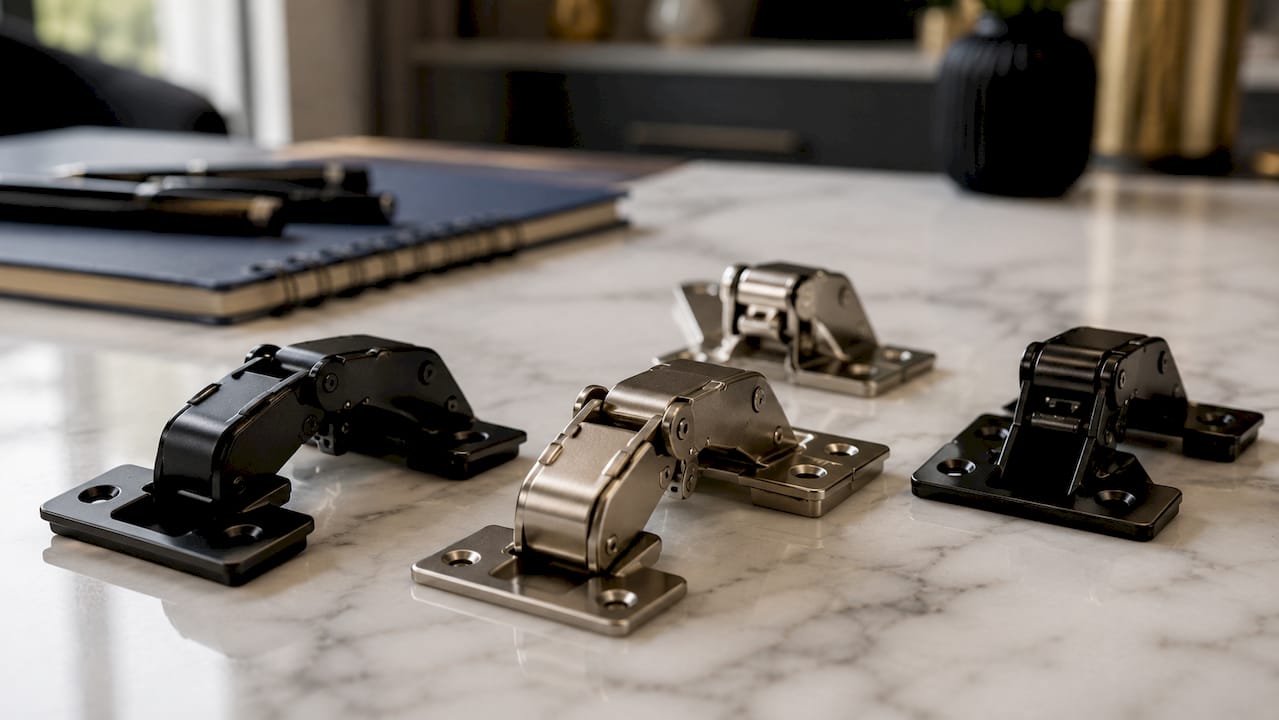
The industry term for the standard used to measure hinge performance is the cycle rating, which counts the number of open-and-close operations a hinge can complete before showing measurable wear. Premium clip-on cup hinges are rated for 80,000–200,000 cycles, compared to 30,000–50,000 cycles for budget alternatives. A wardrobe opened ten times a day reaches 30,000 cycles in just over eight years. A budget hinge hits its limit at that point. A premium hinge is still performing reliably well beyond that.
What features define high-quality wardrobe hinges?
Material and corrosion resistance
The hinge body material sets the ceiling for how long the fitting will last. Stainless steel grade 304 and solid brass outperform plated steel in humid or coastal environments, where rust is the most common cause of early hinge failure. Plated steel looks identical to stainless steel at the point of purchase but corrodes from the inside once the surface coating wears. For bedrooms in older properties with variable humidity, or for homes near the coast, specifying the correct material is non-negotiable.
Cycle ratings and long-term value
Cycle ratings translate directly into years of reliable service. The gap between budget and premium is not marginal. Budget soft-close hinges use spring-and-cam systems that degrade quickly, while premium hydraulic dampers maintain consistent performance across tens of thousands more cycles. Hydraulic dampers absorb the closing energy through fluid resistance rather than mechanical friction. That distinction matters because friction-based systems wear their contact points with every use, while hydraulic systems do not.
Three-axis adjustment
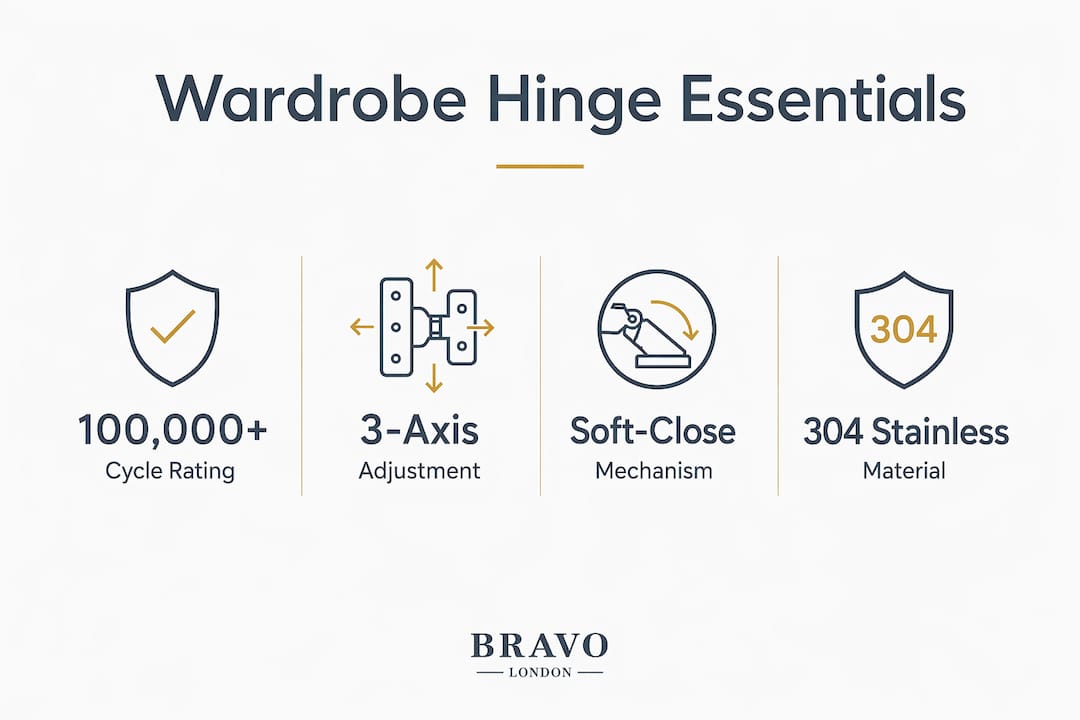
Three-axis adjustment is the feature most often overlooked by DIY installers, and the one most likely to save you money over time. This adjustment system allows you to correct misalignment caused by humidity changes or building movement without removing or replacing the hinge. You can shift the door up, down, left, right, in, and out using a screwdriver alone. Without it, a door that drops 2mm after a damp winter requires either shimming or hinge replacement.
Soft-close mechanisms
- Hydraulic dampers: Fluid-based resistance that remains consistent across the full rated cycle life. These are the benchmark for premium wardrobe hinges.
- Spring-and-cam systems: Mechanical friction-based closing found in budget hinges. Performance degrades noticeably after several thousand cycles.
- Integrated versus clip-on dampers: Clip-on damper cartridges can be replaced independently when worn, making them more cost-effective to maintain than integrated units.
- Opening angle: Quality hinges typically offer 110-degree or 165-degree opening angles. The wider angle matters in tight bedrooms where door clearance is limited.
Pro Tip: When specifying soft-close hinges, ask for the hydraulic damper type specifically. "Soft-close" on a product label does not guarantee hydraulic damping. Check the product specification sheet before purchasing.
How do quality hinges impact wardrobe performance?
Poor hinges produce a predictable sequence of failures. The most common failure modes are sagging doors, squeaking, and damage to laminates and door edges. Each failure compounds the next. A sagging door scrapes the frame, which damages the laminate edge, which then catches on the frame and accelerates the sag. What began as a hinge problem becomes a door replacement.
Stress distribution and door height
Tall wardrobe doors amplify every weakness in a hinge. Doors over 1,800mm require additional hinges to prevent sagging, regardless of hinge quality. Even a premium hinge will fail if the quantity is insufficient for the door's weight and height. The standard rule is three hinges for doors up to 2,000mm and four hinges for anything taller. Fitting a third hinge to a tall door costs very little at installation and prevents the laminate damage and frame distortion that make repairs expensive later.
| Issue | Cause | Consequence |
|---|---|---|
| Sagging door | Insufficient hinge count or low cycle rating | Laminate damage, frame scraping |
| Squeaking | Dry or corroded hinge body | Accelerated wear, noise |
| Door drooping | No three-axis adjustment | Misalignment, poor closure |
| Laminate chipping | Door edge catching on frame | Aesthetic and structural damage |
| Hinge corrosion | Plated steel in humid environment | Premature failure, staining |
Pro Tip: If you are fitting a wardrobe in a child's bedroom, specify hinges rated for at least 100,000 cycles. Children open and close wardrobe doors far more frequently than adults, and the cycle count accumulates faster than most parents expect.
For hinged wardrobes in particular, the hinge is the single most used component in the entire unit. Treating it as an afterthought is the most common and most costly mistake in wardrobe installation.
What practical steps should homeowners take when selecting hinges?
Choosing the right hinge is a process, not a single decision. Work through these steps before purchasing:
-
Measure your door height and weight. Doors over 1,800mm need a minimum of three hinges. Heavier doors, such as those with solid timber or glass inserts, need hinges with higher load ratings. Check the manufacturer's maximum door weight specification.
-
Specify the material for your environment. Stainless steel 304 or solid brass for coastal, high-humidity, or bathroom-adjacent installations. Zinc alloy or plated steel is acceptable only in dry, stable environments.
-
Check the cycle rating. Request the rated cycle count in writing. A reputable supplier will provide this. Anything below 80,000 cycles is a budget product, regardless of how it is marketed.
-
Confirm three-axis adjustment is included. This is standard on quality European-style cup hinges but absent on many imported budget alternatives. If the product listing does not mention it, assume it is not present.
-
Verify the soft-close mechanism type. Hydraulic damper or spring-and-cam. Ask directly if the listing is unclear.
-
Match the hinge to the use case. Children's rooms and high-traffic wardrobes need higher cycle ratings. Walk-in wardrobe doors used less frequently can use mid-range specifications. Walk-in wardrobes with multiple door panels distribute usage across more hinges, which extends individual hinge life.
-
Ask about warranty. A manufacturer confident in their product offers a minimum five-year warranty on the hinge mechanism. Shorter warranties signal lower confidence in durability.
When upgrading wardrobe hardware, the hinge specification should be agreed before any other hardware decision. It is the component that affects every other part of the wardrobe's performance.
How can you maintain wardrobe hinges to extend their lifespan?
Maintenance extends the life of even the best hinges. A consistent routine takes less than 30 minutes per year and prevents the majority of common failures.
- Check and tighten fixing screws every 12 months. Screws loosen through vibration and seasonal wood movement. A loose screw allows the hinge plate to shift, which misaligns the door and accelerates wear on the hinge body.
- Use the three-axis adjustment after each winter. Humidity changes cause timber and board materials to expand and contract. Doors that closed perfectly in summer may drop or bind by february. Adjust before the misalignment causes laminate damage.
- Clean soft-close dampers with a dry cloth. Dust and debris accumulate in the damper mechanism and reduce its effectiveness. Do not use water or solvent-based cleaners on the damper cartridge.
- Replace damper cartridges when the closing speed changes. Soft-close hinges require damper cartridge replacement over time. Replacement is straightforward and far less expensive than repairing door damage caused by a failed damper slamming the door repeatedly.
- Lubricate the hinge pivot point annually. A small amount of dry PTFE lubricant on the pivot eliminates squeaking and reduces friction wear. Avoid oil-based lubricants, which attract dust and create a gritty paste over time.
Pro Tip: Keep a small stock of replacement damper cartridges for your specific hinge model. When one damper fails, the others are usually close behind. Replacing all of them at once saves time and keeps the closing feel consistent across every door.
For a full approach to maintaining fitted wardrobes, the hinge check should sit at the top of your annual maintenance list, not the bottom.
Key takeaways
Quality hinges are the single hardware decision that most directly determines how long a wardrobe functions without repair or replacement.
| Point | Details |
|---|---|
| Cycle ratings define durability | Specify hinges rated for 80,000 cycles or more to match realistic long-term usage. |
| Material choice prevents corrosion | Use stainless steel 304 or solid brass in humid or coastal environments to avoid premature failure. |
| Three-axis adjustment saves money | This feature allows realignment after seasonal shifts without replacing the hinge. |
| Hinge count matters on tall doors | Doors over 1,800mm require at least three hinges to prevent sagging and laminate damage. |
| Annual maintenance extends lifespan | Tightening screws, adjusting alignment, and replacing damper cartridges prevents most common failures. |
The detail that changes everything
After working on over 1,000 fitted wardrobe projects, the pattern is consistent. The clients who return with problems almost always have the same root cause: the hinges were chosen last and budgeted at the lowest possible cost. The doors, the finishes, the internal fittings, all specified carefully. Then a budget hinge was fitted to hold it all together.
What I have seen repeatedly is that a wardrobe with a mid-range carcass and premium hinges outperforms a premium carcass with budget hinges every time. The hinge is the point where all the weight, all the movement, and all the daily use concentrates. Skimping there means the rest of the investment works against itself.
The three-axis adjustment point is the one that surprises most homeowners. Buildings move. Timber moves. A hinge without adjustment turns a seasonal shift into a permanent problem. With adjustment, it is a two-minute fix with a screwdriver. That single feature has saved more wardrobe doors than any other specification choice I can name.
My advice is straightforward. Set a minimum specification before you start: hydraulic soft-close, three-axis adjustment, 80,000-cycle rating, and the correct material for your environment. Treat it as a fixed requirement, not a variable. The difference in cost is small. The difference in outcome over ten years is not.
— Bravo
Bespoke wardrobes built with hardware that lasts
At Bravo London, every fitted wardrobe is designed around the specific dimensions, usage patterns, and environment of your home. That means the hardware specification, including hinge selection, is part of the design process from the start, not an afterthought.
Bravo London's bespoke fitted wardrobes are built with premium hinges as standard, backed by a 10-year warranty and over 1,000 completed projects. Whether you are planning a floor-to-ceiling hinged wardrobe or a fully fitted walk-in, the hardware is specified to match the door size, weight, and environment of your space. If you would like to see how quality hardware integrates into a bespoke furniture design, Bravo London offers a free consultation to discuss your requirements and walk you through the options.
FAQ
What cycle rating should wardrobe hinges have?
Wardrobe hinges should be rated for a minimum of 80,000 cycles. Premium clip-on cup hinges reach 80,000–200,000 cycles, while budget alternatives typically cap at 30,000–50,000 cycles.
How many hinges does a tall wardrobe door need?
Doors over 1,800mm require at least three hinges to prevent sagging. Adding a third hinge at installation costs very little and protects the door edge and laminate from the damage caused by droop.
What is three-axis adjustment on a wardrobe hinge?
Three-axis adjustment allows you to move the door up, down, left, right, in, and out using a screwdriver, without removing the hinge. It corrects misalignment caused by humidity changes or building movement and extends door lifespan without replacement.
Are soft-close hinges worth the extra cost?
Yes. Soft-close hinges reduce wear on door edges and frames and improve the perceived quality of the wardrobe. Hydraulic damper versions maintain consistent performance far longer than spring-and-cam alternatives.
Which hinge material is best for humid environments?
Stainless steel grade 304 or solid brass is the correct specification for humid or coastal environments. Plated steel corrodes from the inside once the surface coating wears, making it unsuitable for bathrooms or coastal properties.