
A bespoke finish is a handcrafted surface treatment made specifically to your individual requirements, using materials, colours, and techniques chosen entirely around your taste and space. Unlike a standard finish you pick from a catalogue, a bespoke finish is created from scratch for you and no one else. The word "bespoke" itself comes from the verb "bespeak," meaning to arrange or order in advance, and the Oxford English Dictionary traces its use as an adjective to 1607, originally describing tailor-made clothing.
What sets a bespoke finish apart in practice:
- Every detail, from sheen level to texture depth, is decided in consultation with you
- No two bespoke finishes are identical, even when the same materials are used
- Application is carried out by hand, by a skilled artisan, not a machine or production line
- The result is a surface that reflects your personality and complements your specific space
What types of bespoke finishes are available?
The range of custom finishing options is broader than most people expect. Each type brings its own character, and the artisan's skill determines how far that character can be pushed.
- Venetian plaster: A multi-layer lime-based technique that creates a polished, marble-like surface with natural depth and translucency. No two applications look identical.
- Metallic finishes: Pigments mixed with specialist binders to produce gold, copper, bronze, or silver effects that shift with the light.
- Stencil work: Geometric or organic patterns applied by hand over a base coat, allowing precise repeating motifs or freeform designs.
- Textured microcement: A thin-layer cement coating that can be applied to walls, floors, and furniture to give an industrial or organic feel, depending on the aggregate used.
- Limewash: A traditional mineral paint that builds up in translucent layers, creating a soft, aged effect with natural tonal variation.
- Colour-matched wood finishes: As demonstrated by Bespoke Finish™, multi-layer wood treatments can achieve unlimited colours and sheens, including finishes that retain full grain clarity or resist yellowing over time.
| Finish type | Key characteristic | Typical application |
|---|---|---|
| Venetian plaster | Polished, marble-like depth | Feature walls, hallways |
| Metallic | Light-reactive, lustrous | Accent walls, furniture |
| Stencil work | Repeating or freeform pattern | Ceilings, statement walls |
| Microcement | Industrial or organic texture | Floors, wet rooms, worktops |
| Limewash | Soft, aged tonal variation | Living rooms, period properties |
| Colour-matched wood | Unlimited colour and sheen | Cabinetry, joinery, furniture |
Why do people choose bespoke finishes over standard options?
The honest answer is that a standard finish simply cannot do what a bespoke one can. A paint colour from a tin or a catalogue tile gives you what thousands of other homes already have. A bespoke finish gives you something that exists nowhere else.
- Personal expression: Your finish reflects your preferences, not a trend cycle or a manufacturer's range.
- Aesthetic precision: Deep consultations explore your personality and the room's existing character, so the result feels intentional rather than added on.
- Focal point enhancement: Bespoke finishes work particularly well at drawing attention to architectural features, alcoves, or statement walls without overwhelming a room.
- Longevity: Quality materials, applied correctly in multiple layers, outlast most standard finishes by a considerable margin.
- Emotional connection: A surface you helped design carries a different weight than one you simply chose from a shelf. That connection is part of what bespoke furniture investment consistently delivers.
How artisan craftsmanship shapes every bespoke finish
No machine replicates what a skilled artisan does by hand. The physical act of applying Venetian plaster or a metallic finish introduces subtle variations in pressure, angle, and layering that give the surface its life. Two artisans working with identical materials in the same room will produce noticeably different results, and that is the point.
The process typically involves:
- Substrate assessment: The wall or surface is evaluated for porosity, moisture, and condition before any material is chosen.
- Material selection: Pigments, binders, and aggregates are chosen or mixed specifically for your project.
- Step board sampling: Physical samples are prepared and viewed in situ, in your actual lighting conditions, before full application begins.
- Multi-layer application: Each layer serves a specific purpose, whether building depth, adjusting sheen, or adding texture.
- Client collaboration: Your feedback at each stage shapes the final outcome. The artisan's interpretation and your preferences meet in the middle.
The bespoke joinery tradition in the UK has long operated on this same principle: the maker's skill and the client's vision are both present in the finished piece.
Bespoke finishes in the UK: craftsmanship and what the word really means
In the UK, "bespoke" carries genuine weight. The Oxford English Dictionary defines it as an item commissioned to unique individual specifications, implying exclusivity and high-level handcrafted attention. That meaning originated in Savile Row tailoring and has since expanded into interiors, software, medicine, and furniture. The word signals that something was made for one person, not adapted from a template.
The evolution of bespoke as a concept has turned it into a powerful marker of quality and emotional resonance, particularly in home design. UK consumers increasingly treat bespoke finishes as the final layer of personalisation, the point at which a house becomes unmistakably theirs.
Bravo London brings this same philosophy to fitted furniture, with over 1,000 completed projects and a 10-year warranty that reflects genuine confidence in the quality of every finish and fitting delivered.
Pro Tip: Ask your artisan or maker for a step board sample viewed in your own room before committing to a full application. Colours and sheens behave differently under natural versus artificial light, and what looks right in a showroom may read quite differently at home.
How to care for a bespoke finish
Bespoke finishes require care that matches their materials. Venetian plaster, for example, should never be cleaned with abrasive cloths or acidic products, as both will damage the polished surface layer. Microcement benefits from a periodic reapplication of its protective sealant, particularly in wet rooms or high-traffic areas. Metallic finishes are sensitive to harsh chemicals, so a soft, damp cloth is usually all that is needed.
The general rule is to ask your artisan for specific maintenance guidance at the point of handover. Because each finish uses a unique combination of materials, generic cleaning advice often does not apply. Keeping a note of the products used in your finish means you can source compatible touch-up materials if needed years down the line.
What does a bespoke finish cost?
Pricing varies considerably depending on the finish type, the surface area, the complexity of the design, and the artisan's experience. Venetian plaster and multi-layer metallic finishes sit at the higher end because of the time and specialist materials involved. Limewash and stencil work can be more accessible while still delivering a genuinely handcrafted result.
As the Oxford English Dictionary notes, bespoke items often cost more due to artisan time and custom materials, but the term primarily denotes personalisation rather than a fixed price point. You are paying for exclusivity and skill, not just materials. For context on how finish costs compare to full replacement or refinishing projects, the cabinet refinishing cost guide offers a useful breakdown of where labour and materials typically sit in bespoke interior work.
How bespoke finishes compare to standard or mass-produced finishes
Standard finishes are designed for speed and consistency. They are manufactured to perform adequately across a wide range of conditions, which means they are rarely exceptional in any one of them. A bespoke finish, by contrast, is formulated for your specific substrate, your lighting, and your aesthetic goals.

| Factor | Bespoke finish | Standard finish |
|---|---|---|
| Uniqueness | One of a kind | Available to anyone |
| Application | Hand-applied by artisan | Machine or roller applied |
| Material choice | Custom-selected or mixed | Fixed manufacturer range |
| Longevity | High, with correct care | Variable |
| Cost | Higher | Lower |
| Personalisation | Complete | Limited to available options |
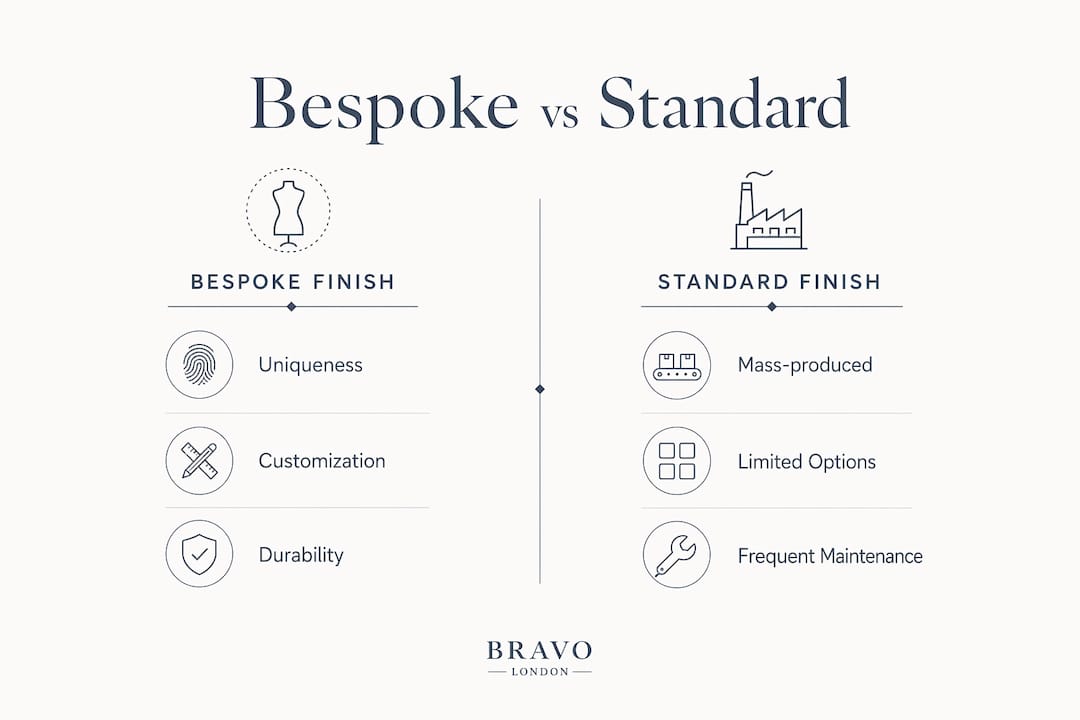
The practical difference shows most clearly over time. A standard emulsion may need repainting every few years. A well-applied Venetian plaster or microcement finish, maintained correctly, can last decades without losing its character.
Key takeaways
A bespoke finish is a handcrafted, individually specified surface treatment that cannot be replicated by standard or mass-produced alternatives.
| Point | Details |
|---|---|
| Definition | Bespoke means commissioned to individual specifications, not adapted from a standard range. |
| Finish variety | Options include Venetian plaster, metallic, microcement, limewash, and stencil work. |
| Artisan process | Hand application, substrate assessment, and step board sampling all contribute to a unique result. |
| Cost principle | Higher cost reflects artisan time and custom materials, not just the finish itself. |
| Care requirement | Maintenance must match the specific materials used; ask your artisan for guidance at handover. |
FAQ
What does "bespoke" mean in simple terms?
Bespoke means made specifically for one person, to their exact requirements, rather than chosen from a ready-made range. The Oxford English Dictionary traces the term to 1607, originally describing tailor-made clothing.
What does "bespoke finishes" mean?
A bespoke finish is a handcrafted surface treatment, such as Venetian plaster, metallic coating, or microcement, created uniquely for a specific client, space, and brief, with no two results identical.
Is bespoke furniture good quality?
Bespoke furniture is generally of higher quality than mass-produced alternatives because it is made to individual specifications using materials selected for the project. Bravo London backs this with a 10-year warranty across its bespoke fitted furniture range.
Does bespoke mean high end?
Bespoke primarily means personalised and made to order, rather than expensive by definition. That said, the artisan time and custom materials involved typically place bespoke finishes above standard options in both quality and price.