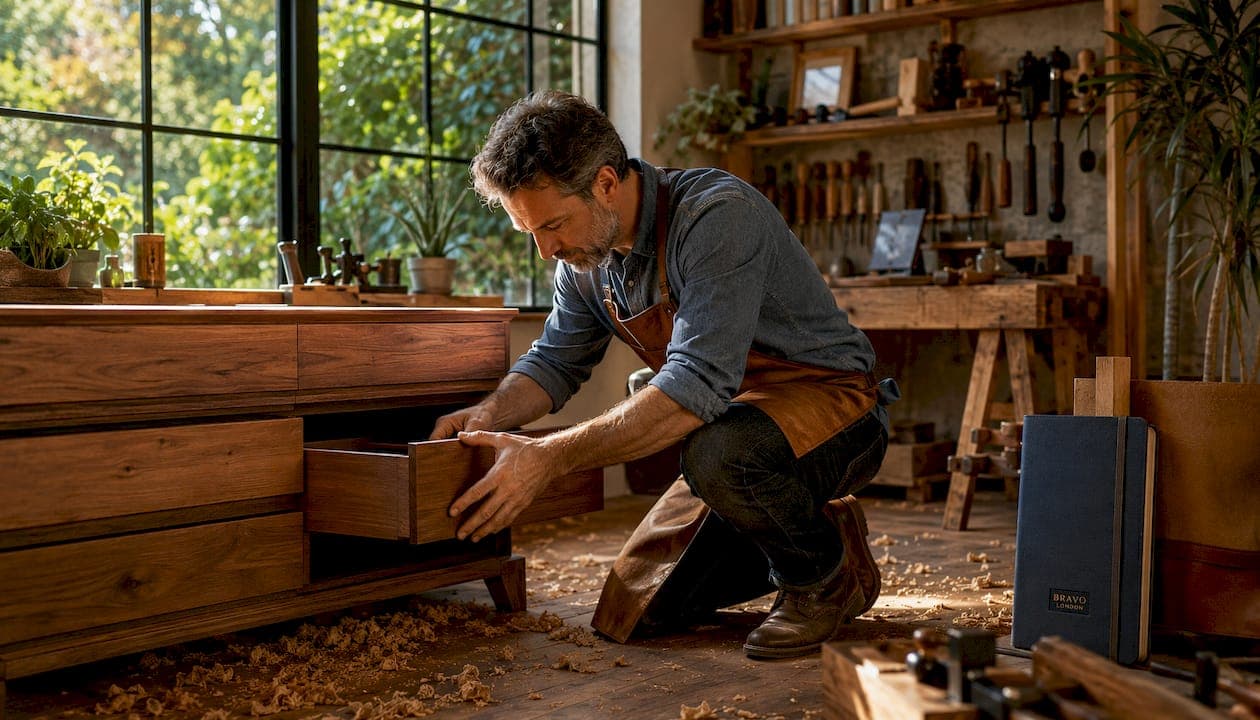
Choose bespoke for awkward spaces, long-term hero pieces, and rooms you plan to live in for years. Choose off-the-shelf when you need furniture quickly, your budget is tight, or the space is temporary. That is the short answer. The detail below will help you apply it to your specific situation.
- Awkward or non-standard spaces (alcoves, attic conversions, sloping ceilings, under-stairs): bespoke is almost always the only practical solution. Standard sizes simply will not fit.
- Long-term investment pieces (fitted wardrobes, media walls, dining tables): the advantages of custom furniture become clear over a 20-to-50-year lifespan, where quality joinery and solid materials outlast multiple retail replacements.
- Rental properties, temporary rooms, or tight budgets: affordable off-the-shelf options are the sensible default. Speed and lower upfront cost matter more than longevity here.
Bravo London, a London-based bespoke manufacturer with over 1,000 projects completed and a 10-year warranty, is used throughout this guide as a worked example of how a UK maker approaches the custom vs ready-made furniture decision.
Table of Contents
- How does custom furniture compare to off-the-shelf at a glance?
- What does bespoke furniture actually mean in the UK?
- What does off-the-shelf furniture mean?
- How do costs and lead times compare in the UK?
- What quality and materials differences should you look for?
- Where does bespoke add measurable value in your home?
- When is off-the-shelf the smarter choice?
- How do you decide? A practical checklist
- How Bravo London approaches the bespoke decision
- Key takeaways
- The case for being deliberate about which route you choose
- Thinking about bespoke fitted furniture for your home?
- Useful sources
- FAQ
How does custom furniture compare to off-the-shelf at a glance?
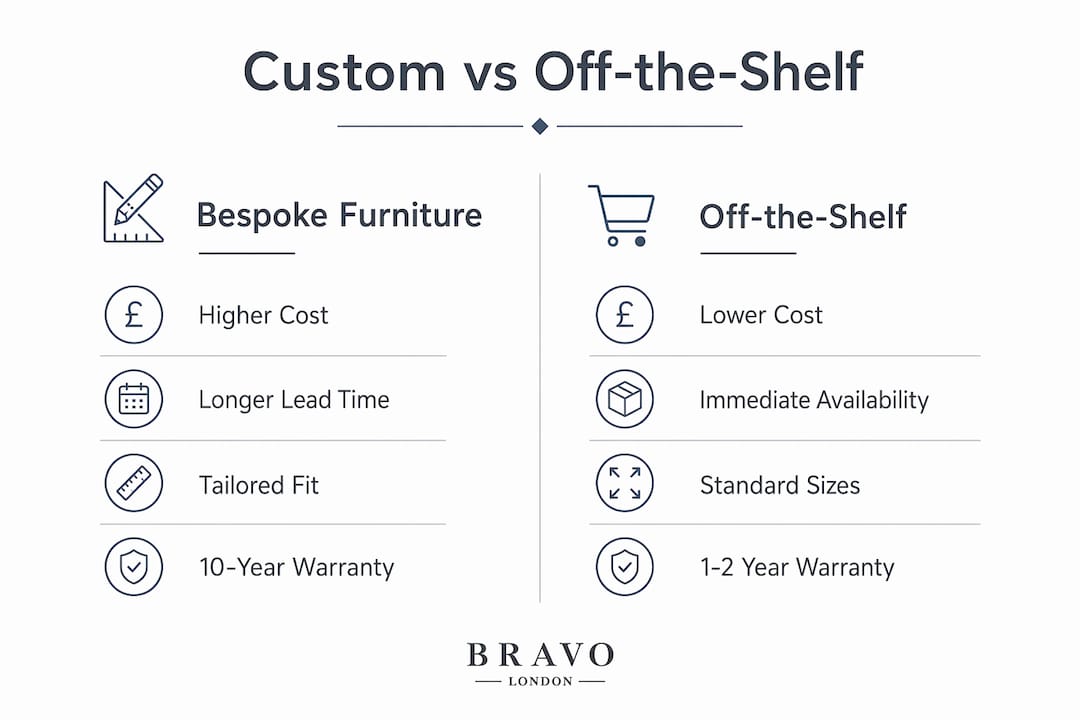
| Dimension | Bespoke / custom | Off-the-shelf / ready-made |
|---|---|---|
| Upfront cost | Higher (often 3–5× retail equivalent) | Lower; wide price range |
| Lead time | 8–14 weeks from first consultation to installation, including 2–4 weeks for the collaborative design and approval phase | Days to 4 weeks |
| Customisation | Full: dimensions, materials, finish, hardware | Limited to catalogue options |
| Durability / quality | Solid timber, quality joinery; 20–100+ year lifespan | Engineered board, thin veneers; typically 10–20 years |
| Fit / use of space | Exact fit; solves non-standard dimensions | Standard sizes; gaps or overhangs common |
| Short-term / rental | Not recommended | Well suited |
| Long-term / permanent home | Excellent long-term value | May require replacement sooner |

The decisive difference is fit and lifespan. Off-the-shelf wins on speed and upfront cost; bespoke wins when the space is irregular or the piece needs to last decades.
What does bespoke furniture actually mean in the UK?
Bespoke furniture, sometimes called made-to-measure or fitted furniture, is designed and built specifically for one client's space. Every dimension, material, and finish is agreed before a single cut is made. In the UK context, the term covers everything from a cabinetmaker producing a single dining table to a fitted-joinery company installing floor-to-ceiling wardrobes across an entire bedroom.
The typical process runs like this:
- Consultation: a designer or surveyor visits your home, takes precise measurements, and discusses how you use the space.
- Design and specification: drawings are produced showing exact dimensions, internal layouts, material choices, and hardware options.
- Sample approval: you review finish samples, veneer swatches, or door profiles before production begins.
- Production: the piece is built in a workshop, often using solid timber, quality-grade MDF cores, or a combination of both.
- Delivery and installation: a fitter installs the piece on site, scribing it to walls and floors so there are no gaps.
Reputable UK bespoke makers will provide a written warranty. A 10-year warranty is a meaningful benchmark; it signals the maker stands behind both materials and workmanship for the long term. Ask any maker you approach what their warranty covers and whether it includes the installation itself, not just the components.
What does off-the-shelf furniture mean?
Off-the-shelf, or ready-made, furniture is mass-produced in standard sizes and sold through showrooms, catalogues, or online retailers. You buy what is in stock, or order from a fixed range, and it arrives flat-packed or pre-assembled within days or a few weeks.
Most retail furniture uses particleboard or MDF cores with a laminate or thin veneer surface. These materials keep costs down and allow consistent factory production, but they come with trade-offs: limited finish options, fixed dimensions, and surfaces that cannot be sanded or refinished once worn. The range of sizes is set by the manufacturer, so you are working around the furniture rather than the other way round.
Ready-made pieces are the natural choice for rental homes, rooms being staged for sale, or any situation where you need furniture in place quickly. They are also sensible for low-use rooms where durability is less of a priority, or when you are not yet certain how a space will be used long-term.
How do costs and lead times compare in the UK?
Price ranges
Custom millwork typically costs 3–5× more than a comparable retail piece. To put that in practical terms: a solid-wood dining table from a bespoke maker might sit in the £3,000–£6,000 range, while a retail equivalent could be £800–£2,500. Fitted wardrobes follow a similar pattern, with bespoke installations running considerably higher than flat-pack alternatives.

That gap looks smaller when you calculate cost per year of ownership. A well-built bespoke piece, maintained and occasionally refinished, can last 50 years or more. A retail piece replaced every 10–15 years costs more in total over the same period, and generates more waste.
A simple worked example: a bespoke fitted wardrobe at £4,000, lasting 40 years, costs £100 per year. A retail wardrobe at £900, replaced every 12 years, costs £75 per year but requires three purchases and three disposal events. The gap narrows considerably once you factor in fitting costs for each replacement.
- Calculate your ownership horizon. If you plan to stay in the property for 10 years or more, amortise the bespoke price across that period before comparing it with retail.
- Include installation costs. Retail flat-pack often needs professional assembly; bespoke includes installation in the quoted price.
- Factor in replacement cycles. Off-the-shelf pieces in high-use rooms (bedrooms, kitchens, home offices) often need replacing within 10–15 years.
Pro Tip: Ask your bespoke maker for a total project cost that includes design, materials, production, delivery, and installation. Hidden extras at each stage are where bespoke projects most often exceed budget.
The collaborative design phase adds weeks that many homeowners do not account for. Finalising dimensions, selecting hardware, and approving samples can take 2–4 weeks before production even starts. A realistic total timeline for a bespoke fitted wardrobe in the UK runs 8–14 weeks from first consultation to installation day.
What quality and materials differences should you look for?
Build quality is where the custom vs ready-made furniture gap is most visible, and most consequential. Here is what to check.
Material signals
- Solid timber vs engineered core: solid wood can be sanded, repaired, and refinished. Engineered board with a thin veneer cannot. Retail veneers are often too thin to refinish, making surface damage effectively permanent.
- Veneer thickness: ask for the veneer specification in millimetres. A veneer thick enough to sand (0.6 mm or above) is a meaningful quality indicator.
- Edge detail: exposed MDF edges sealed with iron-on tape are a cost-cutting sign. Solid-wood lipping or thick ABS edging indicates better construction.
- Core stability: quality bespoke makers use moisture-resistant MDF or birch-ply cores in areas prone to humidity (bathrooms, kitchens), not standard particleboard.
Construction clues
- Joinery type: dovetail or box joints in drawer boxes indicate hand or precision machine joinery. Stapled or glued butt joints are a retail shortcut.
- Drawer runners: full-extension, soft-close runners (Blum or Hettich are common quality benchmarks) outlast basic metal slides by years.
- Back panels: a solid back panel, not a thin hardboard sheet, adds structural rigidity and prevents racking over time.
| Feature | Bespoke quality | Typical retail |
|---|---|---|
| Core material | Birch ply or moisture-resistant MDF | Particleboard or standard MDF |
| Veneer / surface | Thick real-wood veneer or solid timber | Thin paper veneer or laminate |
| Drawer construction | Dovetail or box joint, soft-close runners | Butt joint, basic metal slides |
| Edge detail | Solid-wood lipping or thick ABS | Iron-on edge tape |
| Warranty | a long-term warranty (maker + installation) | 1–2 years (product only) |
On warranties: a standard retail guarantee covers manufacturing defects for one to two years. A bespoke maker offering a 10-year warranty is covering both the materials and the installation, which is a fundamentally different level of commitment.
One resale caveat worth knowing: bespoke pieces are harder to resell than well-known branded retail items because they are built to a specific space and taste. If resale value matters to you, factor that into the decision.
Where does bespoke add measurable value in your home?
Bespoke furniture is the most effective solution for non-standard architectural spaces: attic conversions with sloping ceilings, chimney-breast alcoves, under-stairs recesses, and awkward bedroom corners where standard furniture leaves dead space. In these situations, a made-to-measure piece does not just look better; it recovers floor area and storage capacity that would otherwise be wasted.
The items that benefit most from bespoke are those that anchor daily life: fitted wardrobes, media walls, and dining tables used every day, where materials and joinery take constant wear. A built-in wardrobe running floor-to-ceiling and wall-to-wall in a bedroom with a sloping ceiling is simply not achievable with off-the-shelf units. The same logic applies to alcove shelving, window seats with storage, and under-stairs cupboards.
For sloping ceiling wardrobes and loft storage, bespoke is often the only option that uses the full height of the space without leaving awkward voids. A fitted solution scribes precisely to the roofline, turning what would be dead eaves into usable hanging or shelving space.
Pro Tip: When briefing a bespoke maker on an awkward space, provide a sketch showing the ceiling height at its lowest point, the floor-to-wall angle, and any obstructions (pipes, beams, sockets). The more precise your brief, the more accurate the first design proposal will be, and the fewer revision rounds you will need.
For ideas on maximising storage in compact homes, storage solutions for modern homes offers practical guidance on how different storage types perform in different room configurations.
When is off-the-shelf the smarter choice?
Not every room, budget, or situation calls for bespoke. There are clear scenarios where affordable off-the-shelf options are the right call.
- Immediate occupancy: you are moving in next week and need beds, sofas, and storage in place. Retail delivers in days; bespoke cannot.
- Rental properties: investing in fitted furniture you cannot take with you rarely makes financial sense unless you own the property long-term.
- Tight budgets: if the upfront cost of bespoke would strain your finances, a quality retail piece now and a bespoke upgrade later is a sensible sequence.
- Frequent moves: standard-size furniture can be taken to a new home; built-in bespoke pieces generally cannot.
- Low-use or transitional rooms: a spare bedroom used occasionally, or a home office you expect to reconfigure, does not justify the investment.
- Staging a property for sale: furnished rooms photograph better, but the furniture will be removed; off-the-shelf is the practical choice.
If durability is a concern but bespoke is not in budget, look at the upper tier of retail ranges. Solid-wood construction, dovetail drawer boxes, and full-extension runners are available in better retail lines and represent a meaningful step up from flat-pack particleboard.
For more ideas on creating storage in a small home without committing to a full bespoke project, that guide covers practical interim solutions.
How do you decide? A practical checklist
Use these questions before you commit to either route.
- Is the space a standard size? If walls are not square, ceilings slope, or the alcove is an odd width, bespoke is likely the only workable option.
- How long will you stay in the property? Under three years: off-the-shelf. Five years or more: run the cost-per-year calculation before deciding.
- Is this a high-use piece? Daily-use items (wardrobes, kitchen storage, dining tables) benefit most from quality joinery and solid materials.
- What is your total budget, including installation? Include fitting costs in both comparisons; retail flat-pack is not always as cheap as the ticket price suggests once assembly is added.
- Do you need it within four weeks? If yes, off-the-shelf is the only realistic option unless a maker has immediate availability.
- Will the piece be a visual focal point? A hero piece in a main living space justifies more investment than a utility shelf in a utility room.
- Do you want to take it with you? Fitted bespoke stays with the property; freestanding retail moves with you.
Questions to ask a bespoke maker:
- What core material and veneer thickness do you use?
- What joinery method do you use for carcasses and drawer boxes?
- Can I see a sample of the finish and hardware before production starts?
- What does your warranty cover, and does it include the installation?
- What is the realistic total timeline from today to installation?
Red flags to watch for:
- A maker who cannot provide a written specification before you pay a deposit.
- Unusually short lead times (under four weeks for a fitted wardrobe) with no explanation.
- A warranty that covers only components, not the installation.
- No site visit before quoting.
How Bravo London approaches the bespoke decision
Bravo London is a London-based bespoke manufacturer specialising in fitted furniture and joinery for UK homeowners. With over 1,000 projects completed and a 10-year warranty covering both materials and installation, the company's credentials sit at the more substantive end of the UK bespoke market.
The process Bravo London follows reflects the steps outlined earlier in this guide: an initial consultation and site survey, a design phase where dimensions and finishes are agreed, sample approval, production, and then installation by their own team. The 10-year warranty applies to the finished installation, not just the components, which is the distinction that matters when evaluating any maker's guarantee.
Bravo London's approach centres on solving spatial problems that off-the-shelf furniture cannot address. Sloping ceilings, chimney-breast alcoves, and under-stairs recesses are treated as design opportunities rather than obstacles. The result is storage that feels intentional and integrated, rather than furniture placed in a room.
For a practical illustration: a homeowner with a Victorian terrace bedroom featuring a sloping ceiling and two shallow alcoves either side of the chimney breast has no viable off-the-shelf solution. Standard wardrobes leave gaps at the top and sides; the alcoves are too narrow for catalogue units. A bespoke fitted wardrobe, scribed to the roofline and built into both alcoves, recovers the full height and width of the space. Bravo London's typical timeline for a project of this type runs 8–14 weeks from first consultation to installation.
Key takeaways
Bespoke furniture is worth the investment when the space is non-standard, the piece will be used daily, and you plan to stay in the property long enough to amortise the cost over its lifespan.
| Point | Details |
|---|---|
| Choose bespoke for awkward spaces | Sloping ceilings, alcoves, and under-stairs recesses have no viable off-the-shelf solution. |
| Amortise cost over expected life | A bespoke piece at 3–5× the retail price can cost less per year when it lasts 40–50 years. |
| Check veneer thickness and joinery | Thin retail veneers cannot be refinished; dovetail joinery and soft-close runners signal lasting quality. |
| Off-the-shelf suits short-term needs | Rentals, frequent moves, and tight timelines are clear signals to choose ready-made. |
| Bravo London as a UK benchmark | Many completed projects and a warranty covering materials and installation make Bravo London a credible worked example of what a quality bespoke maker should offer. |
The case for being deliberate about which route you choose
The most common mistake homeowners make is treating this as a binary cost question. It is not. The real question is: what is this piece of furniture supposed to do, and for how long?
Off-the-shelf furniture has been unfairly maligned in some design circles. For a spare room, a rental flat, or a room you are still figuring out, a well-chosen retail piece is entirely sensible. The problem arises when people apply retail logic to permanent spaces. A fitted wardrobe in a bedroom you will use every day for the next 20 years is not the same decision as a bookshelf for a rented flat.
The resale angle is worth a candid word. Bespoke fitted furniture does not add to resale value in the way that, say, a kitchen renovation might. It adds liveability and functionality, which matters to buyers but is hard to price. If your primary motivation is resale uplift, the calculation is less clear. If your motivation is living well in your home for the next decade, bespoke is almost always the better investment.
The lifecycle cost argument is the one that tends to shift people's thinking. Running the numbers on cost per year, rather than sticker price, changes the comparison considerably. That is the frame worth applying before you decide.
Thinking about bespoke fitted furniture for your home?
Bravo London offers a full bespoke service for UK homeowners, from the initial site survey through to installation and a 10-year warranty on every project. With over 1,000 completed projects across London and the surrounding area, the team has worked with the full range of spatial challenges: Victorian terraces with sloping ceilings, modern flats with non-standard alcoves, and period homes where no two walls are quite square.
The process starts with a free consultation and site survey, where a designer takes precise measurements and discusses your brief. From there, you receive a detailed design proposal with material samples before anything goes into production. Lead times are typically 8–14 weeks from consultation to installation, depending on the complexity of the project.
If you are ready to explore what a made-to-measure solution could look like in your home, see Bravo London's bespoke furniture range or browse the fitted wardrobes section for project examples and inspiration.
Useful sources
- Bravo London: bespoke cabinet furniture and credentials — the brand's own explanation of its process, warranty, and project track record.
- Custom Furniture vs. Store-Bought: When the Investment Makes Sense (Timber Design + Build) — detailed cost comparison, veneer quality analysis, and resale considerations.
- Custom Furniture vs. Ready-to-Ship Furniture (ANTARRIA) — market commentary on longevity, lifecycle cost, and the 2026 shift in homeowner priorities.
- Ready-made vs custom furniture: which should you choose? (Kavela) — practical guidance on hero pieces, the design phase timeline, and when bespoke pays off.
- 8 reasons to choose custom-made furniture (Ideas Factory) — covers the space-utilisation benefits of bespoke in non-standard architectural situations.
- Why custom furniture is a worthwhile investment (U-Fab Interiors) — US-market perspective on craftsmanship, materials, and long-term value; useful for quality benchmarks.
FAQ
Is custom furniture worth it?
For permanent spaces and high-use pieces, yes. A well-built bespoke piece amortises over decades, often costing less per year than replacing cheaper retail alternatives. For temporary or rental situations, off-the-shelf is the more practical choice.
Does bespoke furniture have better resale value?
Not necessarily. Bespoke pieces are built to a specific space and taste, which limits their resale marketability compared with recognisable branded retail items. The value is in liveability and longevity, not resale price.
What is the 2-3 rule for furniture arrangement?
The 2-3 rule is a design guideline suggesting you group accessories or furniture in odd numbers (twos and threes) to create visual balance. It is a styling principle rather than a sizing standard, and it applies to arrangement rather than the choice between bespoke and ready-made.
How long does bespoke furniture take to make in the UK?
A typical bespoke fitted wardrobe or storage project takes 8–14 weeks from first consultation to installation. The design and approval phase alone can add 2–4 weeks before production starts, so plan accordingly.
When should I choose off-the-shelf over bespoke?
Choose ready-made when you need furniture within four weeks, are furnishing a rental property, have a tight upfront budget, or expect to move within three years. Off-the-shelf is the recommended route for transitional and temporary living arrangements.